


Live: December 9 Fed odds → · Cross-market divergence → · The October receipt →
What the market is pricing
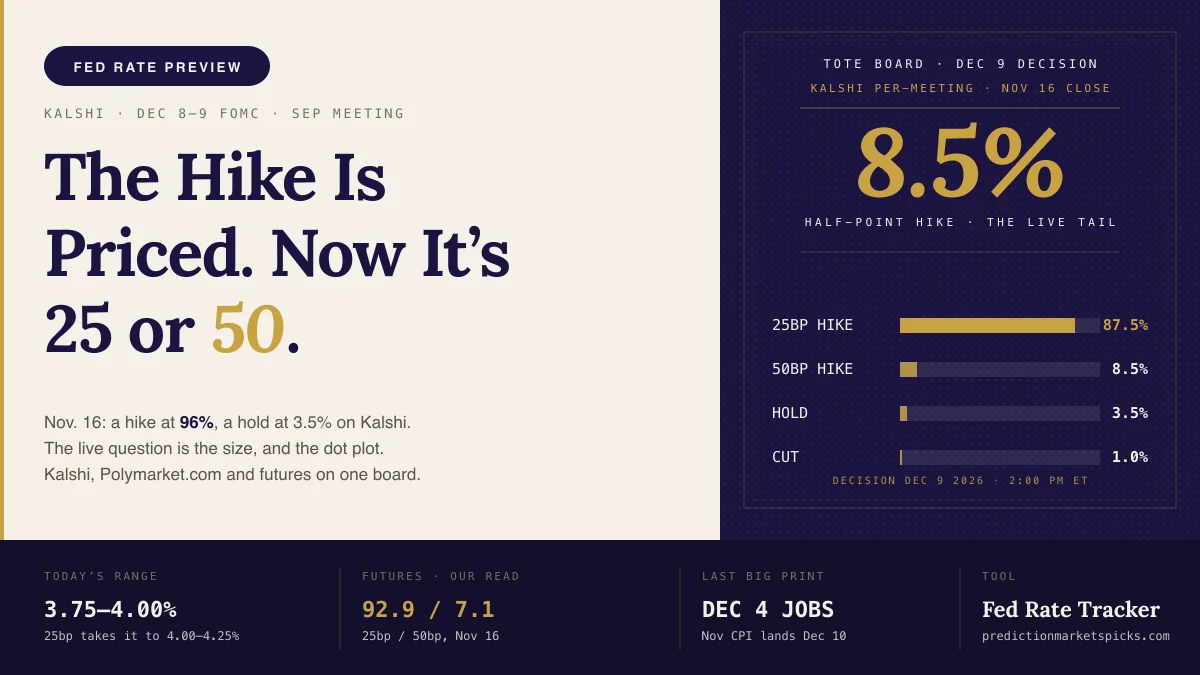
> As of Nov. 16, 2026, Kalshi prices a hike at the Dec. 8–9 FOMC meeting at 96%: 87.5% for a quarter point and 8.5% for a half point, with a hold at 3.5% and a cut at 1%. A quarter-point hike would take the target range from 3.75%–4.00% to 4.00%–4.25%.
Hike-or-hold was the October question. The October hike the market priced at 69% on Sept. 28 never came; the market moved it to December, and a hike there is now about as settled as a Fed meeting gets three weeks out. The live question is the size, and what the committee's own projections say about the year after.
| Venue (Nov. 16 close) | 25bp hike | 50bp hike | Hold | Cut |
|---|---|---|---|---|
| Kalshi, per-meeting contract | 87.5% | 8.5% | 3.5% | 1.0% |
| Polymarket.com | 87.5% | 8.65% | 3.55% | 0.6% |
| Fed funds futures, our FedWatch-method read | 92.9% | 7.1% | 0% | 0% |
Polymarket.com is the international book (US Users: Featured Contract/Price/Trade Not Available; Informational Use Only). Kalshi is its per-meeting decision contract, the same question the other two ask; Kalshi's KXFED ladder asks where the rate sits after the meeting and is not compared here. The futures line is our inversion of the CME fed funds curve: an implied move of 26.8 basis points against an effective fed funds rate of 3.88%. A move bigger than one step splits between the two adjacent outcomes, which is how CME's own FedWatch method handles it, so futures put the hold at zero and the half point near 7%.
The two prediction markets agree to within a fraction of a point on every bucket. Futures are a bit more sure of the quarter point and a bit less sure of the half. That gap is small, and it is the one to watch: if the 50bp bucket moves, it will move on the prints below.
What moved it: the prints since the October meeting
| Release | Date | |
|---|---|---|
| October jobs report | Nov. 6 | Payrolls up 165,000; unemployment 4.1% |
| October CPI | Nov. 10 | +0.4% headline, +0.3% core; no 12-month figure because October 2025 was never collected |
| October PPI | Nov. 13 | +0.3% final demand; +0.5% excluding food, energy and trade services |
Source: the Bureau of Labor Statistics releases, read Nov. 16. Core CPI has now printed 0.3% three months running. Kalshi's December quarter-point contract closed at 80.5% on Nov. 9 and has not closed below 85% since Nov. 10, CPI day. The daily series for every venue is on the December meeting page.
The case for 50. The November jobs report on Dec. 4 comes in hot again, or the October minutes on Nov. 18 read more hawkish than the statement did. Two members already dissented for a hike in October.
The case for 25. November jobs cool, inflation holds rather than re-accelerates, and the Chair signals a measured pace. This is the market's base case at 87.5%.
The case for a hold. It needs a shock the calendar does not show. At 3.5%, the market is saying as much.
The dot-plot ladder disagrees with the decision ladder
December is a Summary of Economic Projections meeting, and Kalshi lists a ladder on the committee's median year-end 2026 dot (KXDOTPLOT). At the December meeting, that median is the rate the decision sets: there are no 2026 meetings left after it.
The SEP prints the median at one decimal, and Kalshi settles on the printed figure. We checked that on the last settled ladder: in September the median was 4.125%, and the "above 4.0%" strike settled Yes while "above 4.1%" settled No. With the range at 3.75%–4.00%, a hold prints 3.9, a quarter point 4.1 and a half point 4.4. So:
| Strike (Kalshi, read Nov. 16) | Bid / ask | What it tracks | Decision ladder |
|---|---|---|---|
| Above 3.9% | 87¢ / 93¢ | Yes on any hike | 96% |
| Above 4.0% | 79¢ / 84¢ | Yes on any hike | 96% |
| Above 4.1% | 8¢ / 14¢ | Yes only on a half point | 8.5% |
The half-point strike lines up with the decision market. The two any-hike strikes trade 3 to 17 points below a 96% hike on what is nearly the same event. Part of that is real: if the Fed publishes no SEP, or one with no year-end 2026 median, every strike resolves No, and the dot ladder carries that risk while the decision market does not. Part of it is thin liquidity: 20 contracts traded across all twelve strikes in the 24 hours to our Nov. 16 read, and the widest quote was 8¢. Read it as market disagreement on a thin book, not a lock. The ladder, with each strike labeled by what it tracks, is in SEP Dot Plot Watch on the December meeting page.
The dates
| Date (Eastern) | Event |
|---|---|
| Wed., Nov. 18, 2 p.m. | FOMC minutes (October meeting) |
| Wed., Nov. 25, 8:30 a.m. | October PCE + Q3 GDP (second estimate) |
| Wed., Nov. 25, 2 p.m. | Beige Book |
| Fri., Dec. 4, 8:30 a.m. | November jobs report: the last major print before the decision |
| Wed., Dec. 9, 2 p.m. | FOMC decision + SEP / dot plot; press conference at 2:30 |
| Thu., Dec. 10, 8:30 a.m. | November CPI, the day after the decision |
The Fed decides without November CPI. That puts the weight on the Dec. 4 jobs report.
How it settles
Kalshi's per-meeting contract settles on the target range the Fed announces in its Dec. 9 statement; the dot-plot ladder settles on the SEP's median year-end 2026 projection as printed. The full rules, and the traps, are in how Kalshi settles Fed decision markets, with the contract-level detail at KXFED and KXDOTPLOT.
Kalshi's favorite has won all 15 Fed decisions we have graded since January 2025; the running record across all three venues is on the divergence page. We will refresh this preview on Dec. 2 and again after the Dec. 4 jobs report, and grade every venue on Dec. 9.