

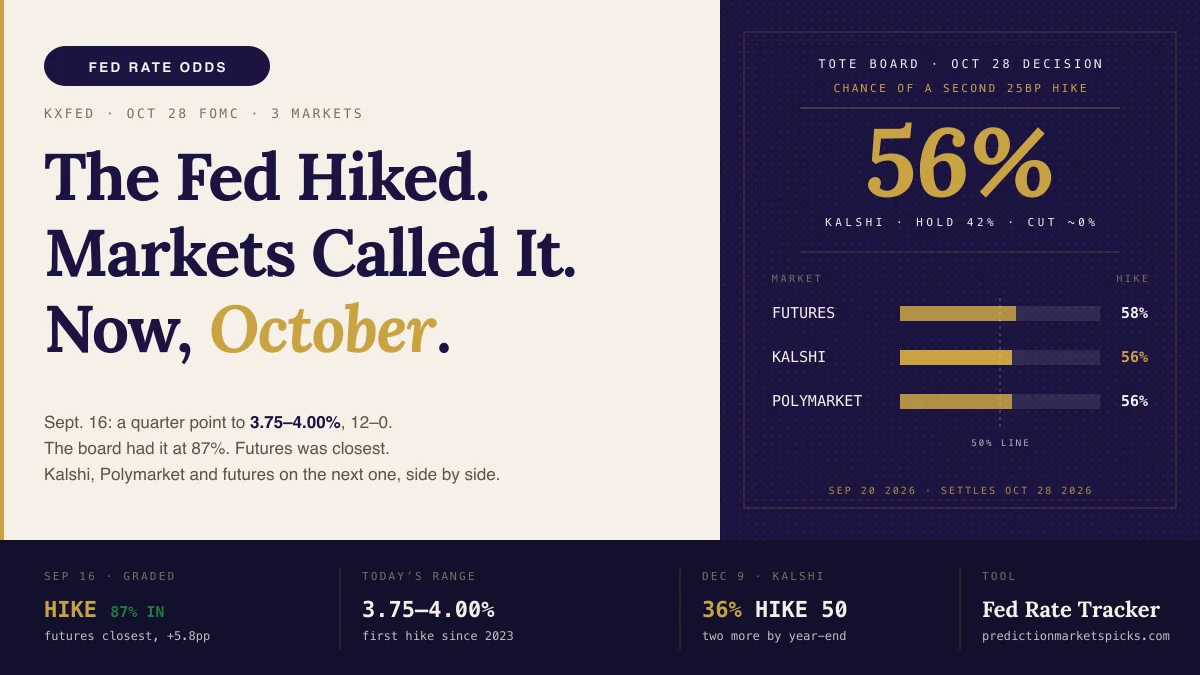
Where the October Fed odds stand
Prediction markets put a second quarter-point hike at the Oct. 27-28 meeting at 56% on Kalshi, 56% on Polymarket and 58% on CME fed funds futures as of Sept. 20, 2026, with a hold at 42% to 44% and a cut priced near zero on all three. The Fed's target range is 3.75%-4.00% after the Sept. 16 hike, and the Fed's own September projections put the median year-end 2026 rate at 4.1%, one more hike above where it sits. So the market and the committee are reading from roughly the same page: probably one more, probably soon, but nobody is sure enough to call it a lock.
The Fed raised rates a quarter point on Sept. 16, 2026 and prediction markets had it at 87% going in — Kalshi 87%, Polymarket 89%, CME fed funds futures 94% on the outcome that happened, with futures the closest. For the Oct. 27-28 meeting the same three venues price a second hike at 56%, 56% and 58% and a hold at 42% to 44%. That is a lean, not a lock, and the September jobs report and CPI both land before the vote.
The receipt: how the three markets scored on the September hike
Before anyone asks what the market thinks about October, it is fair to ask how it did on September. Here is the answer, graded on the same rows the Fed Rate Tracker publishes, not from memory.
The Fed raised the target range for the federal funds rate by a quarter point to 3.75%-4.00% on Sept. 16, effective Sept. 17. It was the first increase since 2023 and the vote was 12-0. In July the committee had held, 9-3, with three members dissenting in favor of a hike. In September the rest of the committee came with them.
On the outcome that happened, here is where each venue closed the night before:
| Venue | Favorite at the close | P(25bp hike) at the close | Since first capture | Result |
|---|---|---|---|---|
| CME fed funds futures implied | 25bp hike | 94.3% | 61.7% → 94.3% (+32.6pp since 2026-08-30) | closest |
| Polymarket | 25bp hike | 88.5% | 52.5% → 88.5% (+36.0pp since 2026-08-30) | |
| Kalshi | 25bp hike | 86.5% | 26.0% → 86.5% (+60.5pp since 2026-08-15) |
Futures was closest, by 5.8 points over Polymarket. All three had the hike as the favorite going in, so the disagreement was never about direction. It was about how sure to be, and the most confident book won.
Two things worth saying about that. First, Kalshi's contract traveled the farthest: it opened the series at 26 cents on Aug. 15 and closed at 87 the night before the decision. That is a market changing its mind in public, in real time, and getting it right. Second, one meeting is one data point. We said we would grade it and we did; the running record, which will be worth more than any single line in it, is on the cross-market divergence page. Nothing there is estimated or backfilled. The September 2026 preview is flipped to a recap at the same URL, charts and all, so you can see what was priced and when.
What changed since September
The hike itself. The range moved from 3.50%-3.75% to 3.75%-4.00%. The rate the Fed pays banks on reserve balances went to 3.90%. The effective fed funds rate, the number the futures market actually settles on, printed 3.88% the next day, up from 3.63%.
The dot plot. The Fed's September Summary of Economic Projections put the median year-end 2026 rate at 4.1%, up from 3.8% in June. The Fed publishes those projections as the midpoint of a range, so 4.1% says the median participant expects to end the year one quarter-point hike above where the range sits today. There are two meetings left. Kalshi ran a contract on exactly that number, and the dot plot piece walks through how it settled.
Oil. West Texas crude was around $84 a barrel in late August. It printed $107 on Sept. 15, the day before the decision. That is the single biggest reason inflation is not cooperating and the single biggest reason the committee went from a 9-3 hold to a 12-0 hike in seven weeks.
Inflation. The August consumer price index printed 3.4% year over year on Sept. 11, up from 3.3% in July, with core prices rising 0.3% on the month. The Fed's target is 2%. The August PCE report, the gauge the Fed prefers, is still to come before the October meeting.
Bond yields. The 10-year Treasury sat at 5.01% on decision day and eased to 4.94% the day after. The two-year, which tracks Fed expectations most closely, went 4.74% to 4.67%. That is a bond market that had the hike priced and did not read the statement as a threat of much more.
What Kalshi, Polymarket and fed funds futures say about October
All three price a second hike as the favorite and disagree only at the edges.
| Market | Hold | Hike 25 bps | Hike 50 bps |
|---|---|---|---|
| CME fed funds futures | 42% | 58% | — |
| Kalshi | 42% | 56% | 2% |
| Polymarket | 44% | 56% | 1% |
Prices as of Sept. 20, 2026. Polymarket is the international book. Cuts round to zero on all three.
That is a much tighter spread than September. Two weeks before the last meeting the three venues were 8 points apart on the hike; today they are within 2. When markets that price the same event agree that closely, the number is usually well-formed, and the honest read is that October is a real coin flip with a hawkish lean. Anyone telling you it is 80% either way is selling something.
The October 2026 meeting page carries the full strike ladder and the three venues day by day. One note on that chart: the Kalshi line starts Sept. 20. For three days after the decision our board priced October against the pre-hike range, which shifted every label a notch; those days were removed rather than relabeled, so the Kalshi series has a gap where the number would have been wrong.
What about December?
Kalshi's board, read against today's 3.75%-4.00% range, says:
| Kalshi, Dec. 9 | Hold | Hike 25 | Hike 50 |
|---|---|---|---|
| Rate after the December meeting vs. today | 14% | 49% | 36% |
Read that carefully, because it is asking a different question than the October table. Kalshi's October and December contracts ask where the rate will be after that meeting compared with today. So "Hike 25" for December means the range ends the year one notch higher than it is now, whether that notch comes in October or December, and "Hike 50" means two notches, whether that is two quarter-point moves or one half-point move. The market gives the Fed a 14% chance of doing nothing more this year, and a 36% chance it ends up a full half point above today.
That is why we do not put Polymarket next to Kalshi in the December table. Polymarket's December contract asks what the Fed does at that one meeting. Same month, different question. Line them up and you will manufacture a 30-point "divergence" that is entirely accounting. The divergence tracker compares venues only for the next meeting, which is October right now, and the KXFED settlement page has the full explanation.
What the first hike already did to your wallet
A quarter point is small. The direction is what matters, because it is the first move up after a long stretch of cuts, and the market says another one is more likely than not. Here is the honest math on the one that already happened.
Credit cards. Card rates are pegged to the prime rate, which banks set three points above the top of the Fed's range. Prime moved to 7.00% with the hike. On a $10,000 balance that is about $25 a year more. A second hike in October would be another $25.
Home equity lines and variable-rate loans. Same path as cards, usually inside one or two billing cycles.
Mortgages. A 30-year fixed does not follow the Fed directly; it follows the 10-year Treasury. Freddie Mac's 30-year average was 6.95% the week of the decision, up from 6.76% the week before, and the 10-year actually eased after the statement. Most of a September hike was priced into mortgage rates before it happened. Most of an October hike probably is too.
Savings. The good news. High-yield savings accounts and money market funds tend to pass hikes along within a few weeks. If your cash is sitting in an account paying close to nothing, it has now been wrong twice in a row: once through the cuts, when you were fine, and once now, when you are not.
What could move the October number
Two releases sit between now and the vote, and both have moved this contract by 10 points in a morning before.
The September jobs report comes Friday, Oct. 2. August's came in at 162,000 against a forecast near 55,000 and pushed the September hike contract 6 points in a day. The September CPI follows in mid-October, and the August PCE report is due before either of them. A hot print in any of the three and the October hike contract goes to the 70s; a soft one and the hold becomes the favorite. The committee is data-dependent by its own description, and so is the price.
Is there a position here?
Not an obvious one, and that is the point of a coin flip. At 56 cents the October hike contract pays about 79 cents on the dollar if the Fed moves; the 42-cent hold pays about $1.38 if it does not. Neither side is mispriced against the other two venues, which are within 2 points of Kalshi. If you hold a view stronger than the market's, the Kelly calculator will tell you how much of that view to put on; on a number this close to 50, the answer is usually "less than you think." What makes a market is that somebody disagrees. Which side are you on?
How to read a prediction market on the Fed
The price is the probability. A contract at 56 cents means the market thinks there is a 56% chance the event happens. If the Fed hikes on Oct. 28, the contract pays $1. If it does not, it pays zero. Nobody is polled; people are putting money on it, and the price is where buyers and sellers meet.
We treat that as a forecast, not a promise. On Aug. 15 the September contract said 26% and was about to be very wrong. What markets are good at is updating fast, which is why the September receipt above reads the way it does.
Where to watch it
The Fed Rate Tracker has the live board, the October meeting page has the ladder and the day-by-day three-venue series, and the divergence tracker keeps the graded record. If you use Claude or ChatGPT, our MCP server gives it the same live numbers: ask "what are the odds the Fed hikes in October" and it will pull the board.
We will grade all three venues on the evening of Oct. 28 and publish who was closest, the same way we did for September. Then we start the clock on December.
October prices as of Sept. 20, 2026, and the September grades as of the Sept. 15, 2026 close, from PredictionMarketsPicks' 30-minute capture of Kalshi, Polymarket and CME fed funds futures. Polymarket prices are from the international book. Prediction market contracts involve risk of loss. This is not financial advice.