

Live: October 28 Fed odds →
> The scoreboard: we graded every Fed decision since January 2025 on each venue's last price the day before. The market favorite won all 14, on Kalshi and on Polymarket. On this hike, futures was closest at 94.3%, then Polymarket at 88.5% and Kalshi at 86.5%. See every call graded →
What the Fed actually did
The Federal Reserve raised the target range for the federal funds rate by a quarter point to 3.75%–4.00%, effective Sept. 17, 2026. It was the first increase since 2023 and the vote was 12–0 — unanimous. In July the Committee held, 9–3, with three members dissenting in favor of a hike. In September the rest of the Committee came with them.
Going in, prediction markets put a hike at 87%.
The Federal Reserve met Sept. 15-16, and for the first time in years the question was not whether it cuts. It was whether it hikes.
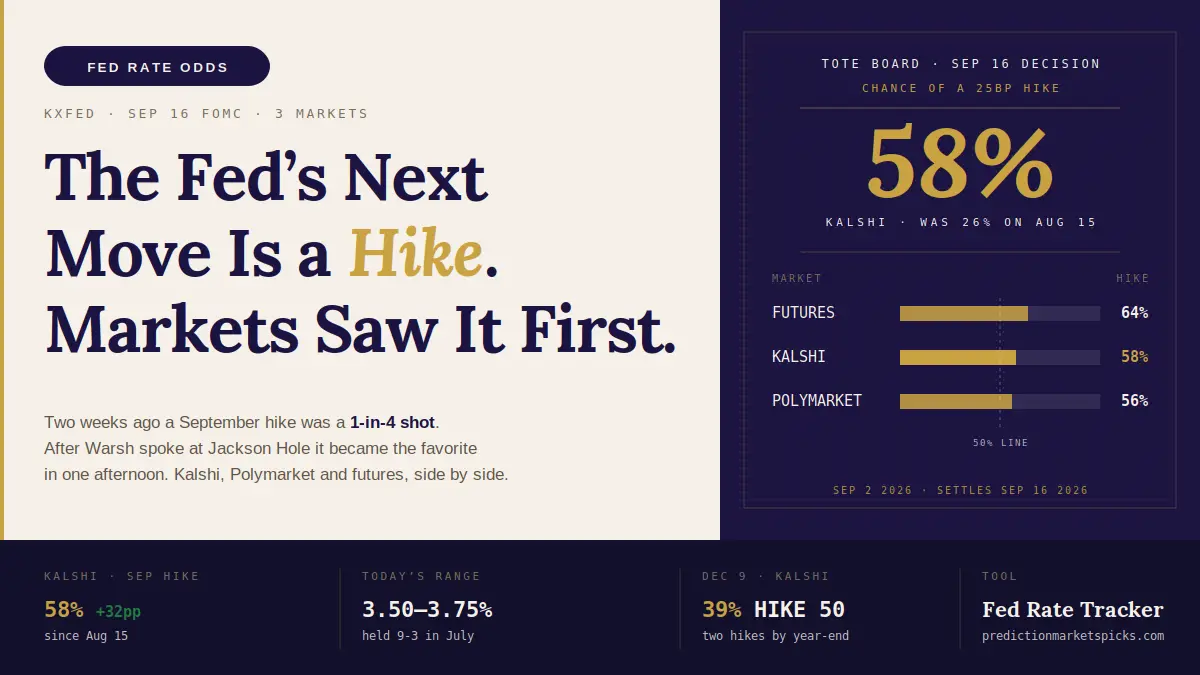
A month earlier, prediction markets said no. On Aug. 15 a contract on Kalshi paying $1 if the Fed raised rates in September traded at 26 cents, a 1-in-4 shot. By Sept. 2 that same contract was 58 cents, and by the final close before the decision it was 87. What follows is the story of how that happened, what three different markets said about it, which one was closest, and what it means if you carry a credit card balance. The pre-decision text and charts are kept as written — they are the record of what was priced, when.
How did the Kalshi Fed hike contract flip from 26 cents to 58 cents?
The contract went from 26 cents on Aug. 15 to 58 cents on Sept. 2, and most of that move happened in a single day. Here is the Kalshi September contract, day by day, from our Fed Rate Tracker capture.
| Date | Kalshi "hike 25 bps" contract, daily close | What happened |
|---|---|---|
| Aug. 15 | 26% | Series start, a 1-in-4 shot |
| Aug. 20 | 28% | |
| Aug. 25 | 34% | High of the pre-Jackson Hole range |
| Aug. 26 | 33% | July PCE prints 3.7%, forecast was 3.6% |
| Aug. 27 | 30% | Day before Jackson Hole |
| Aug. 28 | 51% | Warsh at Jackson Hole, 30 cents to 51 cents in one session |
| Aug. 29 | 47% | |
| Sept. 1 | 60% | |
| Sept. 2 | 54% | Close (58% intraday at publication) |
| Sept. 4 | 50% | August jobs report, 162,000 vs. ~55,000 forecast |
| Sept. 10 | 63% | |
| Sept. 11 | 79% | |
| Sept. 15 | 87% | Final pre-decision close |
| Sept. 16 | — | The Fed hikes 25 bps to 3.75%–4.00%, 12–0 |
For 12 days the number sat between 25% and 34%. Then on Friday, Aug. 28, it went from 30 cents to 51 cents in one session. It has not looked back.
That is not a slow change of opinion. That is a market hearing something and repricing on the spot.
What moved the September Fed hike odds?
A 9-3 hawkish dissent in July and a hot PCE print in August. The chain of events is short and each link is public.
July 29. The Fed holds rates at 3.50%-3.75%. The vote is 9-3, and all three dissenters want a hike, not a cut. A 9-3 split is unusual. It told anyone paying attention that a hike was already on the table.
Aug. 26. The July PCE report, the Fed's preferred inflation gauge, prints 3.7%. The forecast was 3.6%. The Fed's target is 2%. Core inflation, which strips out food and energy, is 3.3%. Nothing in that report gave the committee a reason to relax.
Aug. 28. Fed Chair Kevin Warsh speaks at Jackson Hole, Wyoming. "Inflation is running above our 2% target," he says. "So the Fed's predominant focus right now should be on prices." He does not say the word hike. He does not need to. CME FedWatch odds of a September increase go from about a third before the speech to better than half after it, and Kalshi's contract makes the same move the same afternoon.
That is the logic chain. A divided committee, a hot inflation print and a chair who chose the biggest stage of the year to talk about prices and nothing else. The market added it up.
Oil is the reason inflation will not come down on its own. The conflict with Iran has kept crude around $80 a barrel through a cycle of flare-ups and cease-fires, and every flare-up shows up at the pump a week later. That is the pressure Warsh was talking about.
What do Kalshi, Polymarket and fed funds futures each say about a September hike?
All three price a hike as the favorite and disagree only on how sure to be: futures 64%, Kalshi 58%, Polymarket 56% on Sept. 2. Kalshi is not the only place pricing this. Polymarket lists the same meeting, and the CME fed funds futures market, where banks and hedge funds hedge interest rate risk, has been pricing Fed decisions for decades.
Here is where all three stood on Sept. 2.
| Market | Hold | Hike 25 bps |
|---|---|---|
| CME fed funds futures | 36% | 64% |
| Kalshi | 39% | 58% |
| Polymarket | 43% | 56% |
Everyone agrees on the direction. They do not agree on how sure to be. Futures traders, the professionals, are about 8 percentage points more confident in a hike than the crowd on Polymarket. Kalshi sits in between.
That gap is the interesting part. All three markets are looking at the same PCE report and the same speech. They came to different numbers anyway. One of them was closer to right than the others, and on Sept. 16 we found out which.
We started capturing all three markets side by side on Aug. 30, and the September meeting is the first one we can grade on all three. The cross-market divergence tracker explains why the three disagree and keeps the running record of which venue has been right. We keep the scorecard on the September 2026 meeting page. At publication it read zero meetings graded, because that was the truth, and we said it would read one on the evening of Sept. 16. It now reads one — the September hike, graded on all three venues — and the running record lives on the cross-market divergence page.
The receipt. The Fed went with a 25bp hike on Sep 16, 2026. On the outcome that happened, Kalshi closed at 87%, Polymarket closed at 89%, CME fed funds futures implied closed at 94%. Futures was closest, by 5.8 points over Polymarket. All three had it as the favorite going in — the disagreement was about how sure to be, and the most confident book won. One meeting is one data point; the running record is on the cross-market divergence page, and the clock on October starts now.
| Venue | Favorite at the close | P(25bp hike) at the close | Since first capture | Result |
|---|---|---|---|---|
| CME fed funds futures implied | 25bp hike | 94.3% | 61.7% → 94.3% (+32.6pp since 2026-08-30) | closest |
| Polymarket | 25bp hike | 88.5% | 52.5% → 88.5% (+36.0pp since 2026-08-30) | |
| Kalshi | 25bp hike | 86.5% | 26.0% → 86.5% (+60.5pp since 2026-08-15) |
Does the market expect more than one hike?
Yes — the part that should get your attention is not September. It is what the market says comes after.
| Meeting (Kalshi) | Hold | Hike 25 | Hike 50 |
|---|---|---|---|
| Sept. 16 | 39% | 58% | 2% |
| Oct. 28 | 33% | 54% | 8% |
| Dec. 9 | 16% | 38% | 39% |
Read the December row. The market gives the Fed a 16% chance of sitting still, and a 39% chance the rate ends up a full half point higher than it is today. Two hikes by year-end is the base case. Three is not off the table.
A note on that table, because it matters. Kalshi's contracts for October and December ask a different question than the September one does. They ask where the rate will be after that meeting compared with today, not what the Fed does at that specific meeting. Two quarter-point hikes in September and October land in the same "50 bps" bucket as one half-point hike in October. So the December row says "we are probably two hikes higher by December," which is the plain-English read anyway. Our tracker separates the two kinds of contracts so nobody compares apples to oranges. The full explanation is on the KXFED settlement page.
What does a quarter-point Fed hike mean for you?
A quarter of a percentage point does not sound like much. Here is the honest math.
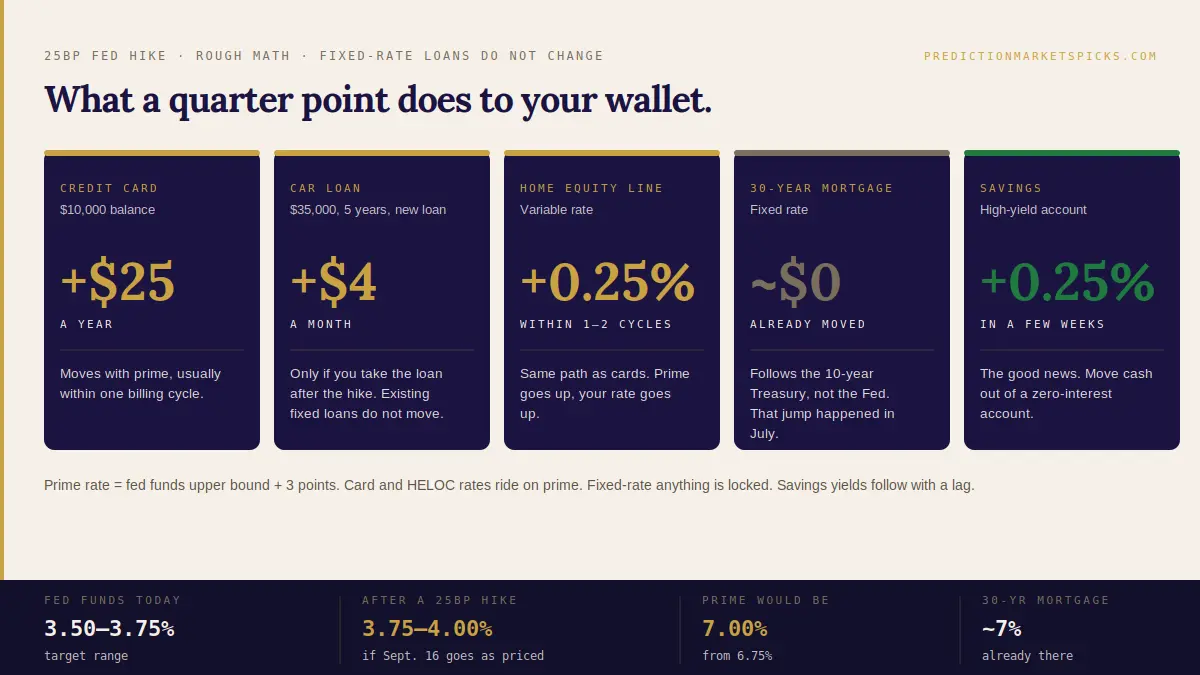
Credit cards. These move first and fastest. Card rates are pegged to the prime rate, and prime moves the day the Fed does. On a $10,000 balance, a quarter point is about $25 a year. Not a crisis. But the average card rate is already north of 20%, and this would be the first increase after a stretch of cuts.
Home equity lines and variable-rate loans. Same path as cards, usually within one or two billing cycles.
Car loans. A new $35,000 loan at a quarter point higher costs roughly $4 more a month over five years. If you already have a fixed-rate car loan, nothing changes.
Mortgages. This is the one people get wrong. A 30-year fixed mortgage does not follow the Fed directly. It follows the 10-year Treasury yield, and Treasury yields already moved. After the July hold, long-term yields jumped and the 30-year Treasury hit its highest level since 2007. Mortgage rates near 7% are the result. A September hike is mostly priced in there already.
Savings. The one piece of good news. High-yield savings accounts and money market funds tend to pass along rate increases within a few weeks. If you have cash sitting in a big bank account paying nothing, this is a decent time to move it.
What moved the number between Sept. 2 and the decision?
Two data releases sat between publication and the meeting, and the first one moved the contract 10 points in a morning.
The August jobs report came in Friday, Sept. 4 at 162,000 against a forecast of about 55,000, with June and July revised up by a combined 55,000. The contract went from 44% to 50% on the print. Two categories delivered nearly two-thirds of the gain, and whether the seasonal adjustment flattered the number is the argument of the week. Both sides, with the numbers, are in our follow-up: August jobs report: real strength or seasonal mirage?
The August consumer price index landed the week before the meeting; the July reading had been 3.4%. The contract went from the low 60s to 79% across Sept. 10–11 and never came back — the flip table above has the closes.
How do you read a prediction market on the Fed?
A price in cents is a probability in percent — if you have never looked at a prediction market before, here is the entire rulebook.
The price is the probability. A contract at 58 cents means the market thinks there is a 58% chance. If the Fed hikes, the contract pays $1. If it does not, it pays zero. Nobody is guessing. People are putting money on it, and the price is where the buyers and sellers meet.
That is why we treat these numbers as a forecast, not a poll. A poll asks what you think. A market asks what you will pay.
We also do not pretend the market is always right. On Aug. 15 it said 26% and it was about to be very wrong. What it is good at is updating fast. The moment Warsh finished speaking the number moved, hours before the analyst notes went out. That speed is the product, and it is why we built the tracker.
Where can you watch the Fed odds live?
The Fed Rate Tracker has the live board, the day-by-day history behind the first chart in this piece and the inflation and jobs indicators the committee is looking at. The Inflation Tracker prices the CPI report itself.
If you use Claude or ChatGPT, you can ask it directly. Our MCP server gives any AI assistant the same live numbers, free, no key required. Type "what are the odds the Fed hikes in September" and it will pull the board.
And if you run a site or a newsletter, the live board is yours to embed. One line, no signup, updates itself.
<iframe src="https://predictionmarketspicks.com/embed/fed-rate-tracker/article?theme=indigo" width="100%" height="400" style="border:0;max-width:728px" loading="lazy" title="Live Fed rate decision odds"></iframe>We graded all three markets on the September hike — the receipt is above — and the clock on October is running on the Fed Rate Tracker.
Pre-decision prices as of Sept. 2, 2026, and the graded closes as of Sept. 15, 2026, from PredictionMarketsPicks' 30-minute capture of Kalshi, Polymarket and CME fed funds futures. Polymarket prices are from the international book. Prediction market contracts involve risk of loss. This is not financial advice.