

Kalshi vs Polymarket vs Fed Funds Futures: Live FOMC Divergence Tracker
The same Fed meeting, priced on three separate books. The spread on every outcome, why the venues disagree, and the running record of which one has been right.
Quick Answer
Kalshi, Polymarket and CME fed funds futures currently disagree by 2.5 percentage points on the most likely outcome of the Oct 27–28, 2026 FOMC meeting — that is the live cross-market divergence, measured only where the three venues price the same question. Which venue has been right: 14 meetings graded, listed below.
Oct 27–28, 2026 meeting — the daily series →Cross-Market Divergence
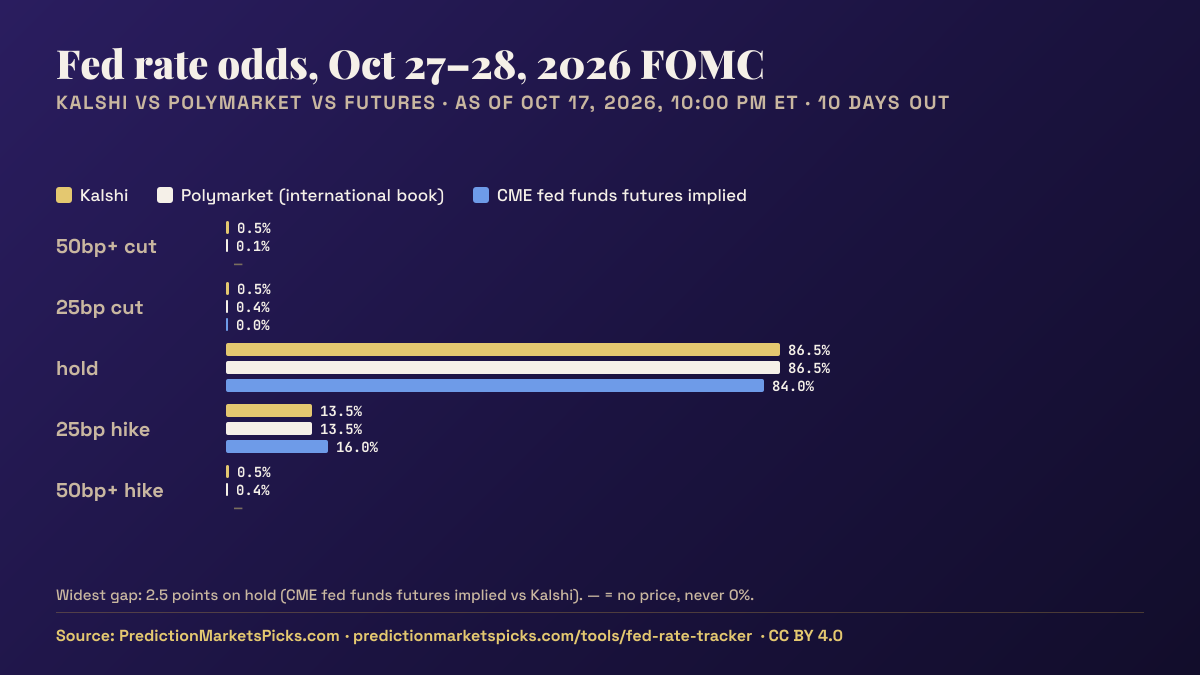
Oct 27–28, 2026 · 10 days outThe same meeting, priced on 3 venues at once. On the outcome the market considers most likely, they disagree by 2.5pp.
| Outcome | Kalshi | Polymarket | Futures | Spread |
|---|---|---|---|---|
| 50bp+ cut | 0.5% | 0.1% | — | 0.4pp |
| 25bp cut | 0.5% | 0.4% | 0.0% | 0.5pp |
| Hold | 86.5% | 86.5% | 84.0% | 2.5pp |
| 25bp hike | 13.5% | 13.5% | 16.0% | 2.5pp |
| 50bp+ hike | 0.5% | 0.4% | — | 0.2pp |
Widest gap: 2.5pp on hold, between Futures and Kalshi.
Which venue has been right
- Jan 28–29, 2025 — actual: Hold · Kalshi 99.5% · Polymarket 98.7% · closest: Kalshi
- Mar 18–19, 2025 — actual: Hold · Kalshi 99.5% · Polymarket 99.2% · Futures 100.0% · closest: Futures
- May 6–7, 2025 — actual: Hold · Kalshi 96.5% · Polymarket 98.0% · Futures 98.7% · closest: Futures
- Jun 17–18, 2025 — actual: Hold · Kalshi 97.5% · Polymarket 98.4% · Futures 100.0% · closest: Futures
- Jul 29–30, 2025 — actual: Hold · Kalshi 97.5% · Polymarket 98.0% · closest: Polymarket
- Sep 16–17, 2025 — actual: 25bp cut · Kalshi 93.5% · Polymarket 92.5% · Futures 100.0% · closest: Futures
- Oct 28–29, 2025 — actual: 25bp cut · Kalshi 98.5% · Polymarket 98.0% · closest: Kalshi
- Dec 9–10, 2025 — actual: 25bp cut · Kalshi 96.5% · Polymarket 96.9% · Futures 94.5% · closest: Polymarket
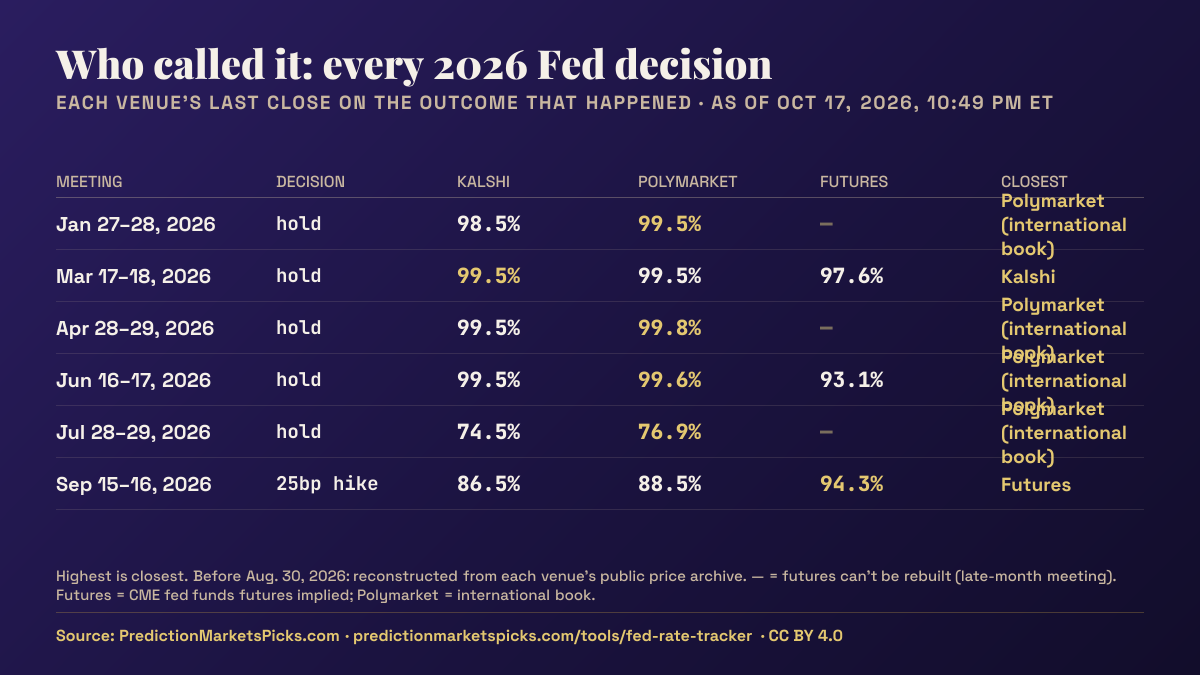
- Jan 27–28, 2026 — actual: Hold · Kalshi 98.5% · Polymarket 99.5% · closest: Polymarket
- Mar 17–18, 2026 — actual: Hold · Kalshi 99.5% · Polymarket 99.5% · Futures 97.6% · closest: Kalshi
- Apr 28–29, 2026 — actual: Hold · Kalshi 99.5% · Polymarket 99.8% · closest: Polymarket
- Jun 16–17, 2026 — actual: Hold · Kalshi 99.5% · Polymarket 99.6% · Futures 93.1% · closest: Polymarket
- Jul 28–29, 2026 — actual: Hold · Kalshi 74.5% · Polymarket 76.9% · closest: Polymarket
- Sep 15–16, 2026 — actual: 25bp hike · Kalshi 86.5% · Polymarket 88.5% · Futures 94.3% · closest: Futures
Polymarket prices are from the international book. Polymarket US is a separate exchange with its own order book — verify the price there before taking a position.
CME fed funds futures implied is derived from the CME fed funds futures curve using the published FedWatch methodology, anchored on the daily effective fed funds rate. It yields a single expected rate, so it is mapped onto a cut / hold / hike triple — it cannot express a 50bp outcome at all, and those cells read “—” rather than 0%.
Updated Oct 17, 9:30 PM ET · refreshes every 30 minutes.
Use this graphic — free with credit (CC BY 4.0)
Download the PNG or paste this into your page:
<a href="https://predictionmarketspicks.com/tools/fed-rate-tracker?utm_source=embed&utm_medium=graphic&utm_campaign=fed-odds-graphic"><img src="https://predictionmarketspicks.com/tools/fed-rate-tracker/graphics/fed-rate-odds-kalshi-polymarket-futures-october-2026.png" alt="Grouped bar chart of Kalshi, Polymarket and futures odds for the Oct 27–28, 2026 Fed meeting: hold 87%, 25bp hike 14%, widest gap 2.5 points." width="1200" height="675"></a>
<p>Source: <a href="https://predictionmarketspicks.com/tools/fed-rate-tracker?utm_source=embed&utm_medium=graphic&utm_campaign=fed-odds-graphic">PredictionMarketsPicks</a> (CC BY 4.0)</p>
The day-by-day version of this board — every venue’s daily close on the outcome the market considers most likely — lives on the Oct 27–28, 2026 meeting page.
Why Kalshi, Polymarket and futures disagree
Most “Kalshi and Polymarket disagree about the Fed” takes are wrong, and the reason is not liquidity or fees. It is that, for every meeting except the next one, the two contracts are asking different questions.
Kalshi’s KXFED contract asks whether the Fed’s target range will be above a given level following a meeting. That is a rate level, measured against today. If the Fed hikes a quarter point in September and another quarter point in October, Kalshi’s October contract lands in the “50 basis points higher” bucket even though October itself was a single quarter-point move. Polymarket’s per-meeting ladder, and the probability we derive from CME fed funds futures, ask what the Fed does at that meeting. One move, at one meeting.
The two questions coincide only for the next meeting, because no decision intervenes between today and it. Measured on the first day we captured all three venues, August 30, 2026:
- September 2026 (the next meeting at the time): Kalshi and Polymarket agreed to within 2.5 percentage points on all five outcomes. Same question, nearly the same answer.
- October 2026: hold read 35.0% on Kalshi versus 70.5% on Polymarket.
- December 2026: a 50 basis point hike read 33.5% versus 3.7% — a 29.8-point gap.
Up to 35.5 points of “divergence” that is entirely basis and zero edge. It is large, stable and directionally consistent, which is exactly why it reads as a persistent venue lean instead of the accounting difference it is — and why every volume, liquidity and book-quality check is blind to it.
So this tracker subtracts only same-basis venues. Kalshi is compared with Polymarket and futures for the next meeting only; for October and December it is shown as context, never in the spread column. The moment September settles, October becomes the next meeting and its Kalshi contract becomes comparable. The full contract language is on the KXFED settlement page.
The math, briefly
Kalshi’s ladder is a set of threshold contracts (“above 3.50%?”, “above 3.75%?” …), so a per-outcome probability is the difference between adjacent thresholds — a CDF difference — and the outcomes need not sum to exactly 100%. Polymarket lists five independent binaries per meeting; they need not sum to 100% either (0.9965 on August 30) and we deliberately do not renormalize them, because forcing agreement between venues would erase the thing being measured. The futures figure inverts the CME curve with the published FedWatch method, anchored on the daily effective fed funds rate rather than the monthly average, because the inversion amplifies anchor error by roughly 8.6 points of probability per basis point; it yields one expected rate, mapped onto cut / hold / hike, and cannot express a 50 basis point outcome — those cells read “—”, never 0%. Two ceilings guard the board: a book-vs-book divergence above 25 points, or a futures-vs-book divergence above 40, is treated as a data fault and withheld rather than published.
Which venue has been right
After each decision, every venue is scored on its last close before the announcement on the outcome that actually happened; the venue with the highest probability on the realized outcome is the closest, and two venues within 1 point are a tie. A grade needs at least two venues. Daily three-venue capture began Aug 30, 2026. Earlier decisions, back to January 2025, are reconstructed from each venue's public price archive with the same rule and marked †; a futures cell the inversion cannot rebuild reads “—”, never a number, and a 0-of-0 never renders as 0%.
14 meetings graded The full table, with the summary, is the graded Fed record on the tracker.
| Meeting | Decision | Kalshi | Polymarket | Futures | Closest |
|---|---|---|---|---|---|
| Jan 28–29, 2025 | Hold | 99.5%† | 98.7%† | — | Tie (Kalshi/Polymarket) |
| Mar 18–19, 2025 | Hold | 99.5%† | 99.2%† | 100.0%† | Tie (all three) |
| May 6–7, 2025 | Hold | 96.5%† | 98.1%† | 98.7%† | Tie (Polymarket/Futures) |
| Jun 17–18, 2025 | Hold | 97.5%† | 98.4%† | 100.0%† | Futures |
| Jul 29–30, 2025 | Hold | 97.5%† | 98.0%† | — | Tie (Kalshi/Polymarket) |
| Sep 16–17, 2025 | 25bp cut | 93.5%† | 92.5%† | ≥99%† | Futures |
| Oct 28–29, 2025 | 25bp cut | 98.5%† | 98.1%† | — | Tie (Kalshi/Polymarket) |
| Dec 9–10, 2025 | 25bp cut | 96.5%† | 96.9%† | 94.5%† | Tie (Kalshi/Polymarket) |
| Jan 27–28, 2026 | Hold | 98.5%† | 99.5%† | — | Tie (Kalshi/Polymarket) |
| Mar 17–18, 2026 | Hold | 99.5%† | 99.5%† | 97.6%† | Tie (Kalshi/Polymarket) |
| Apr 28–29, 2026 | Hold | 99.5%† | 99.8%† | — | Tie (Kalshi/Polymarket) |
| Jun 16–17, 2026 | Hold | 99.5%† | 99.6%† | 93.1%† | Tie (Kalshi/Polymarket) |
| Jul 28–29, 2026 | Hold | 74.5%† | 76.9%† | — | Polymarket |
| Sep 15–16, 2026 | 25bp hike | 86.5% | 88.5% | 94.3% | Futures |
† Reconstructed from each venue’s own public price archive (last close before the decision day). Sept 2026 onward is our live capture.
Use this graphic — free with credit (CC BY 4.0)
Download the PNG or paste this into your page:
<a href="https://predictionmarketspicks.com/tools/fed-rate-tracker?utm_source=embed&utm_medium=graphic&utm_campaign=fed-record-graphic"><img src="https://predictionmarketspicks.com/tools/fed-rate-tracker/graphics/fed-decision-record-who-called-it-2026.png" alt="Scorecard of every 2026 Fed decision graded against Kalshi, Polymarket and CME futures; futures were closest on the 25bp hike of Sept. 16 at 94.3%." width="1200" height="675"></a>
<p>Source: <a href="https://predictionmarketspicks.com/tools/fed-rate-tracker?utm_source=embed&utm_medium=graphic&utm_campaign=fed-record-graphic">PredictionMarketsPicks</a> (CC BY 4.0)</p>
Every 2026 FOMC meeting
January 2026
Settled
March 2026
Settled
April 2026
Settled
June 2026
Settled
July 2026
Settled
September 2026
Settled
October 2026
Next — three-venue series live
December 2026
Kalshi shown as context only
January 2026
Kalshi shown as context only
March 2026
Kalshi shown as context only
April 2026
Kalshi shown as context only
June 2026
Kalshi shown as context only
July 2026
Kalshi shown as context only
September 2026
Kalshi shown as context only
October 2026
Kalshi shown as context only
December 2026
Kalshi shown as context only
Use this data
The daily three-venue series is free to use with attribution — link to this page. JSON by default, CSV with ?format=csv; meeting=YYYY-MM-DD selects a meeting (default: the next one), outcome=HIKE-25 filters one rung. Cached five minutes, CORS open, only derived probabilities.
GET https://predictionmarketspicks.com/api/public/fed-divergence
GET https://predictionmarketspicks.com/api/public/fed-divergence?meeting=2026-09-16&outcome=HIKE-25
GET https://predictionmarketspicks.com/api/public/fed-divergence?format=csv
Embed the live board — one line, no signup, updates itself:
<iframe src="https://predictionmarketspicks.com/embed/fed-rate-tracker/article?theme=indigo" width="100%" height="400" style="border:0;max-width:728px" loading="lazy" title="Live Fed rate decision odds from prediction markets"></iframe>Series today: CME fed funds futures implied, Kalshi, Polymarket. Polymarket prices are from the international book; Polymarket US is a separate exchange with its own order book. The futures figure is a probability derived from the CME curve, not a contract price.
Trade the Oct 27–28, 2026 Fed decision
The spread above is where the venues disagree. Take a position on cut, hold or hike on Kalshi’s KXFED ladder.
Get the cross-market Fed read before each FOMC decision — free
No spam. Unsubscribe anytime.
Related
Fed Rate Tracker
The live KXFED ladder, all 8 meetings
Historical Accuracy
Kalshi vs the decision, since July 2026
How KXFED settles
The contract language behind the basis
Trading Fed decisions
The guide
September 2026 hike — graded
What the three venues priced, and which was closest
August jobs report vs. the Fed
Real strength or seasonal mirage — both sides
Macro markets
Every macro contract we price
Kalshi vs Polymarket vs fed funds futures — frequently asked
Why do Kalshi and Polymarket show different Fed odds?
Three reasons, in order of size. First, for any meeting past the next one they are answering different questions: Kalshi’s KXFED contract asks whether the target range will be above a level FOLLOWING the meeting (a cumulative level versus today), while Polymarket’s per-meeting ladder asks what the Fed does AT that meeting. Measured on August 30, 2026, that basis difference alone was 35.5 percentage points on October’s hold outcome. Second, they are different crowds on different books — Kalshi is a CFTC-regulated US exchange, the Polymarket prices here are from its international book — with different fees and different liquidity. Third, genuine disagreement: on the next meeting, where the question is identical, the two books typically sit within a few points and that gap is a real difference of opinion.
Is CME FedWatch more accurate than prediction markets?
Nobody has published a graded comparison, so we are building one. The CME fed funds futures figure on this page is derived from the futures curve using the published FedWatch method, anchored on the daily effective fed funds rate. It reflects banks and hedge funds hedging rate risk, so it is the deepest of the three books, but it yields a single expected rate and cannot express a 50 basis point outcome at all. The record below scores each venue on its last pre-decision close, one meeting at a time, starting September 16, 2026. Until then the honest answer is that it reads zero meetings graded.
Which market has been right about the Fed?
14 meetings have been graded on all three venues so far; the per-meeting results, including which venue was closest on the realized outcome, are in the graded record on this page. Each grade uses the venue’s last close before the decision.
Can you compare Kalshi and Polymarket odds for October or December?
Not directly, and this page refuses to. For any meeting past the next one, Kalshi’s contract prices the rate LEVEL after that meeting relative to today — two separate 25 basis point hikes at earlier meetings land in the same 50 basis point bucket — while Polymarket and the futures curve price the move at that specific meeting. Subtracting one from the other measures the difference in the question, not a mispricing: 35.0% versus 70.5% on October’s hold and 33.5% versus 3.7% on December’s 50 basis point hike, as of August 30, 2026. We compare only same-basis venues and show the rest as context. The two questions become the same the moment the intervening meeting settles, so October becomes comparable on the evening of September 16.
Where does the data come from and can I use it?
Every 30 minutes we capture Kalshi’s KXFED ladder, Polymarket’s per-meeting Fed ladder (international book) and the CME fed funds futures curve, store each venue’s implied probability per outcome, and roll them into a daily close. The daily series is free to use with attribution as JSON or CSV at predictionmarketspicks.com/api/public/fed-divergence, and the live board can be embedded. Only derived probabilities are published — never a raw futures contract price.
Latest board: 5 comparable outcomes, headline spread 2.5pp · CUT-50 0.4pp · CUT-25 0.5pp · HOLD 2.5pp · HIKE-25 2.5pp · HIKE-50 0.2pp · venues CME fed funds futures implied 84.0% hold, Kalshi 86.5% hold, Polymarket 86.5% hold.