

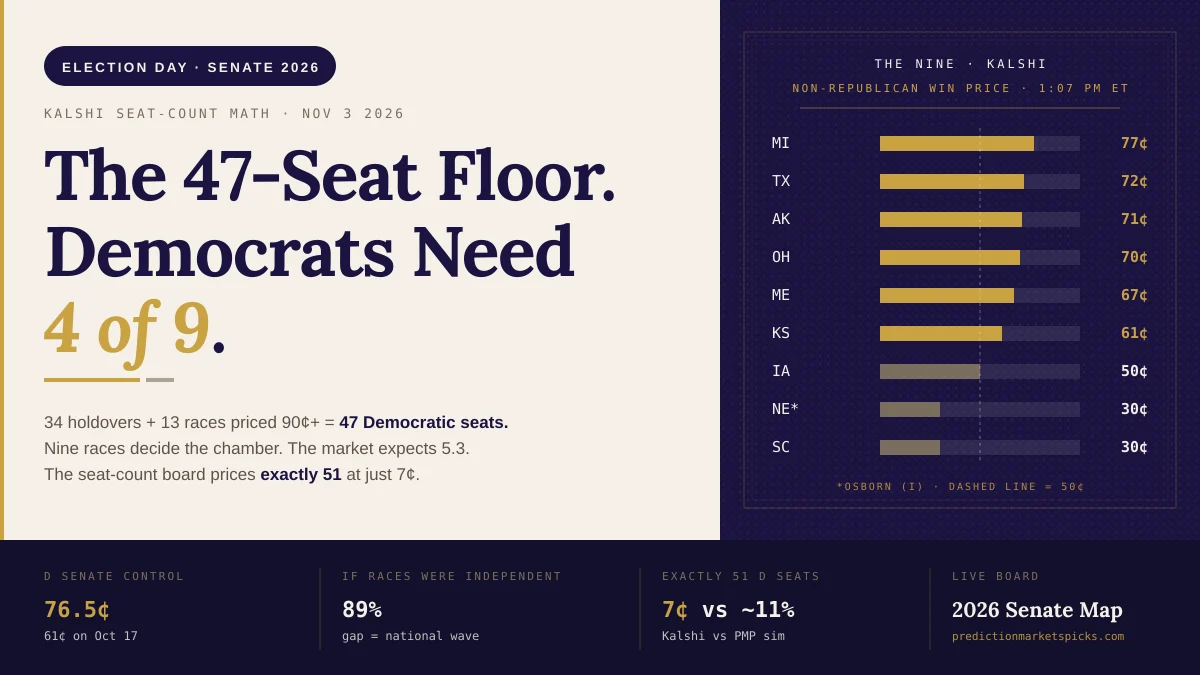

Democrats start Election Day with 47 Senate seats the market treats as settled. They need 51. That leaves nine races, and they need four of them.
Kalshi's Senate control market has Democrats at 76.5¢, up from 61¢ on October 17. The nine races that decide it run from Michigan at 77¢ to South Carolina at 30¢. Add those prices up and the market expects Democrats to win about 5.3 of the nine.
The more interesting market is the one most people skip: Kalshi's seat-count board. It prices exactly 51 Democratic seats at 7¢. Our simulation puts that outcome near 11%.
Here is the floor, the nine, the scenarios and where each view gets the best price.
Watching tonight? The 7 Oracles go live at 7:00 PM ET, and the election-night live blog tracks every race as it's called. Full board: 2026 Midterms hub.
Prices: Kalshi race markets as of 1:07 PM ET, November 3; control and seat-count brackets as of about 9 AM ET. They will move all night. Live Senate map →
1:41 PM ET update: Senate control has slipped to 72¢ while the nine race prices barely moved, so the market is pricing more risk that the races miss together. Exactly 51 is down to 6.7¢. Recalibrated to 72¢, our simulation still puts it near 9%.
See the Senate seat-count board on Kalshi →
The floor: 47 seats
| Bucket | Seats | What's in it |
|---|---|---|
| Democrats + independents not on the ballot | 34 | Includes Sanders and King |
| Races priced 90¢+ for Democrats | 13 | MN, NH, GA, NC (a Republican seat priced at 97¢), IL, MA, NJ, NM, CO, DE, OR, RI, VA |
| Democratic floor | 47 | |
| Republicans not on the ballot | 31 | |
| Races priced 84¢+ for Republicans | 13 | LA, MS, FL, MT, SD, AR, KY, ID, AL, TN, WY, OK, WV |
| Republican floor | 44 |
"Settled" is doing some work there. In our simulation, there's about a 1-in-4 chance at least one of those 13 Democratic seats falls, and about a 4-in-10 chance a Republican seat flips, almost all of it Louisiana, Mississippi and Florida. A 90¢ seat still loses one time in ten. Stack thirteen of them and the odds that one slips get real.
The nine that decide it
| Race | Non-Republican price | Since Aug 30 | Note |
|---|---|---|---|
| Michigan (El-Sayed) | 77¢ | +13 | Democrats already hold it; lose it and they need 5 of the other 8 |
| Texas (Talarico vs Paxton) | 72¢ | +21 | Biggest market on the board: about 66M contracts open |
| Alaska | 71¢ | +7 | |
| Ohio (Brown) | 70¢ | +15 | |
| Maine | 67¢ | −3 | Fell from 73¢ between 9:30 AM and 1 PM today |
| Kansas | 61¢ | +42 | 19¢ on Aug 30; up 20 in the last week alone |
| Iowa | 50¢ | +7 | The only true coin flip |
| Nebraska (Osborn, I) | 30¢ | −2 | An independent, which matters for settlement |
| South Carolina | 30¢ | +16 | Nearly doubled since Oct 17 (16¢) |
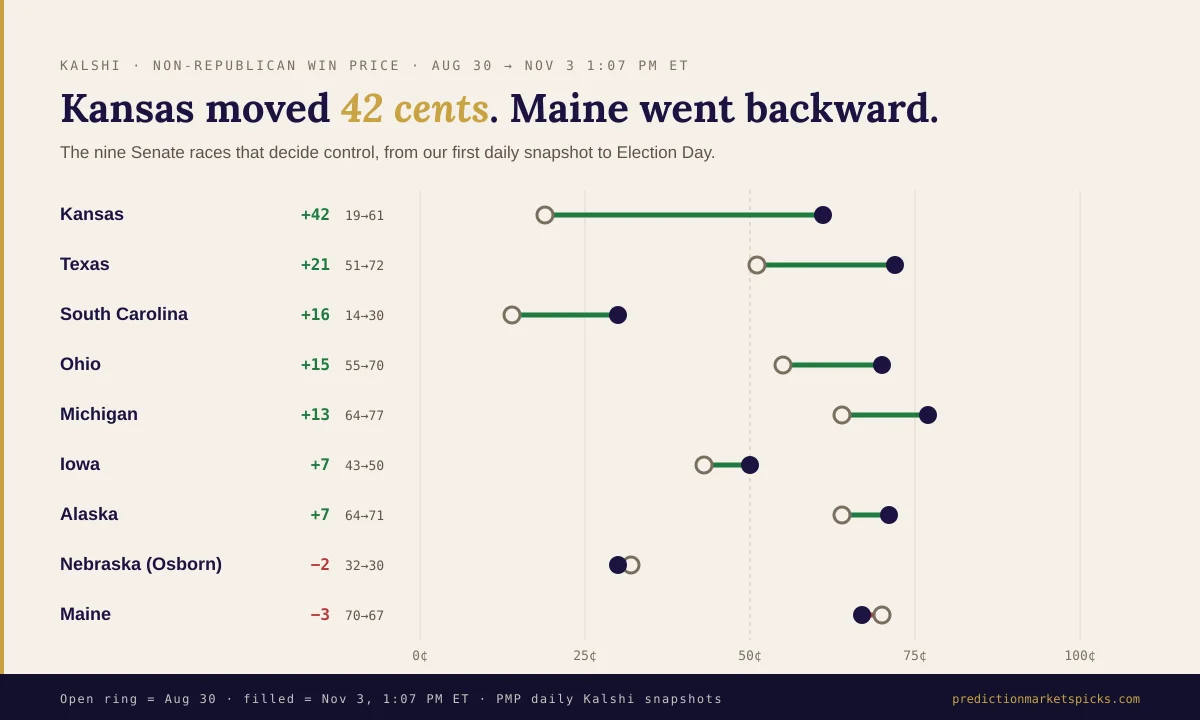
The most likely road to exactly 51 is Michigan + Texas plus two of Alaska, Ohio and Maine. The single most likely road to 52 is Michigan + Texas + Alaska + Ohio + Maine. Kansas and Iowa are what turn a majority into a cushion; Nebraska and South Carolina are the blowout seats.
Why 76.5¢ and not 89%
Treat the nine races as independent and Democrats reach 51 about 89% of the time. The control market says 76.5¢. That 12-point gap isn't a mistake. It's the market pricing a national swing: if the polls miss in Ohio, they probably miss in Iowa and Alaska too.
We ran the full 35-race map with a shared national swing and asked how much of it you need to get from 89% to 76.5%. The answer is about 24% shared, 76% race-specific. That's the same engine behind our 10,000-run Senate simulation, and it's a reasonable number. The race markets and the control market agree with each other.
The seat-count board doesn't.
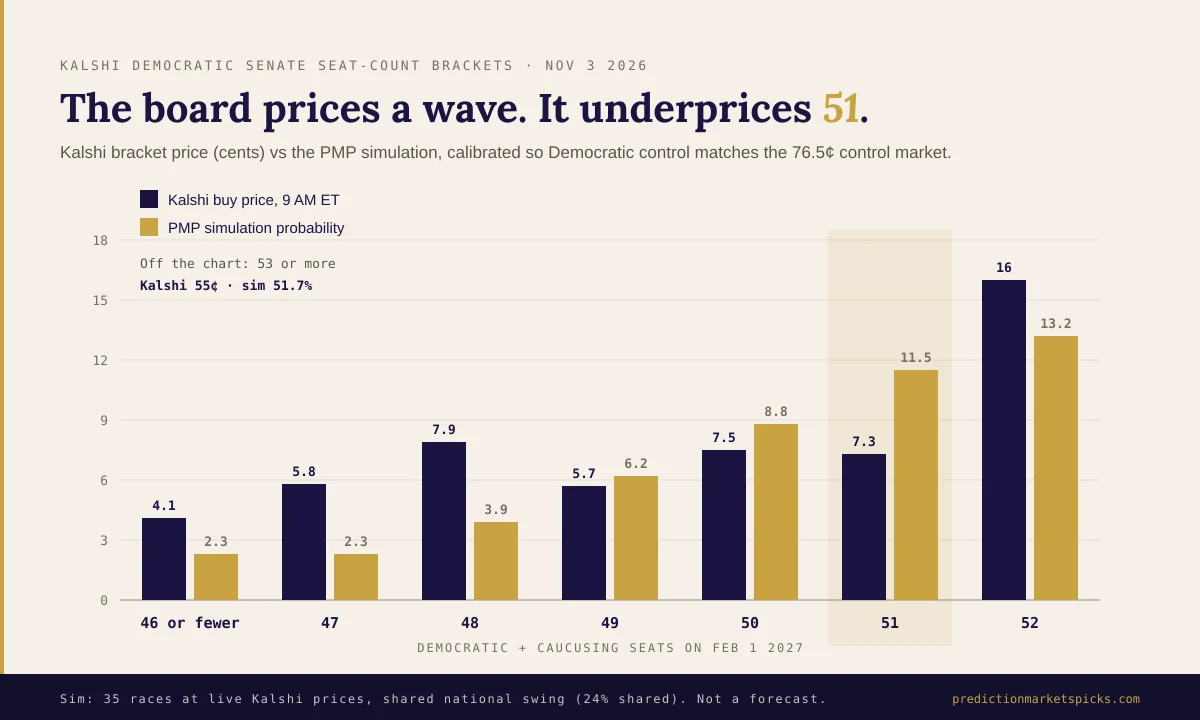
The seat-count board prices a wave and skips the squeaker
| Democratic seats | Kalshi price | PMP simulation | Read |
|---|---|---|---|
| 46 or fewer | 4.1¢ | 2.3% | Priced above the sim |
| 47 | 5.8¢ | 2.3% | Priced well above |
| 48 | 7.9¢ | 3.9% | Priced well above |
| 49 | 5.7¢ | 6.2% | About fair |
| 50 | 7.5¢ | 8.8% | About fair |
| 51 | 7.3¢ | 11.5% | Priced below |
| 52 | 16¢ | 13.2% | Priced above |
| 53 or more | 55¢ | 51.7% | Fair after the board's overround |
Kalshi bracket prices are buy prices, about 9 AM ET. The brackets add up to more than 100¢ (about 107¢ at the midpoint), so every price carries some markup; check the cost after fees on the Kalshi fee calculator. We ran the simulation again with fatter tails and got the same pattern: exactly 51 at 10.9%.
Two things stand out. The 47 and 48 brackets, where Democrats win zero or one of the nine, trade at more than double what race prices imply. And the narrow majority, exactly 51, is the cheapest bracket on the board relative to its odds. The market expects a sweep in one direction or the other. A grind to 51 is the outcome it's least ready for.
The exactly-51 bracket has also been sold all fall: 16¢ on August 30, 11¢ a week ago, 7¢ this morning. Over the same stretch, 53 or more ran from 23¢ to 55¢.
How each view gets the best price
This is market structure, not a call on who wins. Whatever you think happens tonight, this is where the board pays the most for that view.
- Democrats take control: the control contract at 76.5¢ is the cleanest position. Single races are a weaker way to hold this view. Even in our simulated worlds where Democrats win the chamber, Michigan only wins 86% of the time and Iowa 60%.
- Democrats win big: the cheap legs carry it. Iowa at 50¢ and Nebraska and South Carolina at 30¢ are the seats that turn 52 into 54.
- Republicans hold the Senate: Republican control at about 23.5¢ is the most direct position. The best single race for this view is the Republican side of Michigan, a Democratic seat priced at 23¢.
- It comes down to one seat: the exactly-51 bracket at about 7¢, or 50 and 51 together for about 15¢ against about 20% in the simulation. 51 is a narrow Democratic majority; 50 is a Republican Senate on Vance's tiebreak.
- Races are more independent than the market thinks: if you believe candidates matter more than the national swing this year, control at 76.5¢ is cheap against the 89% independent number. If you believe it's one wave, it's about fair.
Size any of these with the EV calculator and the Kelly sizer. A 7¢ contract that's worth 11¢ is still a contract that loses about nine times out of ten.
What looks like an arbitrage and isn't
Democratic control (76.5¢) against the 51-and-up brackets added together (7.3 + 16 + 55 = 78.3¢) sits within two points. That isn't free money. It's inside Kalshi's taker fees, and the two markets settle on different rules: the seat-count board counts seats on February 1, 2027, and counts an independent as a Democrat only if he caucuses with them.
That makes Nebraska the settlement trap. If Dan Osborn wins and doesn't caucus with Democrats, the seat-count board won't count him as one. With Nebraska never counted as a Democratic seat, the independent-races control number drops from 89% to 86.5%, and 53 or more drops from 52% to 45% on the same math. Read the rules on any bracket before you trade it.
Tonight
Polls close in waves, and every race page updates as Kalshi moves. Follow it on the 2026 Senate map, compare it with the forecasters on markets vs pundits, and check the House and governor boards on the midterms hub. For a look back at how markets did last time, see prediction markets' 2024 record, state by state.
If you'd rather ask an AI agent than refresh a page, the same Senate map and race prices are live in our MCP server. Convert any price to a probability with the probability converter.
Market prices are probabilities, not guarantees. Trade responsibly.