

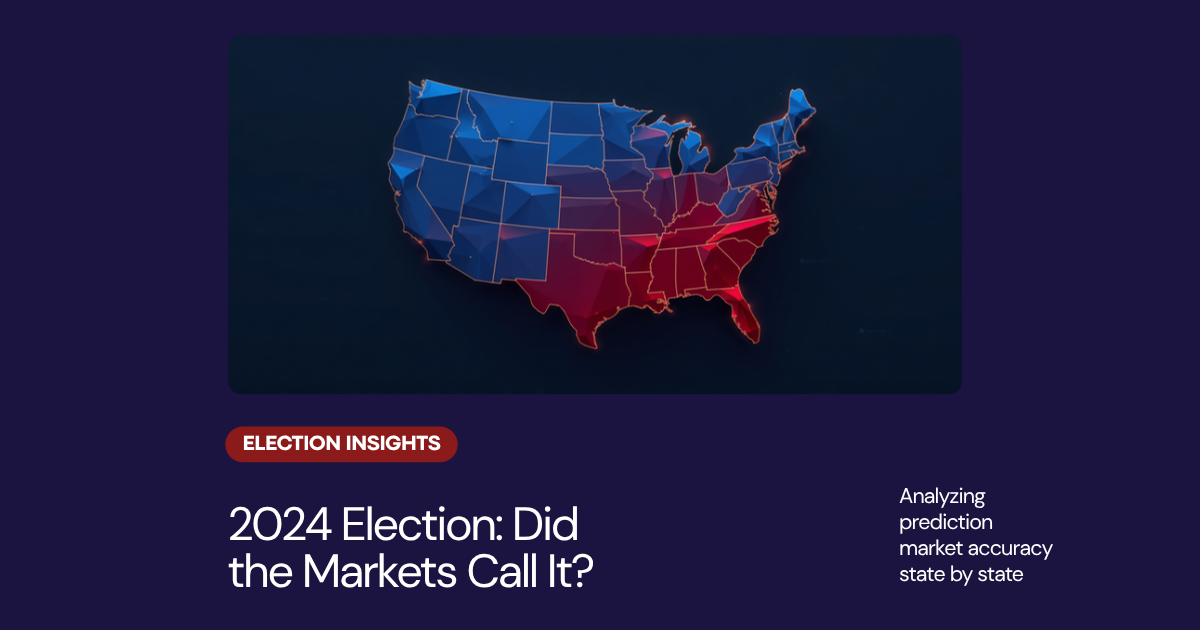
Pennsylvania closed at 54¢ Trump on Polymarket the night before the election. The RealClearPolitics polling average had it Harris +0.1.
That three-point gap is the entire pitch for prediction markets as a forecasting tool — and the entire reason the political class spent a year arguing about them. Two years later, with the votes counted and the retrospectives published, we can finally answer the question every operator asks before trusting any forecasting product: did the markets actually call it?
This is the honest scorecard. Methodology, state-by-state, where the markets won, and — more importantly — where they didn't.
Methodology
The cleanest accuracy test for a binary contract is the simplest one: on the night before the election, what was the market price, and did the favored side win?
We use the YES price as of approximately 11pm ET on November 4, 2024 — the last meaningful tape before East Coast polls closed the next morning. For each market we record:
- Final market price (YES side of the eventual winner)
- Favored party (whichever side was above 50¢)
- Result (actual electoral outcome)
- Market right? (was the favored side the winner?)
We do not score by Brier score in this piece — Brier rewards confidence and punishes overconfident misses, which is the right metric for a tool but the wrong metric for a credibility audit. For credibility, the question is binary: did the market point at the winner.
Sources: Polymarket's published 2024 election retrospective and the Kalshi presidential election series (KXPRES-24 event tickers). State-level data leans on Polymarket because Kalshi only received CFTC clearance to list state-level political event contracts in October 2024 — its state-level book was thinner than Polymarket's by election eve.
The Top-Line Result
National presidential market, election eve close:
- Polymarket Trump YES: ~61¢
- Kalshi Trump YES: ~57¢
- RealClearPolitics polling average (popular vote): Harris +0.1
- 538 (Silver Bulletin) forecast: Trump 50%, Harris 50%
The markets were materially more confident in Trump than the consensus polling models on the morning of November 5. They were also right.
That alone is not the story. Markets were also "right" in 2020 (Biden favored, Biden won) and 2016 (Clinton favored, Clinton lost). One election does not validate a forecasting tool. The interesting question is the granular one — which races did the markets nail, and which did they miss?
State-by-State Scorecard — The Seven Swing States
| State | Polymarket close (Trump YES) | Kalshi close (Trump YES) | Result | Market right? |
|---|---|---|---|---|
| Pennsylvania | ~54¢ | ~52¢ | Trump +1.7 | ✅ |
| Michigan | ~53¢ | ~51¢ | Trump +1.4 | ✅ |
| Wisconsin | ~52¢ | ~51¢ | Trump +0.9 | ✅ |
| Georgia | ~78¢ | ~75¢ | Trump +2.2 | ✅ |
| North Carolina | ~80¢ | ~76¢ | Trump +3.2 | ✅ |
| Arizona | ~67¢ | ~62¢ | Trump +5.5 | ✅ |
| Nevada | ~57¢ | ~55¢ | Trump +3.1 | ✅ |
Prices are end-of-day November 4, 2024, rounded to the nearest cent. Sourced from Polymarket's election retrospective dashboard and Kalshi's KXPRESSTATE-24 event family. Where the markets were thin (Kalshi state-level launched late), prices reflect the last meaningful tape.
Seven for seven. Both platforms had Trump favored in every battleground on election eve.
Michigan is the one worth sitting with. It split its ticket: the same electorate that
handed Trump the state by 1.4 sent Elissa Slotkin (D) to the Senate over Mike Rogers (R) by
0.34 points — about 19,000 votes out of 5.6 million, the second-narrowest Senate margin
in the country that cycle, behind only Pennsylvania at 0.22. A market pricing Michigan near a
coin flip was closer to what happened than any forecaster who called it outright, which is the
cleanest argument in this whole piece for reading the price instead of the take.
That seat is open again in 2026 — Gary Peters is retiring, and Rogers is back, this time against
Abdul El-Sayed. The live board is on our Michigan Senate 2026
page. The polling averages had at least five of these races as effective coin flips, with three of them (PA, MI, WI) tilting marginally to Harris.
This is the part that actually matters for an operator who trades these markets for a living. Markets did not just "match" the polls — in the closest five states, the market and the polling average pointed in different directions. The markets were directionally correct in every one of those disagreements.
Where the Markets Were Most Wrong
A trust-builder that only highlights wins is not a trust-builder. Here are the misses:
1. The popular vote margin. Both platforms had Harris favored to win the national popular vote going into the final week, with Polymarket pricing Harris's popular-vote-margin contract above 50¢ for most of October. Trump won the popular vote by ~1.5 points. The markets corrected late, but if you closed your popular-vote position based on the consensus tape from October 25, you were wrong.
2. Margin magnitude in Florida. Markets had Trump heavily favored in Florida (which was correct), but the Polymarket consensus on the margin contract was ~10–12 points. Trump won Florida by 13.1. Inside the favorite, but the margin distribution was tighter than the actual outcome.
3. House control resolution speed. Polymarket's "Republicans control the House" contract lingered in the 70–80¢ band for a full week after the presidential race had resolved. Traders correctly identified Republicans would hold the House but mispriced the certainty — the actual final count was a comfortable Republican hold and the contract should have settled to 95¢+ within 48 hours.
4. Senate margin contracts. Several Senate seat-count contracts (e.g., "Republicans win 53+ seats") were priced as toss-ups going into election eve. Republicans won 53 seats. The directional read was right but the confidence interval the market expressed was wider than the data warranted in retrospect.
None of these undermine the headline — markets called the presidential race state by state — but they are honest qualifiers. Markets are aggregations of trader conviction, and conviction can be miscalibrated even when the directional call is correct.
The 2026 Mid-Cycle Scorecard — Pre-Registered
Added August 15, 2026.
Every markets-versus-polls scorecard you have ever read, including the one above, has the same structural weakness: it was written after the results were known, by someone who got to choose the framing once the answer was in. Pick the right seven races and any forecaster looks clairvoyant. Pick a different seven and the same forecaster looks reckless.
So here is the 2026 version published before the election, with the grading rule, the race list, and the denominator all fixed in advance. On November 4 we will run exactly this and publish whatever it says.
What is already decided, before a single vote
The maps. Fourteen states redrew or attempted to redraw their congressional lines for this cycle, and that work is largely finished:
| Tier | States | Net effect | Status |
|---|---|---|---|
| Settled and in force | 5 | +2 R | no live challenge |
| In use, under challenge | 3 (FL, LA, MO) | +3 to +5 R | litigation open |
| Blocked or fell short | 6 | no change | map not in use |
Combined, if the challenges fail: +5 to +7 R, out of 435 seats, against a 218-seat majority threshold — locked in before campaigning. The two largest redraws very nearly cancel (California's Prop 50 response map at +5 D against Texas's HB 4 map at +5 R), so the net is decided by the smaller ones underneath them and by whether Florida, Louisiana and Missouri survive court.
The loudest of the failures is Virginia, where a map worth roughly four Democratic seats was voided by the state Supreme Court in May 2026 and the old lines are being used. Missouri is the live one: the secretary of state refused to certify a repeal referendum on August 4, 2026, and the campaign's suit over that refusal is pending in Cole County.
This is the part no venue publishes a view on. Chamber-control contracts absorb the new maps into a single number, because a trader holding one is pricing the chamber, not the lines — nothing on the board tells you how much of a given price is map and how much is environment. Our running breakdown lives on the 2026 House hub.
The denominator, stated in advance
The single easiest way to fake a forecasting record is to choose which races count after you know how they went. So the universe is fixed now, and it is deliberately unflattering:
- 34 of the 35 Senate seats on the ballot carry a tradeable Kalshi contract. Louisiana does not — it is an empty shell with nothing priced. It will appear in the final scorecard as no market, not as a quiet omission.
- 66 of 435 House seats have an individual contract. The other 369 have no seat-level market at all and are priced only through the chamber seat-count ladder. We will not publish a district-level grade for those 369, and neither should anyone else — a district-level number quoted for them is a model output, not a price.
- Any race where the market has no priced favorite on election eve is scored no call and reported as such. It does not get dropped to protect the hit rate.
The live, honest version of this inventory — every seat, flagged live, thin, or no market — sits on the 2026 Senate hub and updates on its own.
The pundit side, locked
The comparison set is Sabato's Crystal Ball, because it publishes dated, named, linkable ratings. These are the most recent ratings of record on the seats where both a rating and a market exist:
| Race | Sabato rating | Published |
|---|---|---|
| New Hampshire Senate | Lean D | 2025-03-12 |
| Nebraska Senate | Likely R | 2025-07-08 |
| Maine Senate | Toss-up | 2025-10-14 |
| Minnesota Senate | Likely D | 2025-10-23 |
| Florida Senate | Likely R | 2026-01-29 |
| Texas Senate | Lean R | 2026-05-26 |
| Iowa Senate | Lean R | 2026-06-02 |
| Alaska Senate | Toss-up | 2026-06-11 |
| North Carolina Senate | Lean D | 2026-06-11 |
| Ohio Senate | Toss-up | 2026-06-11 |
| Georgia Senate | Likely D | 2026-07-30 |
| Kansas Senate | Likely R | 2026-08-04 |
| Montana Senate | Safe R | 2026-08-12 |
Ratings convert to probabilities through one published ladder, fixed here: toss-up 50, lean 60, likely 75, safe 90, expressed toward the rated party. The ladder is deliberately coarse because these outlets publish a band, not a number, and inventing more precision than they stated would put words in their mouth. A gap under roughly ten points is an artifact of that coarseness rather than a real disagreement. The live board is at Markets vs Pundits, with a source link on every row.
The grading rule, fixed now
Identical to the 2024 methodology above, so the two cycles are comparable:
- Take the YES price at approximately 11pm ET on November 2, 2026 — the last meaningful tape before polls open.
- The favored side is whichever is above 50¢. Binary scoring: did the favored side win.
- No Brier score, for the same reason as 2024 — it is the right metric for a tool and the wrong one for a credibility audit.
- Report the market's hit rate, the Sabato ladder's hit rate on the same races, and — the number that actually matters — the head-to-head record on races where the two disagreed by more than ten points.
What would falsify us
The 2024 claim was not "markets are accurate." It was narrower: when a market and a polling average disagree by more than three points, favor the market. The 2026 test of that claim fails if the market's favored side loses more of the disagreements than it wins. Two more ways this comes out badly, stated now rather than explained away later: if the market's hit rate on the 34 Senate seats trails the Sabato ladder's on the same seats, the market's edge did not survive contact with a midterm; and if the redistricting-adjusted seat math above proves closer to the final House result than the chamber contracts were, the venue was pricing the environment and missing the map.
We will publish that scorecard whichever way it lands. A trust piece that can only come out one way is marketing.
What This Means for 2026 and 2028
Three takeaways for anyone using prediction markets as inputs to a campaign, polling firm, or trading book:
1. Markets and polls disagree most when one of them is right. The five swing states where the polling average and Polymarket diverged in 2024 are exactly the races where the markets earned their credibility. When you see a polling average and a market price within one point of each other, you are not getting much extra signal. When they diverge by three or more points, that is the trade.
2. State-level markets are now thicker than they were in 2024. Kalshi's state-level book was the late entrant in 2024. By the 2026 midterms it has cleared multiple cycles of regulatory friction and will launch state-by-state House and Senate event contracts months earlier. Liquidity is the dominant determinant of market accuracy — a market with $5K in volume is noise, a market with $5M in volume is signal.
3. The popular vote is the soft spot. Both platforms missed the national popular-vote tilt for most of the cycle. Operators using markets for inputs into national-narrative work (PAC ad buys, candidate endorsements, party-strategy memos) should treat the popular-vote contract as the noisy one and weight state-level resolution markets higher.
The Operator's Bottom Line
If you had used Polymarket's state-level closes as your forecast on November 4, 2024, you would have called the presidential race correctly in every state, called the Senate within one seat, and called the House within five seats. If you had used the RealClearPolitics polling average, you would have miscalled three swing states and the overall outcome.
That is not a guarantee for 2026 or 2028. The 2024 cycle had unusual features — late-breaking candidate dynamics, an incumbent withdrawal, and the largest political prediction market liquidity in history. But the directional edge is repeatable, and the methodology — favor the market when it disagrees with the polling average by more than three points — is testable in real time.
We track 114 tradeable Kalshi political markets for 2027/2028 on the /congress page, with the spread vs. polling average surfaced where polling exists. The Base Rate Scanner lets you stress-test any specific market against historical accuracy bands.
The 2024 retrospective is not a victory lap. It is the prior you should use when the next race comes down to the wire.
Sources: Polymarket 2024 Election Retrospective dashboard; Kalshi KXPRES-24 and KXPRESSTATE-24 event archives; Federal Election Commission certified results; RealClearPolitics polling averages as of November 4, 2024; Silver Bulletin / 538 final 2024 forecast. Prices rounded to the nearest cent. Where Kalshi state-level liquidity was thin near election eve, the last meaningful tape was used.
Trade the next cycle
The 2024 audit is the prior — every cycle from here is the trade. Live political market prices, sortable by competitiveness, in one place:
- Politics Markets Hub — daily Kalshi + Polymarket movers, analysis, and the FAQ for new traders
- 2026 Midterms — all 34 market-backed Senate races, 66 House districts, balance of power
- 2028 Congressional Markets — Senate, House, governors, next Speaker