

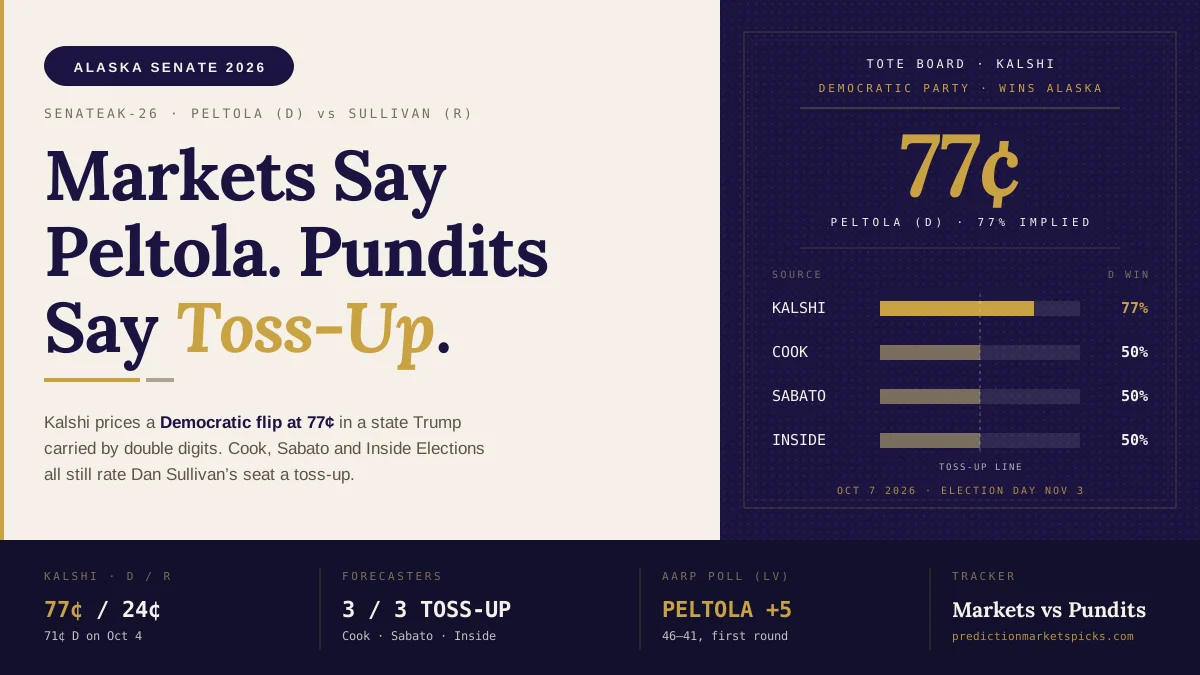
Kalshi has Mary Peltola at 77¢ to take Dan Sullivan's Alaska Senate seat. The Republican side trades at 24¢. Every major forecaster — Cook, Sabato, Inside Elections — still calls it a toss-up.
That is one of the widest markets-versus-pundits gaps on the entire 2026 Senate map, in a state Donald Trump carried by double digits two years ago. We made the case on video on October 4, when the Democratic side was trading at 71¢. Three days later it's six cents higher. Here's the read, and the math on whether there's anything left in it.
▶ Watch on its own page, with the full transcript →
See the Alaska Senate market on Kalshi →
The gap in one table
| Source | Alaska Senate read | As of |
|---|---|---|
| Kalshi (SENATEAK-26) | Peltola (D) 77¢ · Sullivan (R) 24¢ | Oct. 7, 2026 |
| Cook Political Report | Toss-up | Sept. 23, 2026 |
| Inside Elections | Toss-up | Oct. 1, 2026 |
| Sabato's Crystal Ball | Toss-up | June 11, 2026 |
| AARP poll (likely voters) | Peltola 46, Sullivan 41 — first-round ballot | Sept. 8–11, 2026 |
The market isn't thin, either. The race has traded more than 2.5 million contracts with roughly 1.45 million open, and the Democratic side cleared about 40,000 contracts in the last 24 hours alone. That's real money disagreeing with the ratings, not a stray quote. The live board, the forecaster bands and the polls sit side by side on our Alaska Senate 2026 page.
The polls aren't really the problem here — the ratings are
The video's headline is "fade the polls," and the 2024 record backs that instinct. On election eve, Polymarket had Trump at roughly 61% while the polling averages had a coin flip, and both Kalshi and Polymarket had him favored in all seven swing states. Our state-by-state accuracy audit has the full scorecard, including where the markets missed.
But read the Alaska table carefully. The one recent public poll we track actually agrees with the market's direction: Peltola up five on the first-round ballot. The real disagreement is with the ratings, and ratings are sticky. A forecaster looking at a two-term Republican incumbent in a state that went red by double digits in the last presidential race has every structural reason to say "toss-up" and wait. The market doesn't wait. It reprices on every fundraising report, every candidate appearance and every sliver of polling, and right now it's pricing a Democratic flip as the likely outcome.
That's the gap our Markets vs Pundits scoreboard tracks across every race, and Alaska is one of the loudest rows on it.
Why the market likes Peltola
- She's won statewide under this exact system. Peltola won Alaska's at-large House seat in the August 2022 special election and again that November, both under ranked choice. She lost it in 2024 to Nick Begich in a Trump year — but a candidate who has assembled a statewide majority twice isn't a generic Democrat in a red state.
- Ranked choice changes the math. Alaska runs a top-four open primary and a ranked-choice general. A first-choice lead that isn't a majority still gets settled by second choices, and that system has burned favorites before. Raters built on partisan lean tend to underweight it.
- Alaska's partisanship is real, but not uniform. The state has a long independent streak and a big share of voters registered with neither party. A presidential margin doesn't transfer one-for-one to a Senate race with a known, well-liked challenger.
Why it might not be 77¢
- Sullivan is an incumbent who has won this seat twice, in 2014 and 2020, and incumbents rarely get priced this far underwater without a scandal.
- The polling is thin. One public poll is not a polling average, and a first-round number under ranked choice is only half the story.
- One cycle isn't a track record. Markets beat the polls in 2024. Our own audit says the claim worth testing is narrower: when a market and the polling average disagree by more than three points, the market has been the better read — and in Alaska the market and the one recent poll point the same way. Alaska is part of the pre-registered 2026 scorecard, graded on the 11 p.m. ET price on Nov. 2 — we fixed the rule before the result, not after.
The trade math at 77¢
The forecaster-vs-market gap tells you where the disagreement lives. It doesn't make 77¢ cheap on its own. Two ways to frame it:
If you think the market is right — or not aggressive enough. A Democratic contract at 77¢ pays 23¢ if Peltola wins. You need a true probability above roughly 78% once Kalshi's taker fee is in (a penny or so per contract at this price; run your exact size through the Kalshi fee calculator). Say your number is 85%: that's about 7¢ of expected value per contract after the fee. Full Kelly on that edge is (0.85 − 0.77) ÷ (1 − 0.77) ≈ 35% of bankroll; a quarter-Kelly position is about 9%. Plug your own number into the Kelly calculator before you size anything.
If you think the raters are right. Then the value is on the other side. A genuine toss-up priced at 24¢ for Sullivan is a big gap — that's the position a forecaster-truster should be holding. You can't believe "it's a coin flip" and also call the Democratic side at 77¢ a bargain.
Our read leans the market's way, for the reasons above: a proven statewide winner, a ranked-choice system that rewards breadth, and ratings that haven't moved since the summer. But the cheap entry was 71¢ on Saturday. At 77¢, the question is how far above three-in-four you really think she is.
Trade the Alaska Senate market on Kalshi →
Keep tracking it
- Alaska Senate 2026 — live odds, forecaster bands and polls
- Markets vs Pundits: every 2026 race where the price and the ratings disagree
- 2026 Senate map — every seat, closest race first
- 2026 midterms hub — Senate, House and balance of power
- Politics prediction markets — midterms, 2028 and live movers
The 7 Oracles cover politics, sports, entertainment, commodities and the weather markets on The 7 Oracles. The free newsletter gets every race read first, and Pro is $150 a year — $111 your first year.