

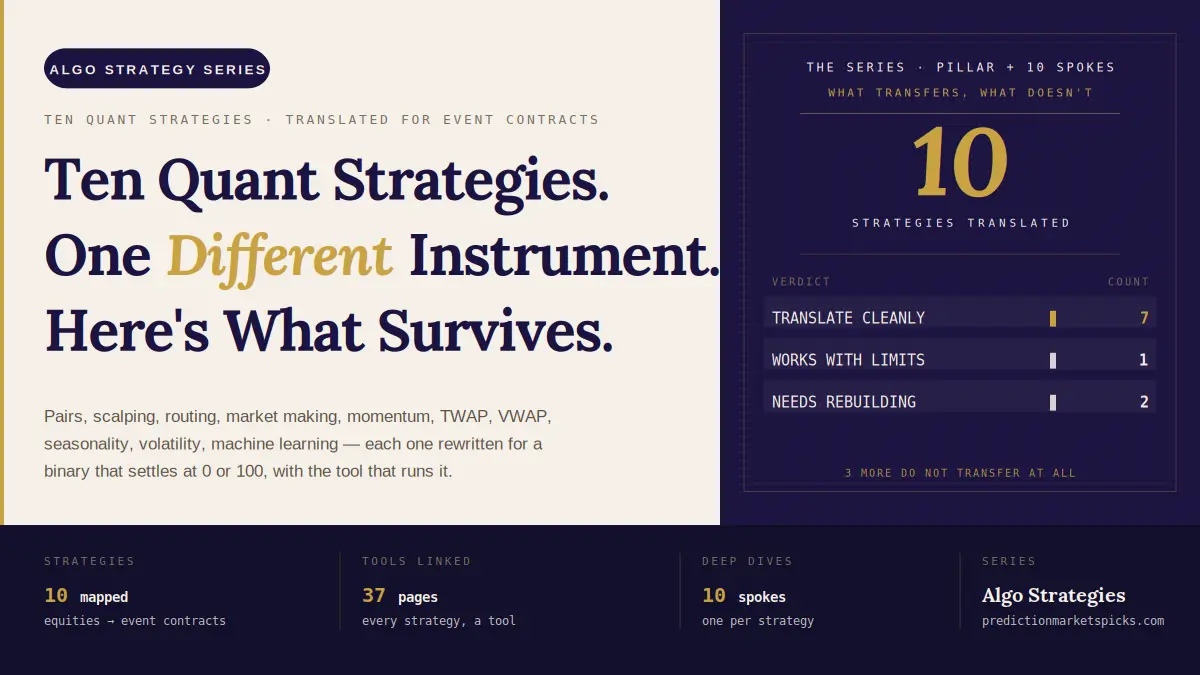

Quant desks have spent forty years formalizing how to trade equities systematically. Prediction markets are eight years old in any serious retail form. So the fastest way to get good at event contracts is not to invent a new discipline — it is to take the strategies that already work, understand exactly where the instrument breaks them, and rebuild from there.
An event contract is not a share of stock. Three differences matter, and they matter every single time:
- The payoff is capped. A contract settles at 100 or at 0. There is no ten-bagger and no unlimited downside. Every strategy that assumes a fat right tail has to be re-derived.
- The clock is hard. Every contract has an expiration, and the probability is dragged toward 0 or 100 as it approaches. Time is not neutral the way it is in a stock — it is a force acting on your position.
- The book is thin. Outside the flagship series, you are often the second- or third-largest resting order. Execution quality is not a rounding error here; it is frequently the entire edge.
Hold those three in your head and the ten canonical algorithmic strategies translate cleanly. Here is each one, what it becomes in event contracts, and the tool that runs it.
The four primitives every strategy sits on
Before any of the ten, four calculations underpin all of them. If you skip these, the strategy above them is decoration.
- Probability Converter — a contract price is a probability. Reading 63¢ as "63% implied, before fees" is the first translation you make, every time.
- EV Calculator — is this trade positive expectancy at this price, or only at a better one? Deep dive: expected value in prediction markets.
- Kelly Criterion Calculator — how much, given your edge and your bankroll. Capped payoffs make oversizing fatal in a way that is easy to miss. Deep dive: the Kelly criterion for prediction markets.
- Bayes Updater — how much your probability should move when new information lands. Most losses in event contracts are not bad theses; they are correct theses updated at the wrong speed. Deep dive: Bayesian mispricing, explained simply.
The full set lives on the tools hub, and the tools guide explains what each one is for in plain English. If contract pricing itself is still new, start with how prediction markets work.
1 · Pairs trading
> Full breakdown: Pairs trading
In equities: go long one asset and short a correlated one, profiting when the historical relationship reverts.
In event contracts: you have two versions of this, and the second is where the money is.
The obvious version is the same contract on two venues. Kalshi and Polymarket frequently price identical questions differently, and that gap is a genuine relative-value trade rather than a directional view. The Arb Scanner surfaces those cross-venue gaps and, importantly, tells you what the gap is actually worth after costs — the full mechanics are in cross-platform arbitrage in prediction markets.
The valuable version is two economically linked but separately worded contracts. A Fed decision market and a recession-threshold market are priced by different crowds using different information, but they cannot both be right about the same economy. The Combo Edge Builder prices correlation between legs — which is the same math as a pairs trade, just expressed as a combination — and the KL Divergence tool measures how far two probability distributions have separated, which is the formal version of "these two should agree and they don't."
Honest caveat: correlation between contracts is not stable. Two markets can be linked for six weeks and decoupled by a single headline. Size like the relationship might break, because periodically it does.
2 · Scalping
> Full breakdown: Scalping
In equities: many small trades capturing tiny price differences.
In event contracts: this only works where markets reset fast enough to give you repetition — which in practice means the 15-minute crypto and metals series. Bitcoin Edge 15-Min, Gold Edge 15-Min and Silver Edge 15-Min publish live fair value against those short-cycle contracts.
Honest caveat, and it is the whole story: a strategy capturing one or two cents per contract is a fee strategy wearing a trading costume. Run the Kalshi Fee Calculator before you decide an edge exists, not after. Our 15-minute tools display the true cost of trading next to the fair value for exactly this reason — a two-cent theoretical edge against a two-cent round trip is not an edge, it is activity.
3 · Smart order routing
> Full breakdown: Smart order routing
In equities: break a large order up and route the pieces to whichever venue shows the best price.
In event contracts: the same discipline, with a twist an equity trader never deals with — venue availability varies by where you live. The same question may be live on Kalshi, Polymarket, Robinhood and the prediction offerings inside the big DFS apps, at four different prices.
The Arb Scanner is the price leg. The State Availability Map is the access leg — best price is meaningless if the venue does not serve your state. And our venue comparisons cover fee structures, settlement rules and liquidity side by side, because the quoted best price and the net best price are frequently not the same venue.
Honest caveat: routing across venues means capital sitting in multiple places. That is real opportunity cost, and it is the reason a two-cent cross-venue gap is usually not worth chasing with a small account.
4 · Market making
> Full breakdown: Market making
In equities: quote both sides, earn the spread, manage inventory.
In event contracts: entirely viable, and arguably the most underrated approach available to a retail trader, because thin books mean wide spreads. But it demands two things before you place a single quote.
First, a fair value you actually trust. Our Edge models publish a derived model probability for the commodity and crypto series — Silver Edge, Gold Edge, Oil Edge, Bitcoin Edge — built from options-implied probability compared against the contract's own price. Second, the Mispricing Scanner to tell you where the book has drifted far enough from the model to be worth quoting into (how the scanner works).
Honest caveat: adverse selection is brutal in event markets. The trader lifting your offer often knows something specific — an injury, a filing, a forecast update — and you are the last to know. A maker without a live fair value is not earning a spread; they are writing free options to better-informed people. That is the single most expensive lesson in this entire article.
5 · Momentum
> Full breakdown: Momentum
In equities: ride the continuation of an existing trend.
In event contracts: probabilities trend, but they trend toward a boundary. Momentum in a market moving from 40 to 60 is a different animal from one moving from 88 to 94 — the second has almost no room left and enormous asymmetry against you. Signals · Movers shows what has actually repriced — and the Polymarket whale playbooks show what large flow looks like when it is informed rather than loud — and in sports the NFL Power Ratings capture team-level momentum in a form you can price rather than eyeball.
Honest caveat: the reason momentum needs a partner here is that in prediction markets, "the price is running" and "the crowd is overreacting to a headline" look identical in real time. Pair every momentum read with the Base Rate Finder before acting on it.
6 · TWAP — time-weighted average price
> Full breakdown: TWAP — time-weighted average price
In equities: split an order evenly across a time window to get a price near the period's average.
In event contracts: this is the most underrated technique on this list, and it costs nothing to adopt. Books are thin. Taking a full position in one click routinely moves the market two to four cents against you — which, on a contract with a five-cent edge, hands most of your thesis to whoever was resting on the other side.
Scale in. Work a resting order across hours instead of lifting the offer once. Use the Kelly Criterion Calculator to fix your target size first, then the Kalshi Fee Calculator to check how many fills that size can absorb before fees eat the improvement.
Honest caveat: patience has a price too. The Theta Edge Calculator tells you whether time decay is working for or against your position — a slow scale-in on a contract that is bleeding toward expiry is not discipline, it is a leak.
7 · VWAP — volume-weighted average price
> Full breakdown: VWAP — volume-weighted average price
In equities: execute in proportion to the day's volume profile.
In event contracts: the intent survives; the shape does not. There is no U-shaped daily volume curve here. Volume in event contracts clusters around catalysts — a scheduled data release, a Fed decision, a filing deadline, kickoff — and is close to dormant between them.
So the working translation is: trade with the catalyst calendar. Macro Pulse is the calendar layer (see trading macro in prediction markets), the Fed Rate Tracker covers the highest-volume recurring event window on the board, and Signals · Positioning shows where the open interest has actually accumulated.
Honest caveat: liquidity around a catalyst is real but it is also the moment the informed flow shows up. Better fills and worse counterparties arrive in the same instant.
8 · Seasonality
> Full breakdown: Seasonality
In equities: exploit recurring calendar patterns.
In event contracts: this is the cleanest translation of the ten, because seasonality in prediction markets has a proper name — it is a base rate. "What normally happens in this situation, at this time of year?" is the single most reliable source of retail edge on the board, and it is systematically underused because it is unglamorous.
Weather contracts are literally seasonal (Weather Markets). Fuel prices follow an annual cycle (Oracle Gas). Inflation prints carry documented seasonal adjustment factors that move the headline number in predictable directions (Inflation Tracker). And the Base Rate Finder is the general-purpose version: what does history actually say about this class of event?
Honest caveat: a base rate is a prior, not a forecast. It is the number you start from and then update with the Bayes Updater — not the number you trade blind.
9 · Volatility trading
> Full breakdown: Volatility trading
In equities: profit from changes in volatility using options and derivatives.
In event contracts: here is the thing most newcomers miss — a prediction market contract is already a volatility instrument. A binary priced at 50 is a market saying the outcome is maximally uncertain. When realized volatility in the underlying rises, the probability distribution widens and every threshold contract reprices, whether or not the spot price moved at all.
That relationship is exactly what our Edge models exploit: Silver Edge, Gold Edge, Oil Edge and Bitcoin Edge each derive an options-implied probability for the underlying and compare it against what the contract is charging. When those two disagree, you have a volatility trade expressed as an event contract. The S&P 500 Year-End Forecast applies the same logic to the index, and Conflict Hedge covers the geopolitical-volatility corner of the board.
Honest caveat: volatility trades near expiry are the most dangerous positions in event contracts, because gamma and time decay both accelerate at once. Check the Theta Edge Calculator before holding one into the final days, and read what an options trader sees in theta edge.
10 · Machine learning models
> Full breakdown: Machine learning models
In equities: train models on large datasets to find patterns humans miss.
In event contracts: this is where a retail trader can genuinely out-resource a market, because the datasets are smaller, more public, and far less picked over than equity data. Sports is the clearest example — our NFL work runs a power-rating model and a win-probability model against the board (NFL Power Ratings, NFL Win Probability), and Thee Oracle is the cross-category model layer. The rating tiers themselves are broken down in NFL power rating tiers, explained.
Honest caveat, and it is the one that separates a model from a story: a model without a graded record is a narrative. Ours is published at Track Record, with the methodology next to it. Ask that question of any model you are handed, including ours.
The full series
Each strategy has its own deep dive. Read the pillar for the map, the spokes for the mechanics.
| # | Strategy | Deep dive |
|---|---|---|
| 1 | Pairs trading | Two contracts that should agree, and don't |
| 2 | Scalping | Why the 15-minute series is the only place it works |
| 3 | Smart order routing | Best price is useless if you can't trade there |
| 4 | Market making | The most underrated retail strategy, and the fastest way to lose |
| 5 | Momentum | Why 88 to 94 is nothing like 40 to 60 |
| 6 | TWAP | The free upgrade nobody uses |
| 7 | VWAP | There's no trading day, there's only the catalyst |
| 8 | Seasonality | Seasonality is just a base rate |
| 9 | Volatility | A contract at 50 is a volatility position |
| 10 | Machine learning | Where retail can actually out-resource the market |
What does not transfer
Three things break, and it is worth saying so plainly:
- Unlimited-upside trend following. A contract cannot go past 100. The entire "let winners run" architecture of trend following has no room to operate.
- High-frequency anything. Retail does not have colocation, and event-contract books are too thin to reward speed at the tick level. Every strategy above is measured in hours and days, not microseconds.
- Naive statistical arbitrage. Two contracts that look statistically linked over a short history usually are not linked economically. In markets this thin, correlation-mining finds noise at an alarming rate. Insist on a mechanism you can state in one sentence before you trade a relationship.
Running these systematically
Everything above is manual by default, which puts a ceiling on it. The lever is our MCP server: the same models these tools sit on are exposed over Model Context Protocol, so Claude, ChatGPT in developer mode, Grok, or your own code can call them directly — probability conversion, expected value, Kelly sizing, Bayesian updates, mispricing scans, cross-venue gaps, and the NFL edge models. One URL, no key for the free tier.
That is not an execution algorithm. It is the analytics layer an execution algorithm needs, and it is the closest thing a retail prediction-market trader has to a systematic process today.
Where to start
If you are working through this list for the first time, the honest ranking by edge-per-hour is not the order above. Start with seasonality — base rates are the highest-yield, lowest-effort discipline on the board. Then TWAP execution, because better fills improve every trade you will ever make and cost nothing to learn. Then pairs and cross-venue routing, which is mechanical once you can read a fee schedule. Market making and volatility work come after you have a fair value you trust.
Start on the tools hub. If you want the mental model underneath all ten of these, reading Kalshi like a bond desk is the piece that ties them together.
Trade responsibly, and size like you might be wrong.