

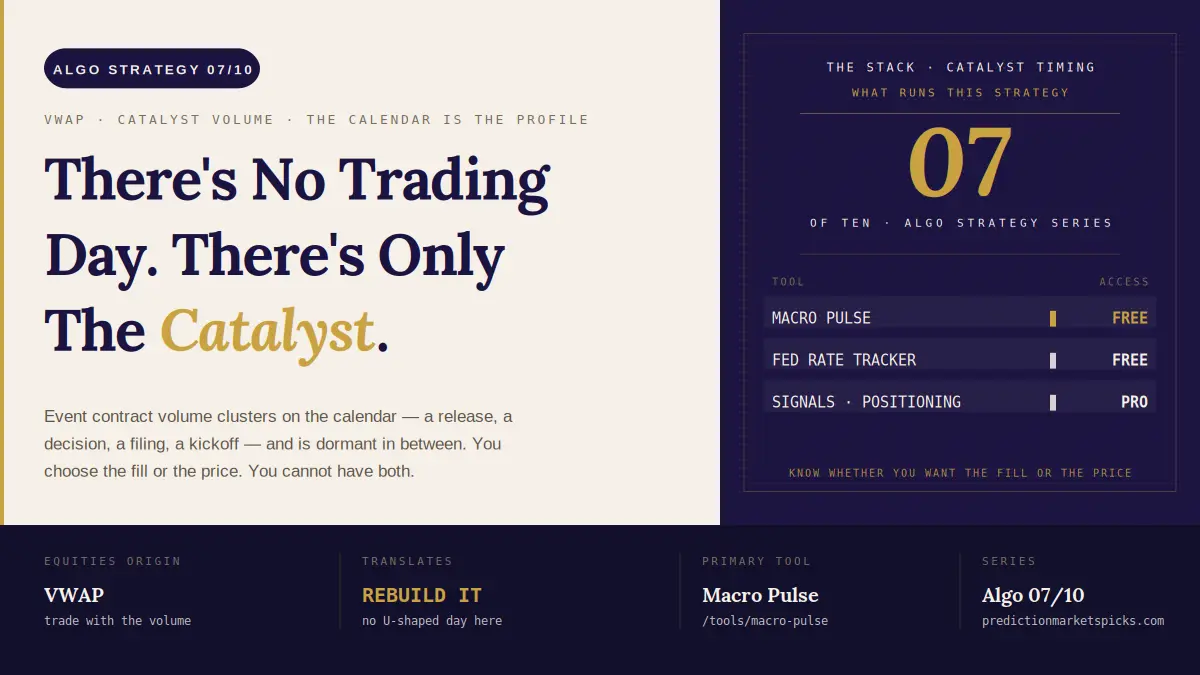

Short version: there is no U-shaped trading day in event contracts. Volume arrives on the calendar — a release, a decision, a filing, a kickoff — and mostly disappears in between. So VWAP does not translate as "trade in proportion to the day." It translates as "trade with the catalyst."
This is strategy seven of ten in Algorithmic Trading Strategies, Translated for Prediction Markets.
The equities version
VWAP divides an order into smaller trades executed through the day in proportion to volume, so your average price tracks the volume-weighted average rather than the simple time average. It works because equity volume has a reliable intraday shape — heavy at the open, light in the middle, heavy into the close — that repeats well enough to plan around.
What replaces it
Event contracts have no such shape. What they have is a calendar.
A contract on an inflation print does most of its trading in the hours around the print. A rate-decision contract does most of its trading around the decision and the guidance that follows. A game contract does most of its trading in the hours before kickoff. Between those moments, the book can be nearly empty for days.
That is not a defect. It is the instrument telling you when it is liquid, in advance, in public. Equity traders would love to know the volume profile a week ahead; here you do.
The strategic consequence
You get to choose between two things, and you cannot have both.
Trade into the catalyst for the fill. That is when there is depth to absorb size without moving the price. If your position is large relative to the book, this is where you go.
Trade before the catalyst for the price. Because the liquidity that shows up at the catalyst is disproportionately informed liquidity. Better fills and worse counterparties arrive in the same instant — that is the trade-off in one sentence.
Deciding which one your thesis needs is the whole strategy. A view that depends on being early goes on early, at a worse fill, accepting the slippage. A view that just needs to be on goes on in the liquidity.
The tools
- Macro Pulse — the calendar layer. What is scheduled, and therefore where the volume will be.
- Fed Rate Tracker — the highest-volume recurring event window on the board, tracked through the whole cycle rather than just on decision day.
- Signals · Positioning — where open interest has actually accumulated, which is a better read on conviction than volume is.
- Signals · Movers — what repriced, so you can see whether a catalyst has already been absorbed.
- Inflation Tracker and Recession Tracker — the two macro series whose release calendars drive the most contract volume outside rate decisions. Trading macro in prediction markets is the wider framework.
How to actually run it
- Build the calendar before the position. Know every scheduled event between now and settlement. Surprises are unavoidable; scheduled events are not surprises.
- Decide fill-first or price-first, explicitly. Write it down. Most bad entries come from wanting both and getting neither.
- Scale across the liquidity window, not the clock. This is where TWAP discipline and VWAP thinking meet: split the order, but weight the clips toward the hours that actually have depth.
- Watch open interest, not just volume. Volume with flat open interest is churn. Rising open interest into a catalyst is people taking a view.
- Budget fees for the extra clips. More fills means more fee events — the Kalshi Fee Calculator tells you where the improvement stops paying for itself.
Where it goes wrong
Trading the dead zone. Between catalysts, the spread widens and the depth vanishes, and it is very easy to convince yourself that a wide quiet market is an opportunity because nobody is watching. Frequently nobody is watching because there is nothing to watch, and your fill will reflect that.
The other failure is arriving at the catalyst with no plan and trading the reaction. Post-release volume is the most informed flow that market will ever see. Reacting inside it, without a pre-formed view, is the definition of being the liquidity rather than using it.
Next
The calendar's evergreen cousin is seasonality and base rates — recurring patterns you can position for weeks ahead rather than hours. For the execution mechanics, TWAP in thin books. For the other side of the trade, market making on Kalshi.
Trade responsibly, and know whether you want the fill or the price.