

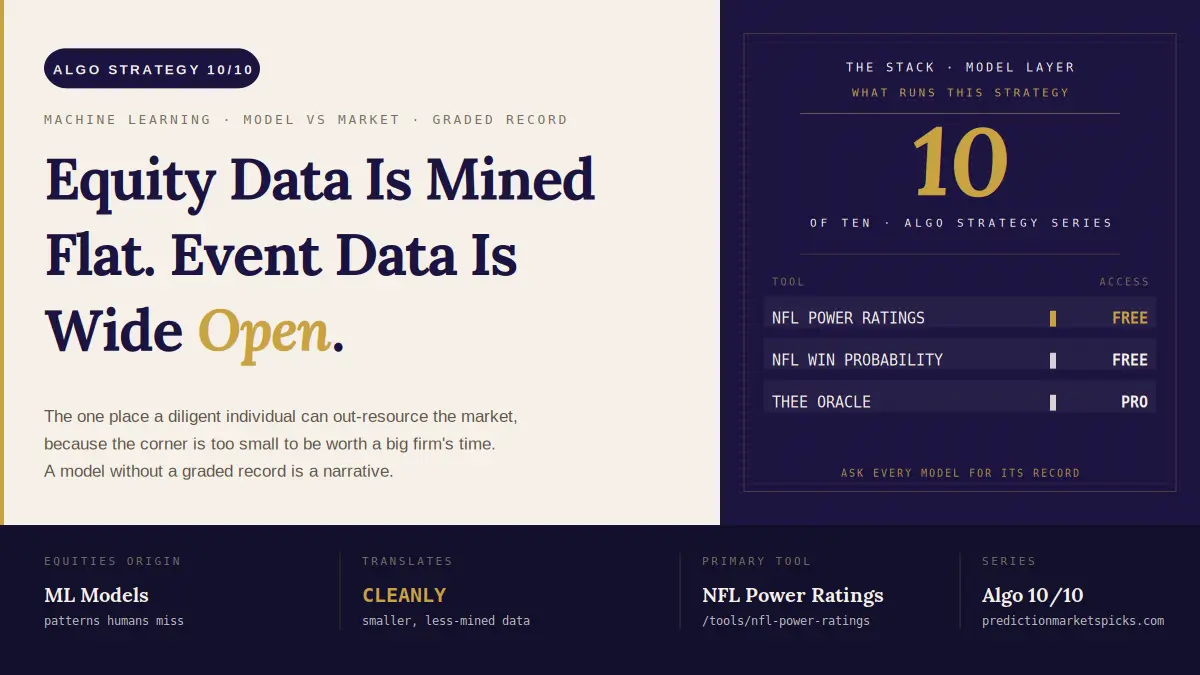

Short version: machine learning transfers to prediction markets better than most people expect, for one structural reason — the datasets are smaller, more public and far less picked over than equity data. That asymmetry favours a diligent individual. What separates a model from a story is a graded record published before the outcomes were known.
This is strategy ten of ten in Algorithmic Trading Strategies, Translated for Prediction Markets.
The equities version
Machine learning in equities means training models — neural networks, random forests, gradient boosting, support vector machines — on large datasets to find patterns humans miss. It is also the most competitive corner of finance on earth. You are up against firms with proprietary data, dedicated research staff and infrastructure budgets larger than most companies' revenue.
The structural argument for doing this here instead
The datasets behind event contracts are, by comparison, wide open.
Sports statistics are public and deep. Weather records are public and deep. Economic releases are public, methodologically documented, and revised in ways that are themselves documented. Election and polling history is public. None of this is a hidden dataset, and that is exactly the point — the constraint in prediction markets is not access to data, it is the effort of assembling and modelling it properly.
That flips the usual asymmetry. In equities, resources win. Here, diligence competes. A retail trader who builds one genuinely good model for one corner of the board can hold an edge that no amount of capital will trivially compete away, because the corner is too small to be worth a large firm's time.
What we run
Our own model layer is the concrete example:
- NFL Power Ratings — team strength as a rating you can price against a market. The tier structure is broken down in NFL power rating tiers, explained, and we simulated the season ten thousand times to show what the ratings imply.
- NFL Win Probability — the game-level model.
- Thee Oracle — the cross-category model layer.
And the part that matters most: Track Record, with the methodology sitting next to it.
A model without a graded record is a narrative
This is the section worth arguing about, so let me be direct.
Any model can be described persuasively after the fact. Backtests are trivially overfittable, especially on small datasets, and small datasets are exactly what this domain offers. A model's description tells you nothing about whether it works. The only evidence that counts is a set of calls timestamped before the outcomes, scored honestly afterwards, losses included.
Ask that question of every model you are handed. Ask it of ours — that is why the record is published, and why the methodology is published beside it rather than summarised in a sentence.
How to actually run it
- Start simpler than you think you need to. A well-constructed base rate plus Bayesian updating beats most retail machine-learning attempts, because it cannot silently fit noise. Seasonality and base rates is the foundation, not the beginner's version.
- Pick one corner and go deep. One league, one commodity, one macro series. A model that is genuinely good at one thing beats a model that is mediocre at nine.
- Hold out data you never look at. Then look once. Every additional peek is a fitting decision you are making without admitting it.
- Check calibration, not accuracy. A model that says 70% should be right about seventy percent of the time. Accuracy alone can look excellent while the probabilities are unusable for sizing.
- Publish or at least log your calls before the event. Not for anyone else — for you. A private timestamped log is the only defence against remembering your model as better than it was.
- Size on a conservative edge estimate. Feed Kelly the pessimistic version of your edge. Model error is a real and usually underestimated input.
Where it goes wrong
Overfitting on a small sample. The datasets here are public and deep in some dimensions and thin in others. A model with forty parameters trained on two hundred observations has memorised the observations.
Regime change. Rule changes, roster turnover, policy shifts and methodology revisions all break models trained on the prior regime, silently. The model keeps producing confident numbers with no signal that its world changed.
Confusing model output with edge. A model probability that disagrees with the market is a hypothesis. Whether it is an edge depends on whether the model is calibrated for situations like this one — and that is a question about your holdout data, not your conviction.
Running it programmatically
If you want to build on our model layer rather than beside it, the MCP server exposes it over Model Context Protocol — probability conversion, expected value, Kelly sizing, Bayesian updating, mispricing scans, cross-venue gaps and the NFL edge models — to Claude, ChatGPT in developer mode, Grok, or your own code. One URL, no key for the free tier.
Next
The discipline that keeps a model honest is seasonality and base rates; the failure mode it protects you from is chasing momentum. All ten strategies: the pillar.
Trade responsibly, and ask every model for its record.