

Skip to content
FED DESK

Kalshi vs Polymarket vs futures on the next FOMC decision

Fed Rate Tracker · live

15-MINUTE

Every Kalshi 15-minute window, priced against the late-flip risk

Bitcoin · gold · silver · oil

MIDTERMS

Every 2026 race priced on Kalshi and Polymarket

Senate · House · governors

COMBO EDGE

Correlation-aware Kalshi combos — free

SILVER EDGE

Options vs. Kalshi on weekly silver brackets

Seasonality Is Just a Base Rate — The Highest-Yield, Least Glamorous Edge on the Board

Calendar patterns are the cleanest translation from quant equities to event contracts, because seasonality in prediction markets already has a proper name: the base rate. It's also the most systematically underused edge in retail trading.

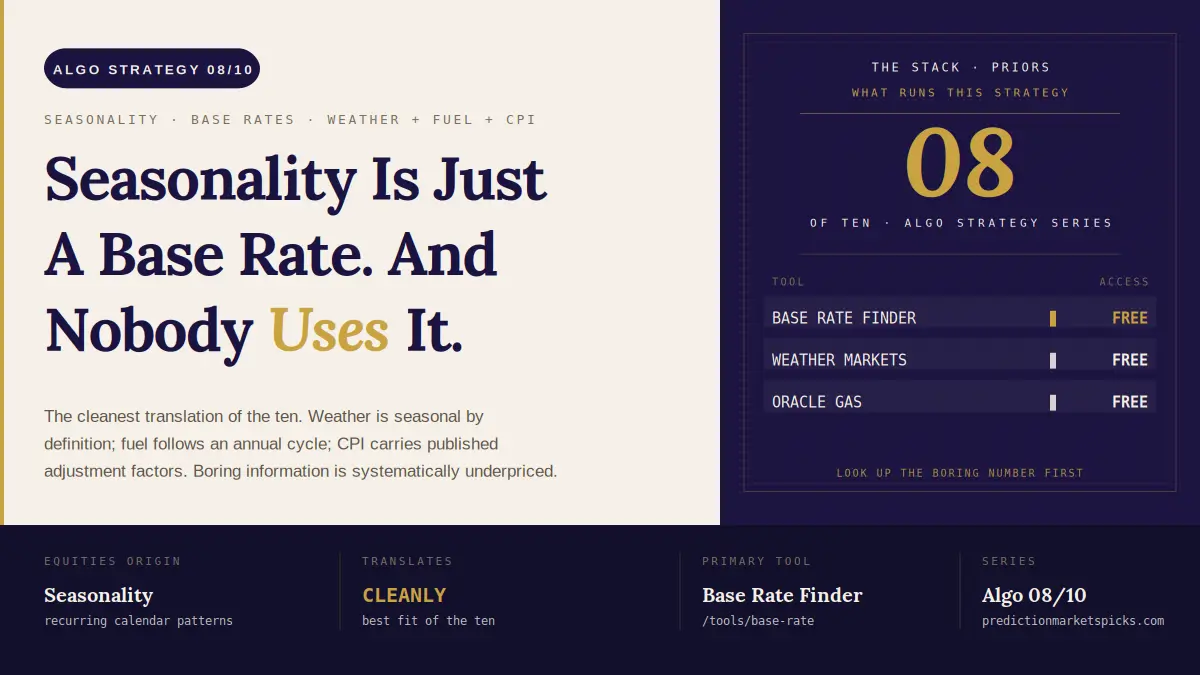
Seasonality as a base rate — recurring calendar patterns in event contracts, parchment and indigo base-rate card
FSWA Award Winner · Published Author · Ran 4Deep Sports · Led FTN Marketing · Traded Bonds on Wall Street
September 30, 2026

Short version: seasonality in prediction markets already has a name — the base rate. It is the cleanest translation of any strategy in this series, the highest-yield discipline available to a retail trader, and the one most consistently skipped because it is boring.

This is strategy eight of ten in Algorithmic Trading Strategies, Translated for Prediction Markets. If you are working through the list for the first time, start here.

The equities version

Seasonality identifies recurring market patterns tied to time — month, quarter, day of week, the calendar-spread trade in futures where you take opposing positions in contracts with different expirations to harvest a seasonal shape. In equities these patterns are heavily mined, often statistically fragile, and frequently arbitraged flat.

Why it translates better here than anywhere else

Event contracts settle on real-world outcomes, and many real-world outcomes are genuinely calendar-driven for physical or institutional reasons rather than statistical ones.

Weather is seasonal by definition, not by coincidence. Fuel demand follows an annual driving-and-refining cycle. Economic statistics carry published seasonal adjustment factors that systematically push a headline number in a known direction at known times of year. None of that is pattern-mining. It is a documented cycle you can look up.

That is the crucial difference from equity seasonality, where a "January effect" is a statistical artifact until proven otherwise. Here, the mechanism comes first and the pattern follows from it — which is exactly the test that pairs trading also demands, and for the same reason.

The tools

Why the market leaves this on the table

Prediction market crowds are attention-driven. Narrative moves prices, and thin books mean a modest amount of narrative-driven flow can push a contract well away from what history supports.

The base rate is not secret information. Anyone can look it up. It is simply boring, and markets built on attention systematically underweight boring information. That gap is not going to be arbitraged away by better technology, because the cause is behavioural, not informational.

That is about as durable a source of retail edge as exists on this board.

How to actually run it

  1. Get the base rate before you read anything about this instance. Order matters enormously. Reading the news first anchors you, and then you will find a base rate that agrees with the anchor.
  2. Check whether the mechanism is physical, institutional or statistical. Physical (weather) and institutional (published adjustment factors) are durable. Purely statistical patterns in price history are the fragile kind — treat them like naive stat-arb and demand a mechanism.
  3. Convert the base rate to a probability and compare it to the contract. Use the Probability Converter so you are comparing like for like.
  4. Update, don't replace. Apply Bayes to move off the prior by the amount the new information justifies — no more. Bayesian mispricing, explained simply is the walkthrough.
  5. Position early. Seasonal edges are visible weeks ahead, which means you do not have to compete for liquidity at the catalyst. This is the one strategy on the list where you can be both early and well-filled.

Where it goes wrong

Sample size. "This has happened four of the last five Septembers" is not a base rate; it is an anecdote with a percentage attached. Ask how many observations are behind the number before you trade it.

Regime change. A cycle driven by a policy, a technology or an institutional rule stops when the policy, technology or rule does. Seasonal patterns in energy, in particular, have been rewritten more than once by structural change in supply. The mechanism test is also the regime test: if you can state the mechanism, you can check whether it still holds.

Trading the prior blind. The base rate is the starting point. Ignoring genuinely new information because "history says" is the mirror-image error of chasing headlines, and it loses money just as reliably.

Next

The opposite failure mode — following the crowd instead of the history — is covered in momentum trading in prediction markets, and the two pieces are best read as a pair. For catalyst timing, VWAP for event contracts. Full map: the pillar.

Trade responsibly, and look up the boring number first.

Seasonality Is Just a Base Rate — The Highest-Yield, Least Glamorous Edge on the Board — frequently asked

What is a base rate in prediction market trading?

The historical frequency of an outcome in the class of situation you are looking at — what normally happens, before you know anything specific about this instance. It is the number you start from and then update. Seasonality is simply a base rate conditioned on the calendar, which is why the two ideas are the same tool wearing different names.

Why is seasonality the cleanest strategy to translate?

Because event contracts are settled on real-world outcomes with long recorded histories, and many of those outcomes are genuinely calendar-driven. Weather is seasonal by definition. Fuel prices follow an annual demand cycle. Economic releases carry published seasonal adjustment factors. You are not mining a pattern out of price data — you are using a documented physical or institutional cycle.

Isn't the base rate already in the price?

Often less than you'd expect. Prediction market crowds are heavily influenced by recent news and narrative, and thin books mean a handful of participants can move a contract well away from what history supports. The base rate is not a secret; it is just unglamorous, and unglamorous information is systematically underweighted by markets driven by attention.

How do I use a base rate without trading it blindly?

Treat it as a prior, never as a forecast. Start from the historical frequency, then update it with what is specific and verifiable about this instance using Bayes' rule. A base rate traded blind ignores real information; a narrative traded without a base rate ignores everything that came before. The discipline is in doing both, in that order.

Read Next

The 10 Algorithmic Trading Strategies, Translated for Prediction Markets
Pairs trading, scalping, market making, VWAP, seasonality, volatility, machine learning — the ten strategies quant desks run on equities, rewritten for Kalshi and Polymarket event contracts, with the tool that runs each one.
Article
Bayesian Mispricing: The Spec in Plain English
How the Polymarket Mispricing Scanner uses two AI agents, a Bayesian swarm, and Kelly sizing — explained without the math jargon.
Article
August Jobs Report: Real Strength or Seasonal Mirage? Prediction Markets Have the September Fed Hike at 50-50
The August jobs report tripled the forecast at 162,000. Two categories delivered almost two-thirds of it, and in the raw, unadjusted count restaurants and bars hired no one. Here is both sides of the argument with the numbers, what Kalshi, Polymarket and fed funds futures are pricing for the Sept. 16 Fed decision, and what the crowd expects the next print to say.
Article
Momentum Trading in Prediction Markets — Why 88 to 94 Is Nothing Like 40 to 60
Probabilities trend, but they trend toward a boundary. A contract running from 40 to 60 and one running from 88 to 94 look identical on a chart and are completely different trades. Here's the distinction.
Article
VWAP for Event Contracts — There's No Trading Day, There's Only the Catalyst
Equity volume follows a U-shaped day. Prediction market volume follows the calendar — a data release, a decision, a filing, a kickoff — and is close to dormant in between. Here's how to translate VWAP into that world.
Article
Base Rate Scanner
Historical base rates vs. market
Tool
Weather Edge
NWS forecast vs. Kalshi temps
Tool
Oracle Gas Edge
Gas price forecast, scored daily
Tool

Go Pro · 26% off your first year

You just read the setup. Pro is the live number — $150/yr

Pro turns the read into a position: Fed-day and election-night alerts, the full Kalshi-vs-Polymarket price-gap board, the commodity and 15-minute strike grids, Thee Oracle, and the NFL edge module — every gap the moment it opens.

Go Pro →

$111 for the first year, then $150/yr. Code applies automatically. Ends Dec 31. Monthly is $14.99/mo.

Every signal graded in public, losers left on the board. See the record →

Prediction-market edges, weekly. The only newsletter built for Kalshi & Polymarket traders.

No spam. Unsubscribe anytime.

Watch The 7 Oracles make the call. Full breakdowns on YouTube, quick hits on X.

Benny Ricciardi

Founder · The 7 Oracles

Benny Ricciardi is an FSWA Award Winner and published author. He ran 4Deep Sports as CEO, led marketing at FTN Network as CMO, and traded bonds on Wall Street. He founded PredictionMarketsPicks.

Follow @BennyR11 →
seasonality prediction marketsbase rate tradingKalshi weather markets strategyseasonal adjustment inflation contractsgas price seasonality prediction markethistorical base rate event contractscalendar patterns Kalshiprior probability trading

Want more analysis like this?

Get The 7 Oracles' daily prediction market breakdown — free, no fluff, straight to your inbox.

Get the daily edge in your inbox →