

Skip to content
FED DESK

Kalshi vs Polymarket vs futures on the next FOMC decision

Fed Rate Tracker · live

15-MINUTE

Every Kalshi 15-minute window, priced against the late-flip risk

Bitcoin · gold · silver · oil

MIDTERMS

Every 2026 race priced on Kalshi and Polymarket

Senate · House · governors

COMBO EDGE

Correlation-aware Kalshi combos — free

SILVER EDGE

Options vs. Kalshi on weekly silver brackets

Market Making on Kalshi — The Most Underrated Retail Strategy, and the Fastest Way to Lose

Thin books mean wide spreads, and wide spreads mean a retail trader can genuinely quote both sides. But a maker without a live fair value isn't earning a spread — they're writing free options to better-informed people.

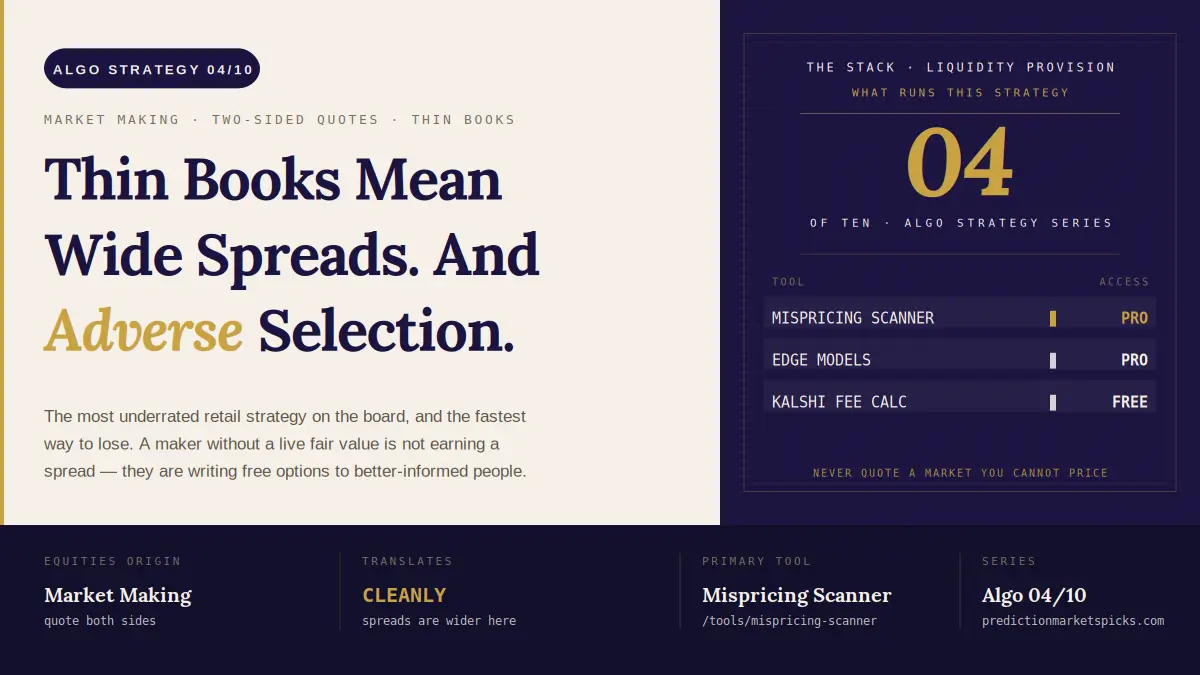
Market making on Kalshi — model fair value against a wide book, parchment and indigo two-sided quote card
FSWA Award Winner · Published Author · Ran 4Deep Sports · Led FTN Marketing · Traded Bonds on Wall Street
September 18, 2026

Short version: market making on prediction markets is genuinely available to retail, because thin books mean wide spreads. It is also the fastest way to lose money if you quote without a fair value, because every fill you get is disproportionately likely to be the one you didn't want.

This is strategy four of ten in Algorithmic Trading Strategies, Translated for Prediction Markets, and it is the one where the gap between "sounds sophisticated" and "is profitable" is widest.

The equities version

A market maker quotes both sides of an instrument, earns the bid-ask spread when both sides fill, and manages the inventory that accumulates when they don't. Their edge is not a view on direction. It is being paid for providing immediacy to people who want it now.

Why it transfers unusually well

Two structural features of event contracts favour a patient retail maker.

The spreads are wide. Outside the flagship series, you are frequently one of a handful of resting orders. A spread that would be unthinkable on a liquid equity is normal here, and that spread is the raw material.

The instrument is bounded. Your worst case on any single contract is knowable before you quote. There is no gap-down-eighty-percent scenario. That makes position sizing arithmetic rather than guesswork — run it through Kelly and cap it per market.

The two things you need before you quote

One: a fair value you trust. This is not optional and it is not negotiable. Our Edge models publish a derived model probability for the commodity and crypto series — Silver Edge, Gold Edge, Oil Edge, Bitcoin Edge — each built by comparing an options-implied probability for the underlying against the contract's own price. Where you have that, you have something to quote around. Where you don't, you need to build a fair value from base rates and maintain it, or stay out of that market.

Two: your true cost. The Kalshi Fee Calculator tells you what a round trip costs. A maker quoting a three-cent spread with a two-cent round-trip cost is working very hard for one cent, and one cent does not survive a single adverse fill.

Then point all of this at the markets that have drifted far enough from a fair value you trust to be worth quoting into. Our Mispricing Scanner did that triage automatically and is paused while it is rebuilt for the 2026 midterms; the method is in how the mispricing scanner worked, and the Ladder Arb Scanner flags Kalshi spread and total ladders with books wide enough to make a market in.

Adverse selection is the whole game

Here is the lesson that costs the most to learn firsthand.

Your resting order does not fill randomly. It fills when someone wants to trade against it, and disproportionately often that someone knows something you don't — a starter is out, a filing dropped, a forecast was revised. They see it, they hit your stale quote, and you are now long the wrong side of a market that has already moved.

In equities this is diluted by enormous continuous flow, much of it uninformed. In event contracts the information is discrete and lumpy, so the ratio of informed to uninformed flow hitting a stale quote is far worse. A maker without a live fair value is not earning a spread. They are writing free options to better-informed people. That sentence is the entire risk of this strategy.

How to actually run it

  1. Pick markets where you have a model, not markets that look wide. Width without a fair value is a trap, not an opportunity.
  2. Quote inside the spread, not at the touch. You want fills from people paying for immediacy, not from people picking you off.
  3. Cap inventory per market before you start. Write the number down. Binary resolution concentrates a one-sided position into a single outcome.
  4. Pull quotes around known catalysts. Scheduled releases, injury reports, filings, kickoff. This is when informed flow arrives and your stale quote is worth the most to somebody else.
  5. Widen as expiry approaches. Time sensitivity accelerates near settlement — check the Theta Edge Calculator for the shape of it.
  6. Track fill quality, not fill count. The metric that matters is what the market did in the ten minutes after each fill. If it consistently moved against you, your quotes are stale and no amount of volume fixes that.

Where it goes wrong

Quoting around the market's own mid. If your fair value is derived from the price you are quoting against, you are not making a market — you are amplifying the consensus and paying fees for the privilege. When the consensus is wrong you will be maximally long the wrong side, with no independent signal to tell you.

Next

If you want the short-cycle version of this, read scalping the 15-minute series. If the fair-value question is what interests you, read volatility trading with binary event contracts — that is where the Edge models come from. And TWAP execution is the taker-side discipline that makes every other strategy cheaper.

Trade responsibly, and never quote a market you cannot price.

Market Making on Kalshi — The Most Underrated Retail Strategy, and the Fastest Way to Lose — frequently asked

Can a retail trader market-make on Kalshi?

Yes, in the sense that you can post resting orders on both sides of a market and earn the spread when both fill. Thin books outside the flagship series mean those spreads are often wide enough to be worth quoting. What you cannot do is skip the prerequisite: a fair value you trust and a fee number you have actually calculated.

What is adverse selection and why does it matter more here?

Adverse selection is the tendency for your resting order to get filled precisely when it is wrong — because the person lifting it knows something you don't. It is brutal in event contracts because the information is discrete and public-but-unevenly-distributed: an injury report, a court filing, a forecast revision. One person sees it, hits your stale quote, and you owned the wrong side before you knew a thing happened.

How do I know what fair value is?

You need a model, or you need to stay out. For commodity and crypto series our Edge tools publish a derived model probability you can quote around. For everything else, build the fair value from base rates and update it as information arrives. A maker quoting around the market's own mid is not making a market — they are amplifying whatever the market already thinks, with fees attached.

What is inventory risk in a binary contract?

Ending up with a large one-sided position because only one of your two quotes kept filling. In a binary that risk is bounded — you cannot lose more than the contract's distance to 0 or 100 — but it is also concentrated, because a single resolution wipes the whole position to one value. Cap your position per market before you start quoting, not after you are long.

Read Next

The 10 Algorithmic Trading Strategies, Translated for Prediction Markets
Pairs trading, scalping, market making, VWAP, seasonality, volatility, machine learning — the ten strategies quant desks run on equities, rewritten for Kalshi and Polymarket event contracts, with the tool that runs each one.
Article
How the Polymarket Mispricing Scanner Works
Every morning a two-agent Bayesian swarm scans Polymarket for mispricings. Here's exactly what it does, why it works, and how to use the results.
Article
Scalping Prediction Markets — Why the 15-Minute Series Is the Only Place It Works
Scalping needs repetition, and event contracts mostly don't offer it. The 15-minute crypto and metals series do. Here's the arithmetic that decides whether a two-cent edge survives the fee.
Article
Volatility Trading with Binary Event Contracts — A Contract at 50 Is a Volatility Position
Most newcomers miss it: a prediction market contract is already a volatility instrument. When realized volatility in the underlying rises, every threshold contract reprices even if the spot price never moved. That's the trade.
Article
TWAP Execution in Thin Prediction Market Books — The Free Upgrade Nobody Uses
One click on a thin Kalshi book routinely moves the price two to four cents against you. On a contract with a five-cent edge, that hands most of your thesis to whoever was resting on the other side. Scaling in costs nothing.
Article
Silver Edge
Kalshi silver ladder vs. the options market
Tool
Kalshi Fee Calculator
What a fill really costs, all-in
Tool

Go Pro · 26% off your first year

You just read the setup. Pro is the live number — $150/yr

Pro turns the read into a position: Fed-day and election-night alerts, the full Kalshi-vs-Polymarket price-gap board, the commodity and 15-minute strike grids, Thee Oracle, and the NFL edge module — every gap the moment it opens.

Go Pro →

$111 for the first year, then $150/yr. Code applies automatically. Ends Dec 31. Monthly is $14.99/mo.

Every signal graded in public, losers left on the board. See the record →

Prediction-market edges, weekly. The only newsletter built for Kalshi & Polymarket traders.

No spam. Unsubscribe anytime.

Watch The 7 Oracles make the call. Full breakdowns on YouTube, quick hits on X.

Benny Ricciardi

Founder · The 7 Oracles

Benny Ricciardi is an FSWA Award Winner and published author. He ran 4Deep Sports as CEO, led marketing at FTN Network as CMO, and traded bonds on Wall Street. He founded PredictionMarketsPicks.

Follow @BennyR11 →
market making Kalshiprovide liquidity prediction marketsquote both sides event contractsadverse selection prediction marketsKalshi maker strategyprediction market spread capturefair value event contractsinventory risk binary contracts

Want more analysis like this?

Get The 7 Oracles' daily prediction market breakdown — free, no fluff, straight to your inbox.

Get the daily edge in your inbox →