

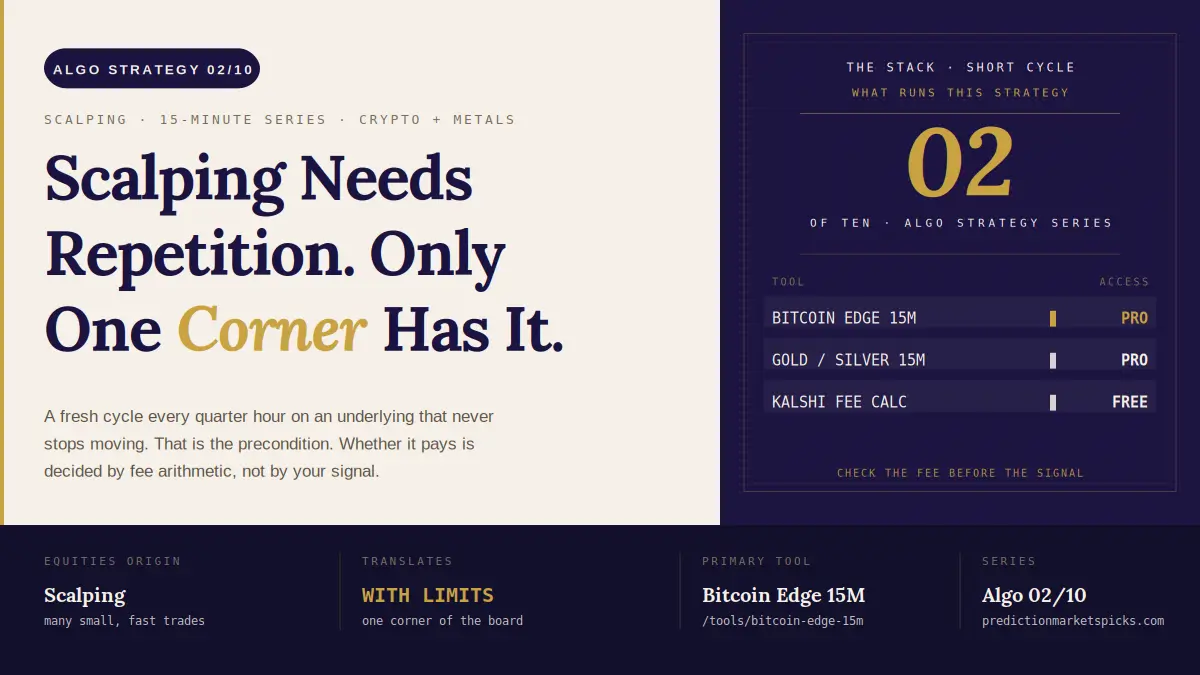

Short version: scalping needs repetition, and almost no event contract offers it. The 15-minute crypto and metals series do — a fresh cycle every quarter hour — which makes them the only corner of the board where the strategy is structurally possible. Whether it is profitable is decided by fee arithmetic, not by your signal.
This is strategy two of ten in Algorithmic Trading Strategies, Translated for Prediction Markets.
The equities version
Scalping is many small trades capturing minimal price differences over short holding periods. It lives on repetition: any single trade is close to a coin flip after costs, and the expectancy only shows up across thousands of them. Tape reading, order-flow analysis and execution speed are the traditional toolkit.
Why it mostly doesn't transfer
Most event contracts resolve on a schedule that gives a scalper nothing to work with. A monthly inflation contract offers you one meaningful repricing event in thirty days. An election contract offers you a handful across a year. You cannot compound a small edge across a sample size of four.
There is a second problem. Between catalysts, event contracts often barely trade. A scalper's raw material is continuous two-sided flow, and a market with twelve trades a day does not have any.
Where it does transfer: the 15-minute series
Kalshi's 15-minute crypto and metals contracts change everything about that arithmetic. A new cycle every quarter hour is roughly 26 cycles in a standard trading session on an underlying that moves continuously. That is repetition, and repetition is the precondition scalping was always missing here.
Three tools publish live fair value against those short-cycle contracts:
Each one shows the model's probability alongside the contract's own price, and — the reason they exist in this form — the true cost of trading, right next to it.
The arithmetic that actually decides this
Here is the whole strategy in four lines.
- Your signal says fair value is 54 and the contract is offered at 52.
- That looks like a two-cent edge.
- Your round trip — entry plus exit, both sides, fees included — costs you two cents.
- You have no edge. You have activity.
That is not a pessimistic framing; it is the arithmetic, and it disqualifies most 15-minute strategies people build. Run the Kalshi Fee Calculator before you decide a signal is tradeable. Use the Probability Converter so you are comparing like for like, and the EV Calculator to check that expectancy is positive at the price you can actually get filled at rather than the price on the screen.
How to actually run it
- Set the cost floor first. Compute your round-trip cost per contract. Any signal producing less than roughly twice that is not a candidate.
- Trade one series until you understand its personality. Bitcoin, gold and silver cycles behave differently. Learning three at once means learning none.
- Log every cycle, not every winner. The strategy exists at the level of hundreds of cycles. A ten-trade sample tells you nothing and will convince you of something.
- Watch the clock inside the cycle. A 15-minute contract has extreme time sensitivity in its final minutes — the Theta Edge Calculator is the general tool for that question, and the instinct it builds transfers directly.
- Stop when the cost structure changes. Fee schedules change. A strategy that clears its floor by half a cent is one schedule update away from being a donation.
Where it goes wrong
The classic failure is a backtest run on mid-price. Mid is not a fill. Scalping strategies are unusually sensitive to this because the entire edge is the same size as the spread — a backtest that assumes mid-price execution will show a profitable strategy that loses money live, every single time, with no bug to find.
The second failure is treating a good week as evidence. At this sample size and this edge, a good week is well within noise.
Next
If you like the execution-quality angle but want something that improves every trade you make rather than just this one strategy, read TWAP execution in thin prediction-market books. If you would rather earn the spread than pay it, read market making on Kalshi. If it is the underlying that interests you, read volatility trading with binary event contracts.
Trade responsibly, and check the fee before the signal.