

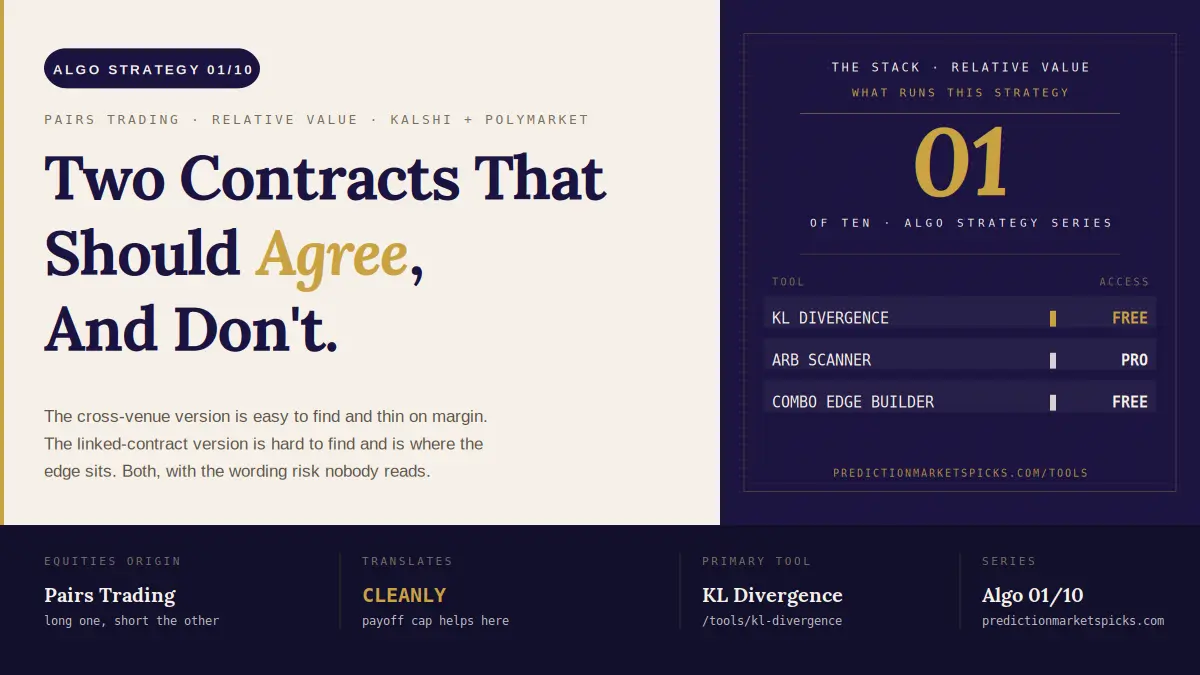

Short version: pairs trading in prediction markets means taking opposing positions in two contracts whose probabilities are economically linked but priced as if they are not. The cross-venue version is easy to find and thin on margin. The linked-contract version is harder to find and is where the real edge sits.
This is one of the ten strategies in Algorithmic Trading Strategies, Translated for Prediction Markets. It is the first for a reason: relative value transfers to event contracts more cleanly than almost anything else in the quant playbook, because you are trading a relationship rather than a direction, and a capped binary payoff barely interferes with that.
The equities version
Classic pairs trading goes long one asset and short a correlated one — two refiners, two airlines, an index and its largest constituent. You are not forecasting the sector. You are forecasting that the historical spread between the two will revert. When it does, you make money regardless of whether the sector went up or down.
What changes in an event contract
Three things, and each one moves the strategy rather than breaking it.
The payoff cap works in your favor here. In equities, a pairs trade can blow up when one leg goes parabolic. A contract cannot go past 100. Your worst case on a two-leg relative-value position is bounded and calculable before you enter, which is a genuine structural advantage over the equity version.
The clock forces a decision. Equity pairs can stay dislocated for years and you can wait. Event contracts expire. If your two contracts settle on different dates, you do not have a pair — you have two positions with a shared story. Match expiries or accept that you are taking a directional view on the gap between them.
The book is thin, so the spread is often the trade. A four-cent dislocation is worth nothing if entering both legs costs you three cents in slippage and fees. Run the numbers before, not after — the Kalshi Fee Calculator is the unglamorous first step of every pairs trade you will ever put on.
Form one: the same question, two venues
Kalshi and Polymarket list overlapping questions. They frequently disagree, sometimes by several cents, because they have different user bases, different collateral, and different fee structures. The Arb Scanner surfaces those gaps and — this is the part that matters — prices what the gap is worth net of costs.
The honest caveat here is large enough that we wrote a whole piece about it: why most prediction market arbitrage isn't real. Two contracts on "the same" event routinely settle on different sources, different cutoff times, or different edge-case wording. The gap you are looking at is often the market correctly pricing a resolution difference you have not read. The mechanics of separating real gaps from wording gaps are in how Kalshi–Polymarket arbitrage detection works and cross-platform arbitrage in prediction markets.
Form two: two linked questions, one venue
This is the one worth learning.
Consider two contracts that are not the same question but cannot both be right about the same world. A rate-decision market and a recession-threshold market. A division-winner market and a team season win-total market. A "candidate wins the nomination" market and a "candidate wins the general" market. Each is priced by a partly different crowd using partly different information, and the crowds do not reconcile with each other. Nobody is running a book that forces the joint distribution to be coherent.
That incoherence is the trade. Two tools get you there:
- KL Divergence measures how far two probability distributions have separated, as a single number. It is the formal version of "these two should agree and they don't," and it lets you rank candidate pairs instead of scrolling.
- Combo Edge Builder prices correlation between legs. A conditional-probability engine is the same math as a pairs trade expressed the other way round — if it tells you two legs are far more correlated than their standalone prices imply, you have found a relationship the market is not pricing.
Start with the Probability Converter so you are comparing probabilities rather than prices, and size with Kelly, which is unusually important on relative-value trades because the edge per trade is small and the temptation to lever it is large.
How to actually run it
- Pick the mechanism first, not the chart. Write one sentence explaining why these two contracts must move together. If the sentence needs an "and also," discard the pair.
- Match the expiries. Different settlement dates turn a hedge into two naked positions.
- Read both resolution criteria in full. This is where cross-venue pairs die. The wording is the product.
- Price the round trip. Both legs, both sides, fees included. If the dislocation is smaller than the cost, there is no trade at any conviction level.
- Size for the relationship breaking. Because periodically it does, and a relative-value book that never sized for decoupling is the one that gets carried out.
Where it goes wrong
The failure mode is correlation-mining. In markets this thin, with this many listed contracts, you can always find two series whose recent prices moved together. Almost none of those are economically linked. This is the single most reliable way to lose money on a strategy that feels sophisticated — you have built a backtest on noise and then traded it with conviction because the math looked serious.
The defense is the one-sentence mechanism test in step 1. It sounds trivial. It filters out most of what the screen shows you.
Next
If venue selection is what you want to go deeper on, read smart order routing for prediction markets. If you want to be on the other side of these trades — quoting the spread instead of crossing it — read market making on Kalshi. The full ten-strategy map is in the pillar.
Trade responsibly, and size like the correlation might break.