

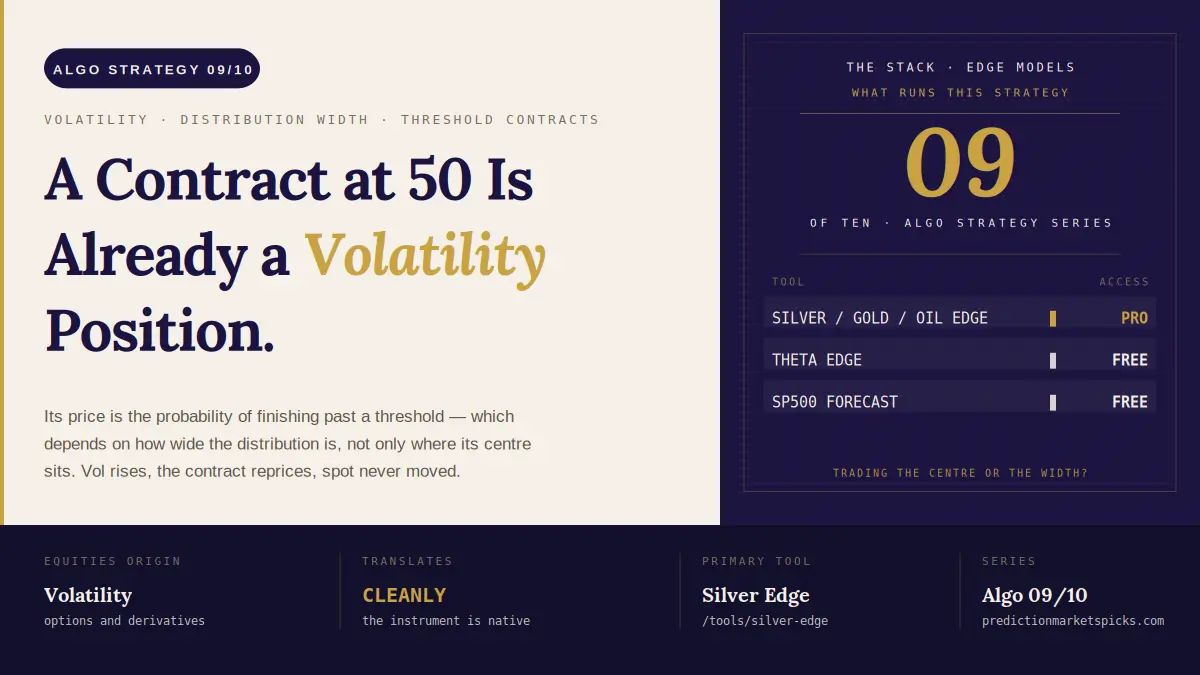

Short version: a prediction market contract is already a volatility instrument. Its price is the probability of finishing past a threshold, and that probability depends on how wide the distribution is, not just where its centre sits. When volatility rises, threshold contracts reprice even if spot never moved. That is the trade, and it is the engine underneath our whole Edge model family.
This is strategy nine of ten in Algorithmic Trading Strategies, Translated for Prediction Markets.
The equities version
Volatility trading profits from changes in how much an asset moves rather than which direction it moves. The classic expressions are options structures — straddles, strangles, variance positions — and the classic setup is the volatility breakout: position for a large move after a period of unusual calm.
Why event contracts are natively volatile instruments
Here is the intuition most people miss on the way in.
A contract asking "will silver finish above X by date Y" is not a directional call on silver. It is a question about the shape of the distribution of silver prices on date Y. Two inputs determine the answer: where the centre of that distribution sits, and how wide it is.
Change the width and you change the answer, with the centre untouched. If volatility rises, a threshold far above spot becomes more reachable — that contract gets more valuable while spot has not moved a cent. If volatility collapses, the same contract decays toward zero on nothing happening at all.
So a contract priced at 50 is a market saying the outcome is maximally uncertain. A contract at 5 is a market saying the distribution does not reach that far. You are trading distribution width whether you meant to or not. Understanding that is the difference between using these contracts and being used by them.
Where our models come from
That relationship is exactly what the Edge family exploits. Each tool derives an options-implied probability for the underlying and compares it against what the event contract is charging for the same outcome:
When those two probabilities disagree materially, the disagreement is a volatility trade, expressed as a single binary instead of an options spread. Two more sit alongside them: the S&P 500 Year-End Forecast applies the same reasoning to the index, and Conflict Hedge covers the geopolitical corner, where volatility arrives in discrete jumps rather than continuously.
One structural note for the oil series specifically: the settlement source rolls forward every month, which introduces a basis effect that has nothing to do with volatility and can quietly wreck a position held through the window. WTI contract rollover explained is the mechanic.
How to actually run it
- Ask the width question first. Is this contract mispriced because the market has the centre wrong, or because it has the width wrong? They are different trades with different catalysts.
- Compare the model probability to the contract, not to your intuition. Use the Edge tool for that series and the Probability Converter so both numbers are probabilities.
- Locate the threshold relative to spot. A threshold far from spot is almost purely a volatility position. A threshold near spot is closer to a directional one. Know which you are putting on.
- Check the clock before sizing. The Theta Edge Calculator tells you whether time is working for or against you — and on a volatility position that answer flips depending on which side of the threshold you sit. What an options trader sees in theta edge is the deeper read.
- Have an exit that isn't expiry. Volatility trades are the ones most improved by taking a good outcome early.
Where it goes wrong
Holding into the final days. This is the single most dangerous position type in event contracts. Sensitivity to the underlying and time decay both accelerate near settlement, so a contract that behaved calmly for weeks can swing violently on a move that would have been unremarkable earlier. Many traders discover this once, expensively.
Confusing a wide market with a volatile one. A wide bid-ask spread means the book is thin. It says nothing about the volatility of the underlying. Those are different problems with different solutions — the first is an execution problem covered in TWAP execution, the second is a modelling problem.
Next
If you would rather quote around these fair values than take positions with them, read market making on Kalshi — the Edge models are the input to that strategy too. For the short-cycle version, scalping the 15-minute series.
Trade responsibly, and know whether you're trading the centre or the width.