

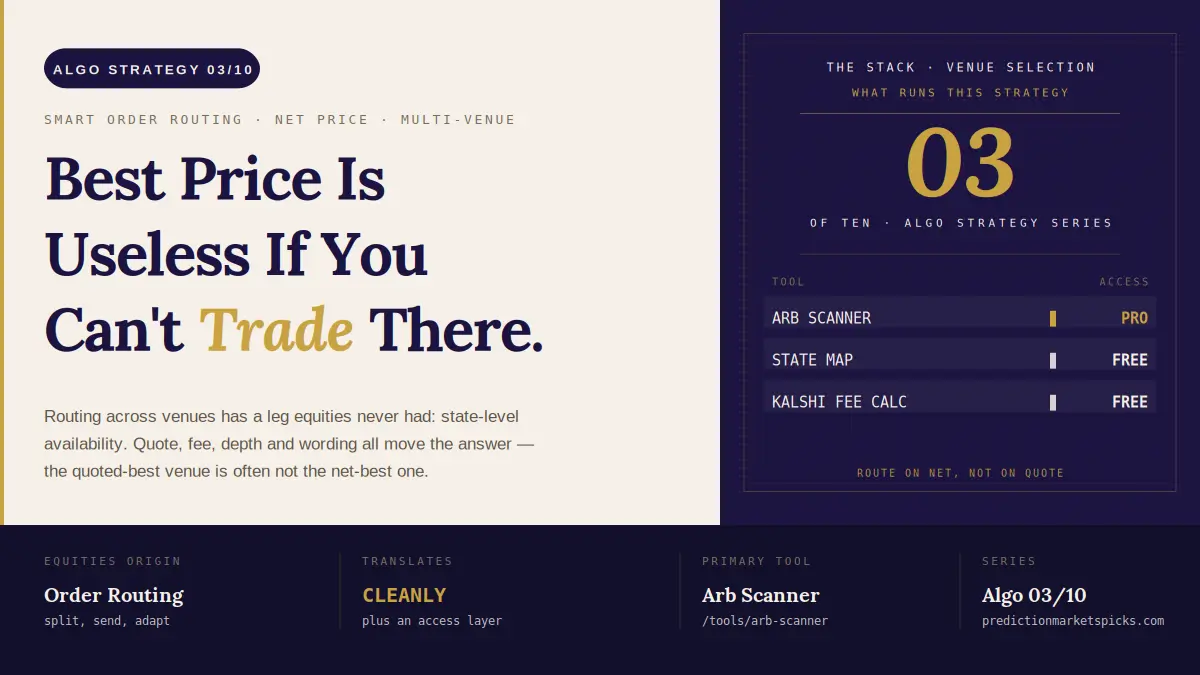

Short version: smart order routing on prediction markets means picking the venue by net price — quote adjusted for fees, depth and settlement wording — with one extra leg equities never had: whether you can legally access that venue from where you live. The quoted-best venue and the net-best venue are frequently not the same one.
This is strategy three of ten in Algorithmic Trading Strategies, Translated for Prediction Markets.
The equities version
An institutional router breaks a large order into pieces and sends each piece to whichever venue shows the best available price, adapting in real time to liquidity and market conditions. It is an execution technology, not a view. The entire purpose is to stop the act of trading from eating the thesis.
What changes in an event contract
The same discipline applies, with three differences that matter.
Fee structures differ enough to flip the answer. In equities, venue fee differences are fractions of a cent on a multi-dollar instrument. On a contract priced between 0 and 100, the fee is a material share of the whole position. Two cents of quote advantage is routinely erased by the fee schedule on the "cheaper" venue. Model it with the Kalshi Fee Calculator.
The contracts are not actually identical. Two venues listing "the same" event frequently settle on different sources, cutoff times or edge-case wording. That is not a technicality — it is the reason a persistent price gap exists. Why most prediction market arbitrage isn't real is the long version, and it is required reading before you route on price.
Access varies by state. No equity trader has ever had to check whether they are allowed to use an exchange from their home address. Prediction-market availability differs by state and moves with regulation. The State Availability Map is the access layer, and it belongs at the start of a routing plan rather than the end.
The tools
- Arb Scanner — the price leg. Finds where the same event is quoted differently across venues, and prices the gap net of costs rather than gross.
- State Availability Map — the access leg. Best price is meaningless on a venue that does not serve you.
- Kalshi Fee Calculator — the cost leg.
- Venue comparisons — Kalshi vs Polymarket, Robinhood vs Kalshi, Kalshi vs DraftKings and the rest of the comparison set, which lay out fees, settlement and liquidity side by side.
Convert everything to probability with the Probability Converter before comparing. Comparing raw prices across venues with different fee structures is how people talk themselves into bad routes.
How to actually run it
- Filter by access first. Build your venue list from what you can actually reach, then optimise within it.
- Read both resolution criteria. If the wording differs, you are not routing — you are choosing between two different contracts, and the cheaper one may be correctly cheaper.
- Convert to net price. Quote plus fees plus expected slippage at your size. Rank on that number.
- Check depth, not just top of book. A two-cent better quote good for five contracts is not better than a flat quote good for two hundred.
- Split only when the size justifies it. Splitting an order across venues costs you two sets of fees and two sets of attention. Below a certain size that is a worse outcome than taking the second-best venue in one clip.
Where it goes wrong
The expensive mistake is capital fragmentation. Chasing cross-venue gaps means keeping balances on several platforms, and idle capital is a real cost that does not show up in any of the gap numbers. For most retail accounts, a disciplined single-venue process with good execution beats a multi-venue process with mediocre execution — which is why TWAP execution is usually the higher-ROI thing to learn first.
The second mistake is treating routing as a source of edge rather than a preserver of it. Routing does not create alpha. It stops you from donating the alpha you already had.
Next
For the relative-value cousin of this strategy — trading the gap rather than routing around it — read pairs trading on prediction markets. The full map is in the pillar.
Trade responsibly, and route on net, not on quote.