

Skip to content
FED DESK

Kalshi vs Polymarket vs futures on the next FOMC decision

Fed Rate Tracker · live

15-MINUTE

Every Kalshi 15-minute window, priced against the late-flip risk

Bitcoin · gold · silver · oil

MIDTERMS

Every 2026 race priced on Kalshi and Polymarket

Senate · House · governors

COMBO EDGE

Correlation-aware Kalshi combos — free

SILVER EDGE

Options vs. Kalshi on weekly silver brackets

TWAP Execution in Thin Prediction Market Books — The Free Upgrade Nobody Uses

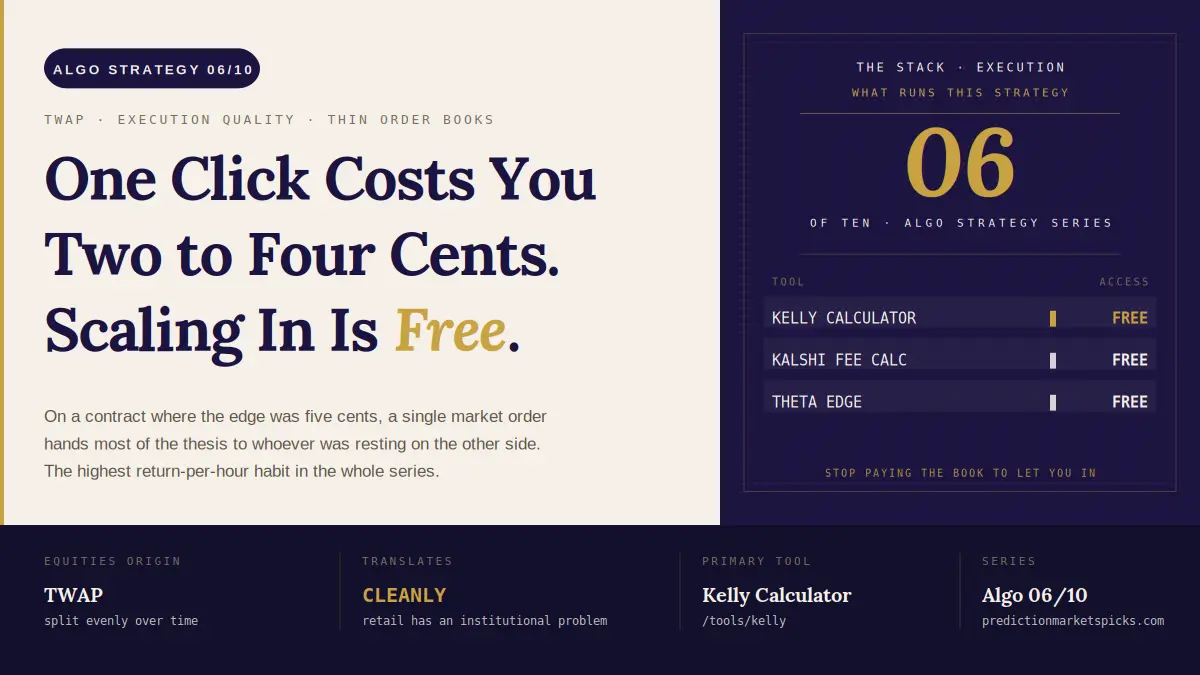
One click on a thin Kalshi book routinely moves the price two to four cents against you. On a contract with a five-cent edge, that hands most of your thesis to whoever was resting on the other side. Scaling in costs nothing.

TWAP execution on a thin prediction market book — one clip versus a scaled entry, parchment and indigo execution card
FSWA Award Winner · Published Author · Ran 4Deep Sports · Led FTN Marketing · Traded Bonds on Wall Street
September 24, 2026

Short version: prediction-market books are thin. Taking a full position in one click routinely moves the price two to four cents against you — which, on a contract where your edge was five cents, hands most of your thesis to whoever was resting on the other side. Splitting the order across a window fixes it, and costs nothing.

This is strategy six of ten in Algorithmic Trading Strategies, Translated for Prediction Markets. If you only adopt one thing from the whole series, adopt this one — it improves every trade you will ever make, on every strategy, forever.

The equities version

TWAP splits an order evenly over a set time period regardless of volume, aiming for an average execution price close to the start-to-finish price. It is the simplest execution algorithm there is, and institutions use it constantly, for one reason: their size moves the market and they want to stop paying for the privilege.

Why retail suddenly has an institutional problem

Here is the thing that surprises people coming from equities. In a liquid stock, a retail-sized order is invisible — you are a drop in an ocean and execution algorithms are somebody else's concern.

On a prediction market outside the flagship series, you are frequently one of the largest orders in the book. Your two hundred contracts are not a drop in anything. When you take the offer, you clear the top level, then the next, then the next, and your average fill is several cents worse than the price you clicked on.

That makes a retail trader's execution problem structurally institutional. Not because you are large in absolute terms, but because the book is small.

The arithmetic

Say your model puts fair value at 60 and the contract shows 55. Five cents of edge, and you want two hundred contracts.

Same thesis. Same market. Twice the money. The difference is entirely execution, and it cost nothing but patience.

The tools

How to actually run it

  1. Set total size before the first order. Non-negotiable. This is where most scale-ins go wrong.
  2. Choose the window from the contract's clock, not your patience. Days to expiry: hours are fine. Hours to expiry: minutes.
  3. Work limits inside the spread. You are trying to be the resting order that someone else pays to hit — the same position a market maker occupies, just for one trade.
  4. Re-check the thesis at the halfway mark. A scaled entry has a built-in advantage: if the reason to be in the trade evaporates, you are only half-sized when you find out.
  5. Accept a partial fill. Not getting the last fifty contracts at a good price is a better outcome than getting them at a bad one. This is the discipline people skip.

Where it goes wrong

Two ways.

Scaling into a decaying contract. On a short-dated market, the value you lose to time can exceed the slippage you saved. That is not discipline; it is a leak wearing discipline's clothes. Check the clock first.

Signalling. A perfectly regular clip every ten minutes on a thin book is legible to anyone watching, and someone will trade in front of it. Vary the size and the interval. Institutions solved this decades ago with randomisation; you can solve it by not being a metronome.

Next

The volume-aware cousin of this is VWAP and catalyst timing — trading with the liquidity instead of spreading evenly through the desert between catalysts. If you want to be on the resting side permanently, read market making on Kalshi. And smart order routing is the venue-level version of the same instinct.

Trade responsibly, and stop paying the book to let you in.

TWAP Execution in Thin Prediction Market Books — The Free Upgrade Nobody Uses — frequently asked

What is TWAP and does it apply to prediction markets?

TWAP is time-weighted average price: split an order evenly across a time window instead of executing it at once, so your fill lands near the period's average rather than at whatever the book happened to show. It applies extremely well to event contracts, because the books are thin enough that a single large market order visibly moves the price against the person sending it.

How much does a single large order actually cost me?

On a thin book, routinely two to four cents of adverse movement. If your edge on the contract was five cents, you just paid most of it to enter. That is not a rounding error — for many retail-sized positions, execution quality is a larger factor in the final result than the quality of the thesis.

Doesn't waiting cost me something too?

Yes, and this is the real trade-off. A contract decaying toward expiry loses value for the holder on the wrong side of the clock, so a slow scale-in on a short-dated contract can cost more than the slippage it saves. Check time sensitivity before you choose your window — patience is a strategy on a monthly contract and a leak on a two-day one.

What's the simplest version I can start using today?

Decide your total size first, divide it into three or four clips, and work resting limit orders instead of lifting the offer. That single change improves the entry price on most thin-book positions and costs nothing but attention. It is the highest return-per-hour habit on this entire list.

Read Next

The 10 Algorithmic Trading Strategies, Translated for Prediction Markets
Pairs trading, scalping, market making, VWAP, seasonality, volatility, machine learning — the ten strategies quant desks run on equities, rewritten for Kalshi and Polymarket event contracts, with the tool that runs each one.
Article
Kelly Criterion for Prediction Markets: Sizing Calculator + Examples
The Kelly Criterion is the mathematically optimal position sizing formula for any positive-EV trade. Here's how to apply it to Kalshi and why fractional Kelly is the professional standard.
Article
I Saw a Twitter Thread About an Options Trader Who Cracked Polymarket — So I Built the Tool
A fired options trader opened Polymarket and immediately saw what nobody else was seeing: the whole market ignores time. He made $131K in 3 months. I read the thread, did the math, and built the Theta Edge calculator.
Article
VWAP for Event Contracts — There's No Trading Day, There's Only the Catalyst
Equity volume follows a U-shaped day. Prediction market volume follows the calendar — a data release, a decision, a filing, a kickoff — and is close to dormant in between. Here's how to translate VWAP into that world.
Article
Market Making on Kalshi — The Most Underrated Retail Strategy, and the Fastest Way to Lose
Thin books mean wide spreads, and wide spreads mean a retail trader can genuinely quote both sides. But a maker without a live fair value isn't earning a spread — they're writing free options to better-informed people.
Article
Smart Order Routing for Prediction Markets — Best Price Is Useless If You Can't Trade There
Routing across Kalshi, Polymarket, Robinhood and the DFS prediction products has a leg equities never had: state-level availability. Here's how to find the net-best venue, not the quoted-best one.
Article
Kelly Criterion
Optimal position sizing
Tool
Kalshi Fee Calculator
What a fill really costs, all-in
Tool
Theta Edge
Binary time-value calculator
Tool

Go Pro · 26% off your first year

You just read the setup. Pro is the live number — $150/yr

Pro turns the read into a position: Fed-day and election-night alerts, the full Kalshi-vs-Polymarket price-gap board, the commodity and 15-minute strike grids, Thee Oracle, and the NFL edge module — every gap the moment it opens.

Go Pro →

$111 for the first year, then $150/yr. Code applies automatically. Ends Dec 31. Monthly is $14.99/mo.

Every signal graded in public, losers left on the board. See the record →

Prediction-market edges, weekly. The only newsletter built for Kalshi & Polymarket traders.

No spam. Unsubscribe anytime.

Watch The 7 Oracles make the call. Full breakdowns on YouTube, quick hits on X.

Benny Ricciardi

Founder · The 7 Oracles

Benny Ricciardi is an FSWA Award Winner and published author. He ran 4Deep Sports as CEO, led marketing at FTN Network as CMO, and traded bonds on Wall Street. He founded PredictionMarketsPicks.

Follow @BennyR11 →
TWAP prediction marketsscaling into Kalshi positionthin order book event contractsprediction market slippageexecution quality Kalshilimit orders prediction marketsmarket impact event contractshow to enter a large Kalshi position

Want more analysis like this?

Get The 7 Oracles' daily prediction market breakdown — free, no fluff, straight to your inbox.

Get the daily edge in your inbox →