

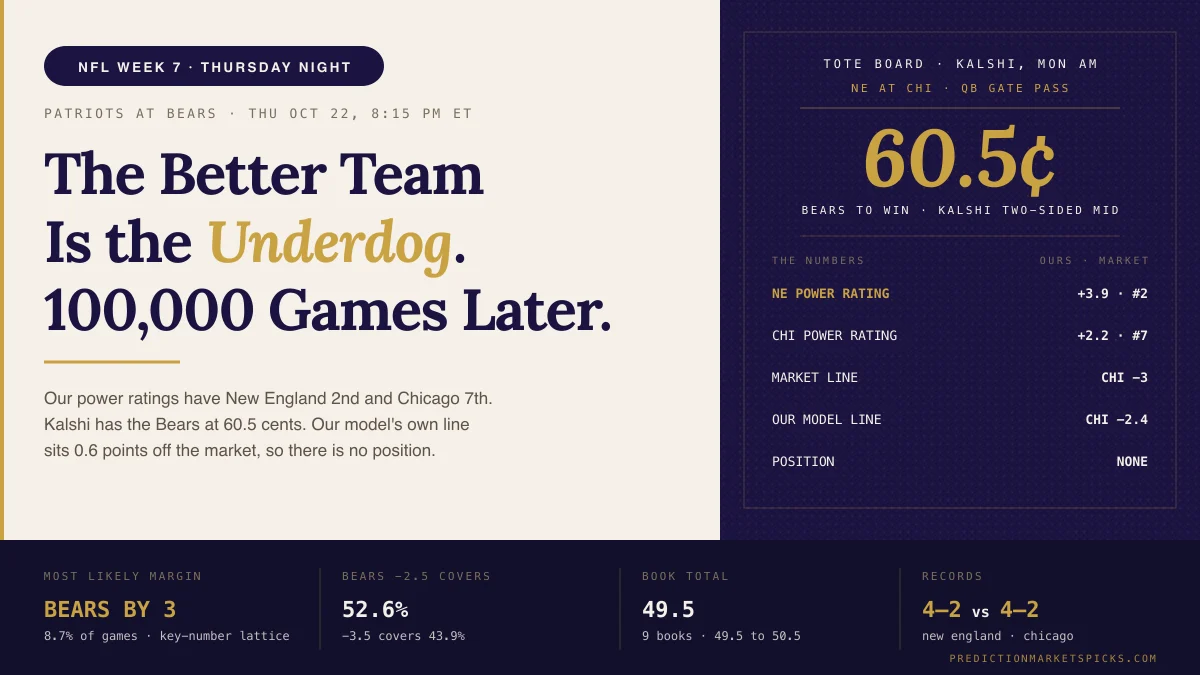
Our power ratings say New England is the better football team. Second in the league against Chicago's seventh.
Kalshi says the Bears win this game 60.5% of the time.
Both of those can be true, and on Thursday night in Chicago they are. So we did what we do with every Thursday game worth the trouble: we lined up our ratings, our model's own line and the market, played the game 100,000 times on our key-number lattice, and went looking for a disagreement worth your attention.
The Calls
| Market | Kalshi | Ours | Read |
|---|---|---|---|
| Bears to win | 60.5¢ | 60.5% (fair value, books) | Priced. Our number restates the market here. |
| Our model's own line | Market: Bears by 3 | Bears by 2.4 | Lean 0.6 pts toward NE. Below our lean tiers. Not a position. |
| Bears by 3+ (−2.5) | 52¢ (Sun.) | 52.6% | Priced |
| Bears by 4+ (−3.5) | 42¢ (Sun.) | 43.9% | Priced |
| Total | Over 49.5: 51.5¢ (Sun.) | Not published | Pass. Our totals are masked. |
| Player props | See below | Not yet run | The Week 7 read posts on the props board when the slate runs. |
See the Patriots at Bears market on Kalshi →
Why a 0.6-point lean is not a call. Our model writes its own line for every game, and we grade those leans in public. But the lowest lean tier we publish starts at 2 points, and a position needs our price and the market's to be more than 2 points apart once the book's spread is netted out. Six-tenths of a point is the model and the market agreeing.
The Ratings Puzzle
The headline of this game is that the team our ratings like more is getting points.
| Patriots | Bears | |
|---|---|---|
| Power rating (PWR) | +3.9 | +2.2 |
| Rank | 2nd | 7th |
| Offense (Off PR) | +3.0 | +1.9 |
| Defense (Def PR) | +0.8 | −0.1 |
| Special teams (ST PR) | +0.1 | +0.4 |
| Tier | Playoff | Playoff |
| 2026 record | 4–2 | 4–2 |
PWR is points per game above an average team on a neutral field, and it is the sum of the three columns under it. New England is better on offense by about a point and better on defense by about a point; Chicago gets a little of it back on special teams.
The arithmetic from there is short. New England by 1.7 on a neutral field, plus 2.5 points of home field for Chicago, is Bears by 0.8. Our stored model line, which carries more than that headline sum, is Bears by 2.4. The market is Bears by 3. Every version of this game has Chicago favored at home; they disagree by less than a field goal on how much.
One caution on the ratings: the board above was cut on October 14, before Week 6 was played. Both teams won in Week 6, and the next ratings refresh will fold those games in.
How they got to 4–2
| Week | Patriots | Bears |
|---|---|---|
| 1 | L 10–13 at Seattle | W 59–37 at Carolina |
| 2 | W 20–3 vs. Pittsburgh | L 3–9 vs. Minnesota |
| 3 | L 6–35 at Jacksonville | W 27–7 vs. Philadelphia |
| 4 | W 29–26 at Buffalo | W 23–12 vs. N.Y. Jets |
| 5 | W 45–17 vs. Las Vegas | L 7–31 at Green Bay |
| 6 | W 26–19 vs. N.Y. Jets | W 31–23 at Atlanta |
| Points for / against | 136 / 113 | 150 / 119 |
Two teams with the same record, each with one ugly road loss (New England's 35–6 at Jacksonville, Chicago's 31–7 at Green Bay), and each coming off a Week 6 win. New England has won three straight.
The Game, 100,000 Times
The game simulation does not carry a new opinion on who wins. Like our Steelers–Browns run, it is centred on the market, Bears by 3, and drawn on our fitted key-number lattice: the part of the model, fitted to 6,405 games from 2002 to 2025, that knows NFL games end on 3 and 7 far more often than on 2 and 5. It tells you the shape of the outcomes around the market's number.
| Exact (lattice) | 1,000 sims | 10,000 sims | 100,000 sims | |
|---|---|---|---|---|
| Bears win by 3+ (cover −2.5) | 52.6% | 55.4% | 51.8% | 52.6% |
| Bears win by 4+ (cover −3.5) | 43.9% | 46.1% | 43.4% | 44.0% |
| Bears win by exactly 3 | 8.7% | 9.3% | 8.4% | 8.6% |
| Patriots win by exactly 3 | 6.7% | 5.9% | 6.8% | 6.7% |
| Tie | 0.4% | 0.3% | 0.5% | 0.4% |
That convergence is the point of running it three times. A thousand games can tell you the Bears cover −2.5 55% of the time; it takes 100,000 to land on the real number, 52.6%. Anyone quoting you a simulation of a few hundred or a few thousand runs is quoting noise to the first decimal.
The most likely final margins, read straight off the lattice:
| Final margin | Share of games |
|---|---|
| Bears by 3 | 8.7% |
| Patriots by 3 | 6.7% |
| Bears by 7 | 4.6% |
| Patriots by 7 | 4.6% |
| Bears by 6 | 3.9% |
| Bears by 10 | 3.4% |
| Bears by 1 | 2.8% |
| Patriots by 6 | 2.8% |
Half of the 100,000 games finished between Patriots by 6 and Bears by 10. One in ten had New England winning by 14 or more; one in ten had Chicago winning by 20 or more.
A note on the win number. Read straight off the lattice, a Bears-by-3 game ends in a Chicago win 58.0% of the time, which is how often the favorite has actually won games with a 3-point expected margin since 2002. Our published win probability, 60.5%, is the moneyline from the market's own win curve, and it is the number on the matchup page. We use the lattice for margins and spreads and the moneyline for who wins; the 2.5 percentage points between them are the difference between the two methods, not a call.
The Kalshi Spread Ladder vs. the Lattice
Kalshi lists this game as a ladder of "wins by more than X" contracts. Here is every rung next to the lattice, at Sunday evening's prices.
| Contract | Kalshi mid | Lattice | Gap |
|---|---|---|---|
| Bears by 2+ | 54.5¢ | 55.1% | +0.6 |
| Bears by 3+ | 52¢ | 52.6% | +0.6 |
| Bears by 4+ | 42¢ | 43.9% | +1.9 |
| Bears by 7+ | 33¢ | 35.3% | +2.3 |
| Bears by 8+ | 29¢ | 30.6% | +1.6 |
| Bears by 10+ | 25.5¢ | 27.2% | +1.7 |
| Bears by 11+ | 21.5¢ | 23.8% | +2.3 |
| Patriots by 2+ | 40¢ | 39.4% | −0.6 |
| Patriots by 3+ | 39.5¢ | 37.2% | −2.3 |
| Patriots by 4+ | 31.5¢ | 30.5% | −1.0 |
| Patriots by 7+ | 22.5¢ | 23.2% | +0.7 |
| Patriots by 8+ | 19.5¢ | 18.6% | −0.9 |
Two things stand out, and neither is big enough to act on.
The Bears-by-3 rung. The gap between Bears by 3+ (52¢) and Bears by 4+ (42¢) is the market's price on Chicago winning by exactly 3: about 10%. The lattice says 8.7%. That is the same pattern we saw in Steelers–Browns, where Kalshi put more on the favorite winning by exactly 3 than the lattice did. At 1.3 points, it is a curiosity.
The Chicago side of the ladder runs a little cheap. Every Bears rung from 4+ out sits 1.6 to 2.3 points under the lattice. But that ladder is from Sunday evening, when the Bears' moneyline was 57.5¢; by Monday morning it was 60.5¢. A 3-cent move toward Chicago is exactly the kind of thing that closes a 2-point gap on the spread rungs. The ladder you see on Thursday will not be the one in this table.
Only one rung carries real trading volume, Bears by 3+. Several Patriots rungs show a quote with no trades behind it, so treat those prices as indications, not a market.
The Total
The books have 49.5: nine books, every one between 49.5 and 50.5. Kalshi's over-49.5 rung was 51.5¢ on Sunday evening, which is the same number with a whisker of lean to the over.
We don't publish a total for this game. Our totals model is masked from every surface until it is refit, so there is no projected score, no fair total and no over/under probability of ours anywhere on the site. The fair total here is the market's.
The Quarterbacks
Drake Maye for New England and Caleb Williams for Chicago, both on file as the expected starters, and the game passed our QB gate: both rooms are vetted, so every number on this page is built on the quarterbacks who are expected to play. If either status changes before Thursday, the gate re-runs and the line, the lean and the props all move with it.
The Early Prop Board
Kalshi has listed its first player props for this game. These are the only ones with a tight two-sided book and a price between 25¢ and 75¢ as of Monday morning:
| Player | Contract | Kalshi mid | Bid / ask |
|---|---|---|---|
| Drake Maye | 225+ passing yards | 58.5¢ | 57 / 60 |
| Caleb Williams | 250+ passing yards | 46.5¢ | 45 / 48 |
| A.J. Brown | 60+ receiving yards | 51.5¢ | 50 / 53 |
| Drake Maye | 25+ rushing yards | 58¢ | 56 / 60 |
Our read isn't in this table yet, on purpose. The Week 7 player projections haven't run, and a prop read may only be served from the projection run it was priced against. When the slate runs, our calibrated read and tier for each of these lands on the props board and the matchup page; the tier is the call. The Maye rushing contract is the thinnest of the four, with almost nothing traded.
The Season Stakes
From our season simulation, run Sunday evening, October 18:
| Patriots | Bears | |
|---|---|---|
| Projected wins | 10.9 | 10.0 |
| Make the playoffs | 82.9% | 64.2% |
| Win the division | 53.6% | 20.8% |
| Win the Super Bowl | 8.8% | 5.2% |
New England is the AFC East favorite in our numbers. Chicago is chasing in the NFC North, and a home loss on a Thursday to a team our ratings rank higher is the kind of result that moves those odds. More on Chicago's path in our Bears playoff odds piece.
What We Refused To Publish
- A game position. The model's line and the market's are 0.6 points apart. That is agreement.
- A total. Masked across the site until the totals model is refit.
- A prop read. Not until the Week 7 projections run, and then only the calibrated read and tier.
- A ratings-only call on New England. "Better team, getting points" is a story, not an edge. Home field closes most of the gap, and the model's own line closes almost all of the rest.
What This Doesn't Know
- News after the model line was written. A late inactive, an injury or a quarterback change is not in our number until the gate re-runs.
- Week 6 in the ratings. The power ratings above were cut October 14, before either team played in Week 6. The next refresh folds those games in.
- Thursday weather. Soldier Field is outdoors, and we have no wind reading for this game yet.
- Rest. Our model has the two teams on even rest, so it carries no rest edge for either side.
- The lattice is a shape, not an opinion. It is centred on the market's number. It tells you how often a 3-point game lands on 3; it does not tell you who is better.
The distribution is what the engine can tell you. The rest is why it might be wrong.
Game: New England at Chicago · Thursday, October 22, 8:15 p.m. ET · Soldier Field, Chicago · matchup page · all Week 7 games
Board: Kalshi moneyline two-sided mid around 7:15 a.m. ET, October 19, 2026 (Bears 60/61¢, Patriots 39/40¢). Spread and total ladders: Kalshi mids snapshotted around 6:50 p.m. ET, October 18. Player props: Kalshi mids around 7:10 a.m. ET, October 19. Game anchor: nine-book consensus, Bears −3, total 49.5.
Method: 100,000 draws (plus 1,000 and 10,000) from our key-number margin lattice at an expected margin of Bears by 3, seed 20261022. The exact lattice probabilities match the spread ladder stored with our published fair value for this game to the fourth decimal. Model line, lean and QB gate from our engine's stored row for this game; power ratings from the October 14 board; season odds from the October 18 season simulation.
The live board moves. Check the matchup page before you do anything with a number on this page.
Trade Patriots at Bears on Kalshi →
Keep Going
- Patriots vs Bears Week 7: the matchup page, every ladder and the QB gate
- Every Week 7 game on one page
- The Ladder: where our number and the market disagree across every strike
- Every Kalshi prop on this week's slate, best price across venues
- NFL power ratings, all 32 teams · NFL win probability calculator
- Build a Patriots–Bears combo, same-game legs priced on their true joint odds
- Steelers–Browns, simulated 10,000 times on real rosters
- Patriots–Seahawks, simulated 100,000 times: the series precedent