

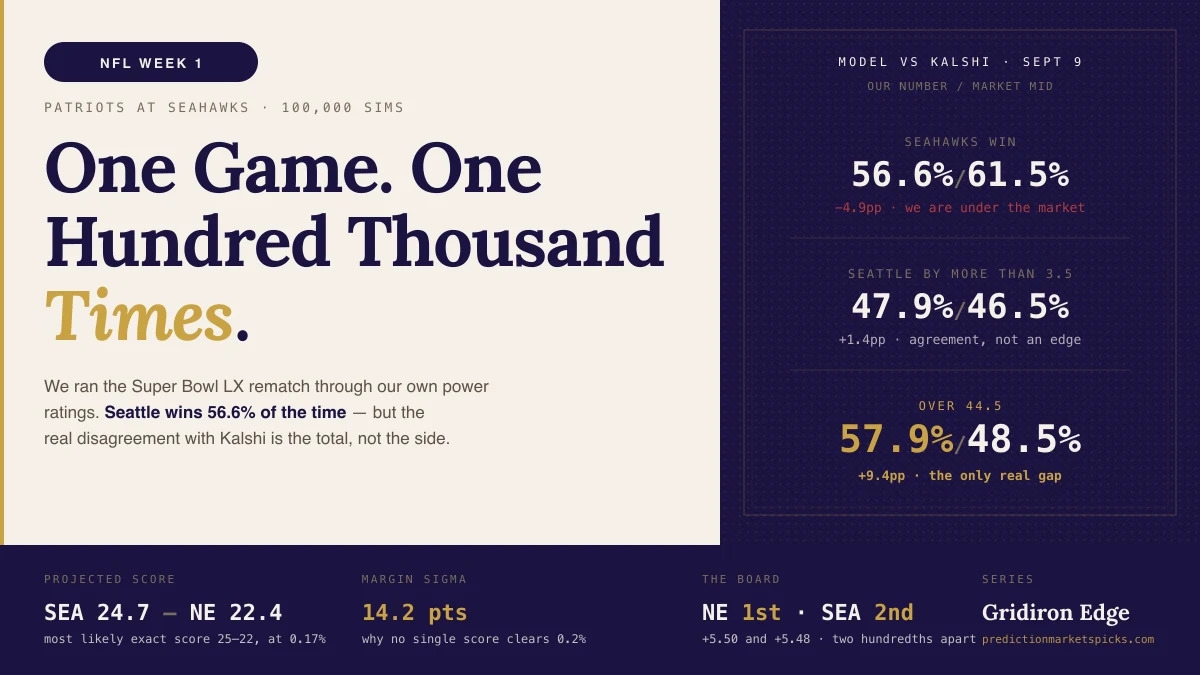

Seven months ago these two teams played the actual Super Bowl. Seattle won it, 29-13, and tonight they raise the banner and open the season against the team they just beat, on Wednesday Night Football, at Lumen Field. There is no bigger Week 1 game on the schedule, and it happens to be the one where our own model has the most interesting things to say.
So we did what we did to the whole season three weeks ago, at one game instead of 272: took our own power ratings, built the joint scoreline grid our combo-builder prices same-game parlays with, and played this specific matchup 1,000 times, then 10,000, then 100,000. Then we broke down the trenches, the corner-receiver matchups, and the run and pass games on both sides, because a model with no film is a model that doesn't know Christian Gonzalez exists.
What does the model say about Patriots at Seahawks?
Even teams, a 2.5-point home edge, and a 56.6% Seattle moneyline against a 61.5% market. Our power ratings have this as close to even as two teams can be. New England grades out at +5.5 (1st overall, +4.0 offense / +1.3 defense / +0.2 special teams). Seattle grades out at +5.5 as well (2nd overall, +2.3 offense / +1.9 defense / +1.2 special teams — the best special-teams unit in the sample). Add Seattle's home field (+2.5 in the current model) and the Seahawks are favored by 2.5 points — not the 3.5 the market has posted.
That gives us three things to check against Kalshi, and only one of them turns out to be worth anything.
On the spread, we and the market are saying the same thing. We have Seattle clearing -3.5 in 47.9% of simulated games; Kalshi's own “Seattle wins by over 3.5” contract — the most-traded spread strike on this game — prices it at 46.5%. A point and a half of daylight is agreement, not an edge, and nobody should be attacking -3.5 in either direction off it.
On the moneyline we are the more skeptical side: 56.6% on Seattle against Kalshi's 61.5% (the mid of a 61/62¢ book). That 4.9-point gap is a fade-the-favorite lean, and it lands right on the 5-point threshold our game board requires before it will call an edge — which is why the matchup page passes on this game, and why this article doesn't overrule it.
The total is the one with a real disagreement. We project 47.1 combined points and the over hits in 57.9% of our simulations; Kalshi's Over 44.5 — again the deepest strike on the board — prices it at 48.5%. That is a 9.4-point gap, and it is the only number on this page that clears our own bar. Respect Seattle, don't pay up for the aura of the defending champs, and expect points.
What happens when you simulate Patriots–Seahawks 100,000 times?
Seattle wins 56.6% of them, and you can watch the answer converge. The machinery is the same joint scoreline grid that prices our Combo Edge Builder's same-game parlays: margin and total are modeled as two independent normal distributions over the real integer score lattice (0 to 80 points a side), tie probability corrected to the real NFL rate of about 1 game in 200, then we draw from that grid at random — 1,000 times, then 10,000, then 100,000 — the same way our 10,000-season sim plays out the whole league.
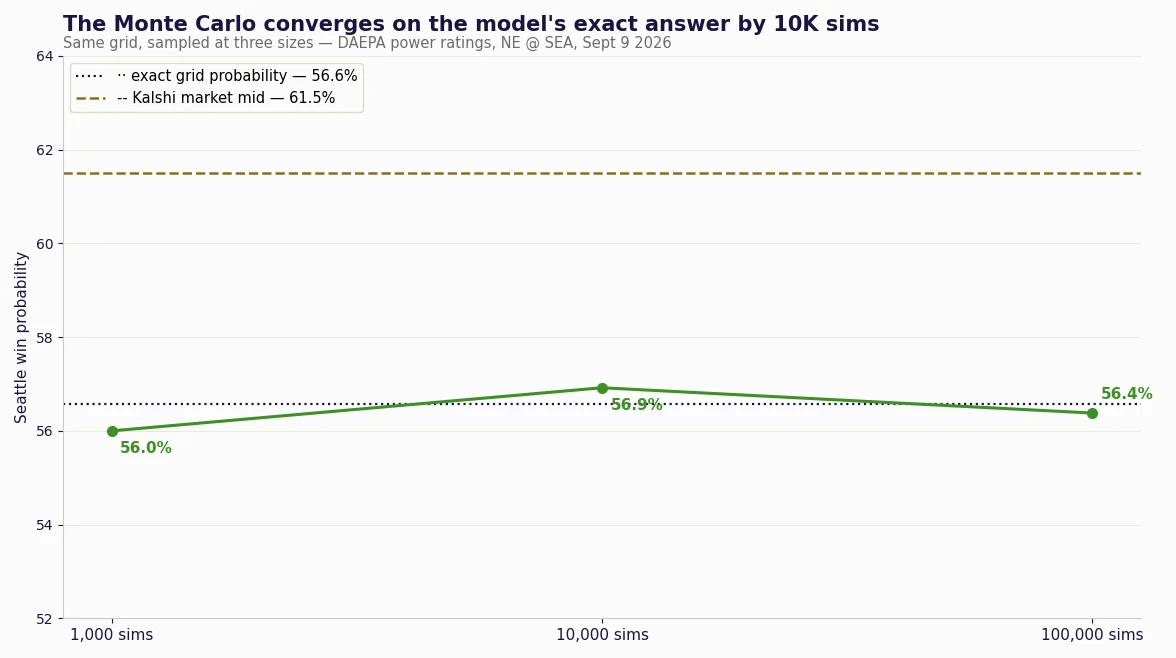
This is the part we think is underrated as content in its own right: you can watch the answer stabilize. At 1,000 sims, Seattle wins 56.0% of the time — noisy, but already in the neighborhood. At 10,000, it's 56.9%. At 100,000, it settles at 56.4%, a few tenths of a point from the exact grid answer of 56.6% you'd get by integrating the whole thing analytically instead of sampling it. That gap — simulation vs. exact math — is itself the honest measure of how much random variation is left in a 100,000-trial run, which is not zero. It's just small. The two market-facing numbers behave the same way: the cover settles at 47.9% against an exact 47.9%, and the over at 57.9% against an exact 57.8%. At a thousand runs the over was still reading 54.3%, three and a half points off — which is exactly why we don't publish a thousand-run number.
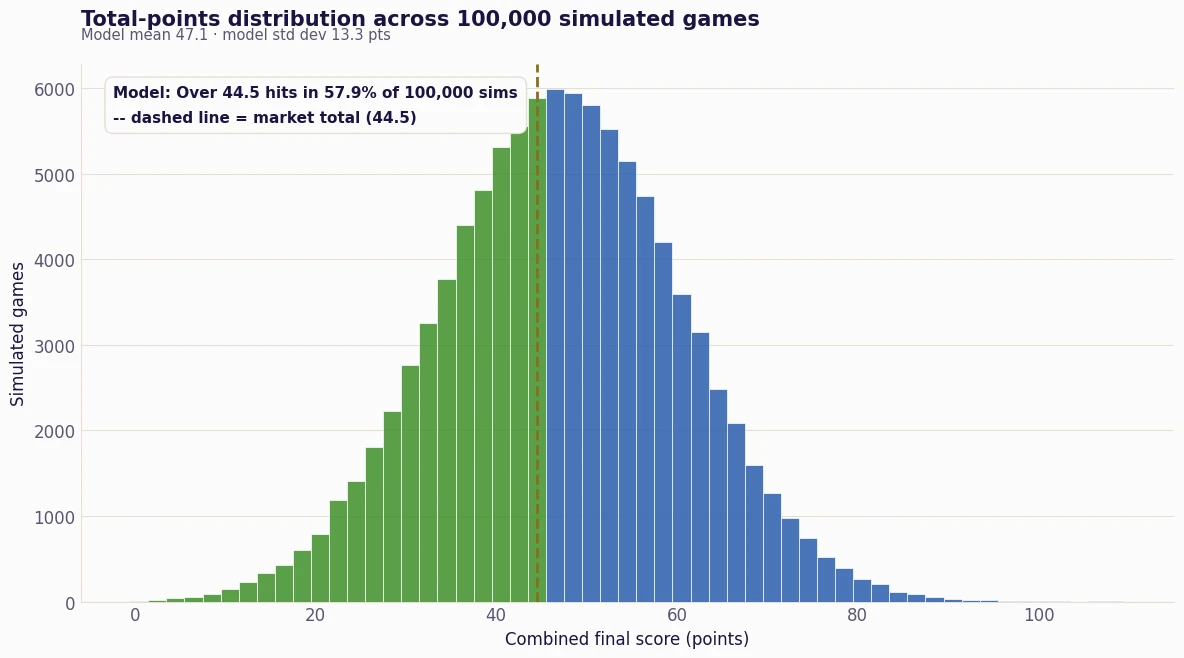
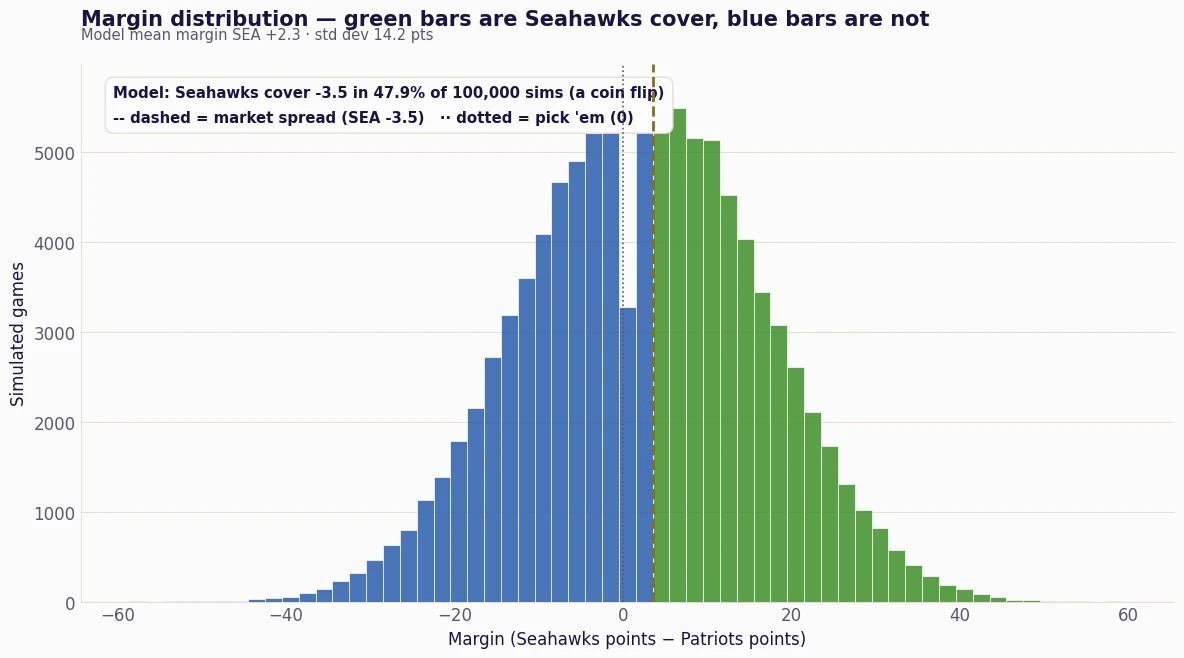
The margin chart is the one worth sitting with. The model's whole disagreement with the market lives in that middle third of the distribution — the difference between "Seattle wins by a field goal" and "Seattle wins by a field goal and change" — and it's a coin flip either way. Nobody should be attacking -3.5 hard in either direction when our number and Kalshi's own strike are 1.4 points apart. The total is the cleaner lean, and by some distance.
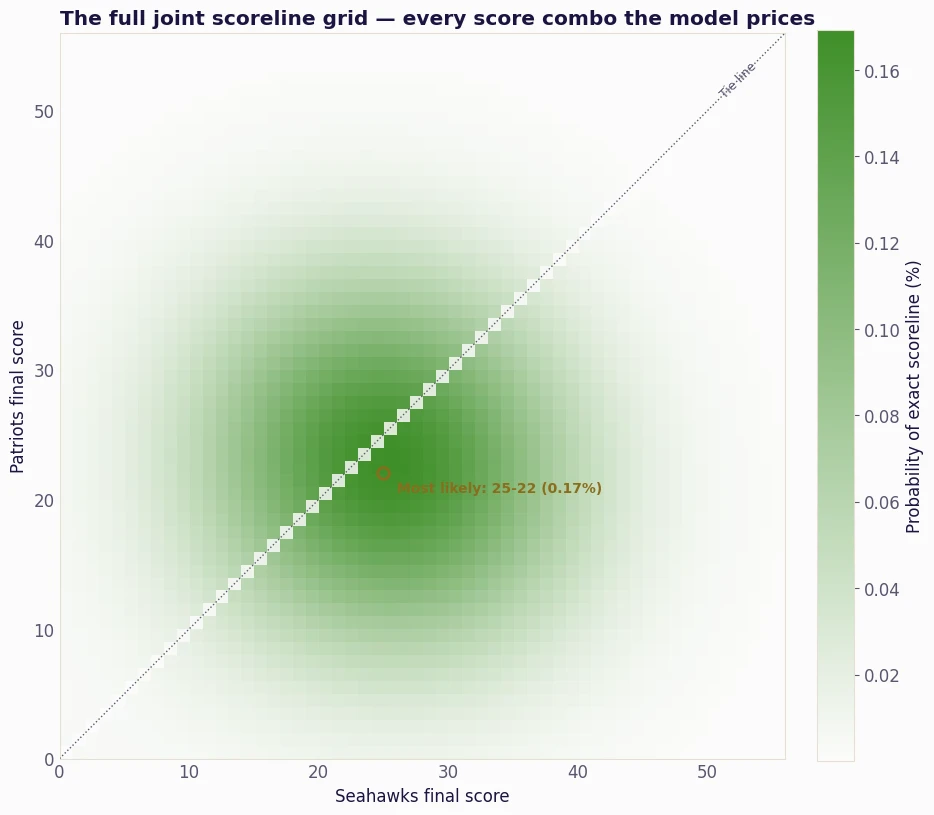
That last image is the actual grid — every scoreline from 0-0 to 55-55, shaded by probability. It's the same object the model uses to price a same-game parlay leg on our Combo Edge Builder, and it's a good reminder of what "47.1 projected total" actually means: not a prediction, a peak. The single most likely final score in 100,000 simulated games was Seattle 25, New England 22 — and that happened only 0.17% of the time. Point projections are a summary of a shape. The shape is the product.
Can the Patriots' offensive line hold up against the Seahawks' defensive line?
It is where the Super Bowl actually got decided, and it's the single biggest swing factor both fan bases keep coming back to. New England's line — Will Campbell, Alijah Vera-Tucker, Jared Wilson, Mike Onwenu, Morgan Moses left to right — got outclassed in February. Campbell played through a torn knee ligament and struggled, the interior allowed pressure in bunches, and Seattle's front pressured Drake Maye on 43.4% of dropbacks with only a four-man rush, adding five sacks. That's not a bad half, that's a plan working.
New England's answer was to spend the offseason on exactly that problem: signed Alijah Vera-Tucker in free agency, traded up to draft Utah tackle Caleb Lomu 28th overall, and handed the center job to Jared Wilson. Reserve OL Ben Brown (knee) is out for tonight and didn't travel, which thins an already-retooling group further.
Seattle's front is what it was in February, and arguably better paid: Leonard Williams just signed a 3-year, $90M extension off a Pro Bowl year (7 sacks, 22 QB hits, 9 TFL), flanked by Byron Murphy II at nose and Jarran Reed (acquired from Green Bay) inside, with DeMarcus Lawrence (signed away from Dallas) and Uchenna Nwosu rushing off the edge. This unit doesn't need to blitz to get home, which is the specific thing that broke New England in the Super Bowl and the specific thing this retooled line has to prove it fixed on national television in Week 1.
Edge: Seattle, and it isn't especially close on paper. If there's a reason to doubt it, it's that "prove it fixed in Week 1 against the team that just exposed it" is a real, specific test rather than a vague expectation — sometimes an offseason of continuity and cap dollars is exactly enough.
Where is the Seahawks' offensive line vulnerable against the Patriots' front?
Right guard — flip the matchup and it's a genuine question mark for Seattle, not a strength. Seattle's line — Charles Cross, Grey Zabel, Jalen Sundell, Anthony Bradford, Abraham Lucas — has one identified soft spot: right guard Anthony Bradford was among the league's weakest starting guards in 2025, allowing 38 total pressures including six in the NFC Championship. New OC Brian Fleury (replacing Klint Kubiak, now the Raiders' head coach) is calling his first real games, and the running back who used to help mask Bradford in protection, Zach Charbonnet, is out on PUP recovering from his ACL. Tackle Josh Jones (knee) was limited in practice and is a game-status watch.
New England's front — Milton Williams, Cory Durden, Christian Barmore inside, Dre'Mont Jones and Elijah Ponder off the edge — is a legitimately good group even in a down defensive year for the Patriots: Williams ran a 9.6% pressure rate (3rd among interior defenders in 2025), Barmore graded 7th among defensive tackles in pass-rush win rate, and the two combined for 86 pressures. The defense overall finished 6th in rush yards allowed per game. Barmore is off the injury report and expected to play.
Edge: New England, specifically through the Bradford matchup and Seattle's backfield uncertainty compounding it — an interior rusher who wins quickly turns a green run-blocking situation into third-and-long fast.
Who wins the corner-versus-receiver matchups?
Christian Gonzalez vs. Jaxon Smith-Njigba is the matchup of the night, and it's a rematch with a very specific history: Gonzalez shut Smith-Njigba down in the Super Bowl — one catch on five targets for 16 yards, three pass breakups, on the biggest stage there is. Smith-Njigba finished 2025 with 1,793 receiving yards — this is not a corner beating a scrub, it's a corner beating one of the two or three best receivers in football on national TV, and JSN gets seven months to think about it. Edge: Gonzalez, on both reputation and recent history, but the sample is one game.
On the other side, Devon Witherspoon vs. A.J. Brown is brand new — first career meeting. Witherspoon is coming off a legitimate All-Pro-level season at corner. Brown is New England's marquee offseason addition, acquired in a trade from Philadelphia, and while he is a step off his peak Eagles years, he's a clear talent upgrade to Maye's arsenal regardless. We call this one close to a toss-up, with a lean to Witherspoon on pedigree.
Underneath: Carlton Davis III likely draws Seattle's Rashid Shaheed (added from New Orleans, a deep-threat/return specialist) on the other perimeter spot, Marcus Jones in the slot likely sees Cooper Kupp (acquired from the Rams), and on the other side of the ball Josh Jobe likely lines up on Romeo Doubs while Seattle's slot/safety rotation — thinned by Nick Emmanwori's ankle (questionable, coming off July surgery) — covers DeMario Douglas. If Emmanwori sits, that's a real downgrade to Seattle's coverage versatility underneath, and it's the single injury-report line most worth checking again right before kickoff.
How do the run games match up on both sides?
New England hands the ball to Rhamondre Stevenson with TreVeyon Henderson out (ankle) — Stevenson finished 2025 strong, nine total touchdowns and zero fumbles over his final 16 games, and now runs behind a line that added Vera-Tucker and Lomu specifically to get more push. He's running into a Seattle front that was the league's best defense last season and finished #1 in yards allowed per rush in 2025. That's about as hard a first NFL test as a lead back can draw.
Seattle's run game is the bigger question mark on the field. Kenneth Walker III left in free agency for Kansas City, Zach Charbonnet is on PUP, and the Week 1 answer is rookie Jadarian Price and George Holani, with Emanuel Wilson (hamstring, full participation) also in the mix — running behind a line with the Bradford issue already flagged above. New England's run defense finished 6th in the league in yards allowed per game (101.7) in 2025. Two unproven backs against a solid front, on the road against a division-tested unit, is not a recipe for a heavy ground night from Seattle.
How do the pass games match up on both sides?
Drake Maye enters as a legitimate MVP-caliber quarterback now — 4,934 yards, 31 touchdowns, 8 interceptions, led the NFL in completion percentage (72.0%) in 2025, finished runner-up in MVP voting — throwing to a receiver room that got a serious offseason upgrade in A.J. Brown plus Romeo Doubs, Hunter Henry and DeMario Douglas underneath. He's throwing into the league's best pass defense, anchored by two elite corners in Gonzalez and Witherspoon and a safety group that's a notch thinner tonight than it was in February if Emmanwori sits.
Sam Darnold is coming off a strong regular season (4,048 yards, 25 touchdowns, 14 interceptions) capped by a clean, pick-free playoff run, even though he struggled with traditional dropbacks specifically in the Super Bowl (47% completion that day). His receiver room is deep and veteran: Smith-Njigba, Cooper Kupp, Rashid Shaheed, tight end AJ Barner. He's throwing against a Patriots secondary that's genuinely good at corner (Gonzalez, Davis) but thin at edge behind Williams and Barmore, which is the same lever that broke New England's defensive gameplan in the Super Bowl — a corner can only cover so long before the rush has to get home.
What is the market already pricing on Patriots–Seahawks props?
Thirty-plus Kalshi strikes, and Stevenson's 40+ rushing yards is the widest gap. Our own prop board is already up for this game — 30-plus priced Kalshi strikes against DraftKings, FanDuel, ESPN Bet, Novig and ProphetX. A few that line up with the matchup notes above: Rhamondre Stevenson's 40+ rushing yard strike is the widest gap on the board (Kalshi mid 70.5¢ vs. consensus book price near 50.5¢, a real Kalshi-vs-book vig gap rather than a model edge), and Smith-Njigba's 7+ reception strike sits right around a coin flip across every venue (44-47¢), which tracks with a game our model expects to be close and our matchup notes expect to feature Gonzalez shadowing him hard. Full board, every strike, updates through kickoff: predictionmarketspicks.com/nfl/props.
What does the simulation not know?
Film, injuries and matchups — the grid ran on team-level power ratings — the same three numbers (offense, defense, special teams) that feed every matchup page and the win-probability tool. It has no film, no injury report, no idea that Christian Gonzalez already beat Jaxon Smith-Njigba once this year in the game that actually counted. That's the entire reason the trench and matchup sections exist above it: the simulation gives you the honest shape of the outcome distribution, and the football tells you which tail is more likely to bite. Lines can move between now and 8:20 PM kickoff — re-check the live board before you do anything with this.
Every number on this page is live somewhere else on the site, and all of it moves until kickoff. The matchup page for this game carries the model against the current Kalshi price and re-prices on a five-minute refresh. The Ladder shows our margin distribution against every spread strike Kalshi lists, which is where the total lean above actually gets expressed. The prop board has the 30-plus player strikes for this game against every venue we track. And the ratings themselves live on the Patriots and Seahawks team pages.
Appendix: the full simulation grid
For anyone who wants the raw convergence rather than the chart. Every figure below is from the same seeded run described in the methodology note; the exact row is the analytic grid, integrated rather than sampled.
| Sample size | SEA win | NE win | Tie | SEA covers -3.5 | Over 44.5 |
|---|---|---|---|---|---|
| 1,000 sims | 56.0% | 43.0% | 1.0% | 47.4% | 54.3% |
| 10,000 sims | 56.9% | 42.6% | 0.5% | 48.4% | 58.2% |
| 100,000 sims | 56.4% | 43.1% | 0.5% | 47.9% | 57.9% |
| Exact (analytic grid) | 56.6% | 42.9% | 0.5% | 47.9% | 57.8% |
Market prices for comparison, all Kalshi mids at the same timestamp: Seahawks moneyline 61.5%, “Seattle wins by over 3.5” 46.5%, “Over 44.5” 48.5%.
Simulation run: Sept. 9, 2026, on the Sept. 1 power ratings (SEA +5.48, NE +5.50). Model: margin ~ N(2.48, 14.4), total ~ N(47.12, 13.38), independent, on the integer score lattice, tie mass corrected to 0.5% — the same joint-grid machinery behind the Combo Edge Builder. 1,000 / 10,000 / 100,000 draws, seed 20260909. Kalshi lines as of Sept. 9 kickoff morning, priced off the mid of a two-sided book: SEA moneyline 61/62¢, "Seattle wins by over 3.5" 46.5%, "Over 44.5" 48.5% (KXNFLGAME / KXNFLSPREAD / KXNFLTOTAL-26SEP09NESEA) — check the live board, prices move.