

NEW YORK — The September Consumer Price Index landed hot on the morning of Wednesday, Oct. 14, and the prediction markets did what they do: repriced the Federal Reserve in about an hour.
Headline CPI rose 0.6% in September and 3.7% from a year earlier, above the 3.6% consensus and up from 3.4% in August. Core CPI, which strips out food and energy, rose 0.3% on the month and 2.6% year over year, against 2.5% expected and 2.4% the month before. Gasoline did a lot of the damage, up 7.1% in the month, but core was not clean either — the 0.3% monthly core number was above the 0.2% some desks had penciled in.
It was the hottest headline print of 2026, and it came two weeks before a Fed meeting the market had all but written off.
What it did to the October Fed odds
Going into the number, the October meeting was a sleepy hold. On Friday, Oct. 9, Kalshi priced a hold at the Oct. 27-28 meeting at 83.5% and a quarter-point hike at 15.5%, with Polymarket and CME fed funds futures within two points of that.
As of noon ET on Oct. 14, per the Fed Rate Tracker:
| Venue | Hold | Hike +25 | Change in hike odds since Oct. 9 |
|---|---|---|---|
| Kalshi | 63% | 37% | +21.5 pp |
| Polymarket (international book) | 63% | 37% | +21.5 pp |
| CME fed funds futures | 60% | 40% | +22 pp |
A hold is still the market favorite — and the market favorite has won all 14 Fed decisions we have graded since January 2025, which you can check on the Fed decision record. But a hike went from a tail to a real coin-flip-adjacent outcome in a single data release, and the three venues moved together. The cross-venue gap is 2.5 points, Kalshi versus futures, which is inside the normal noise on the divergence page and not a trade on its own.
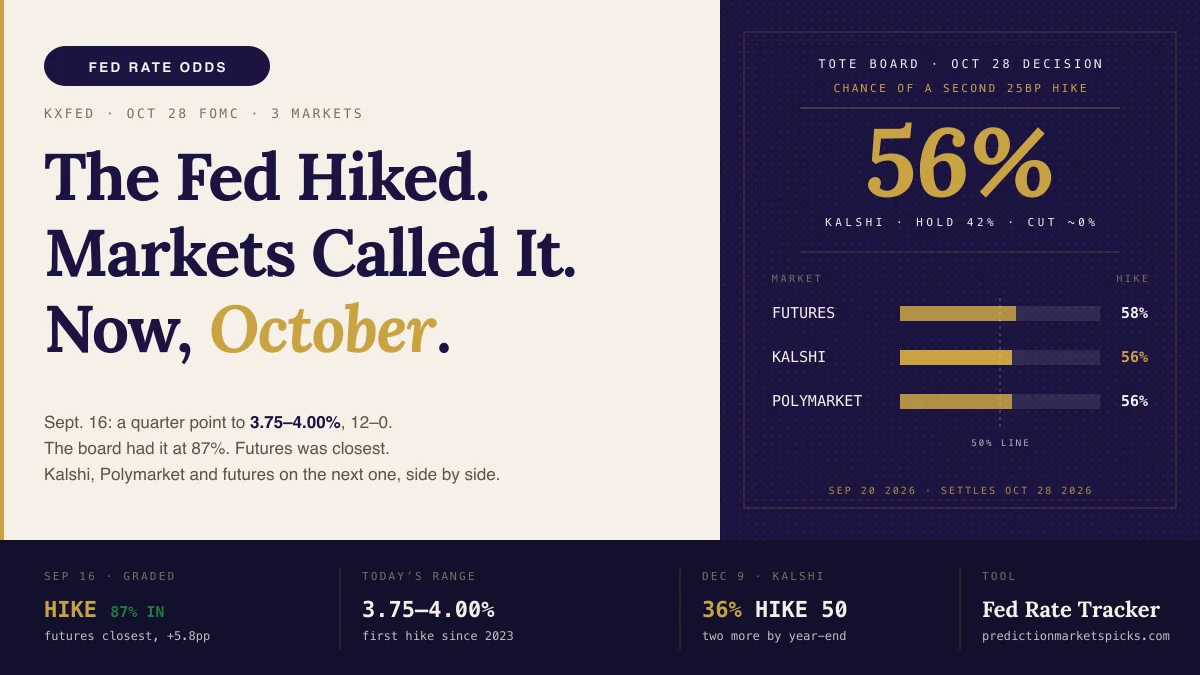
The current target range is 3.75%-4.00%, set at the Sept. 16 meeting on a 12-0 vote. That was the first hike since 2023, and the market had it at 87% on Kalshi going in. We wrote up the October setup when the hike odds collapsed from 71% to 28% at the turn of the month; the Oct. 14 print put a good chunk of that back.
December is where the real move is
The October number is the headline, but the path is the story. After the print, Kalshi prices the Dec. 8-9 meeting as:
- Hold: 10%
- Hike 25 bp: 61%
- Hike 50 bp: 27%
Put plainly, the market now has the fed funds rate higher by year-end at roughly nine in ten. Whether the Fed goes in October or waits for December is the open question; whether it goes at all is, in the market's read, mostly settled. The full 2026-27 rate path is on the tracker.
If you are new to how these contracts resolve, how KXFED settles covers it. The short version: the contract pays on the upper bound of the target range the FOMC announces, nothing else.
The tape at midday
Every asset moved the way a hot inflation print says it should:
- 2-year Treasury yield: 4.93%, up 14 basis points. The 10-year rose to about 5.28%-5.31%, up 6-10 bp depending on the print time.
- Dollar index: 102.75, up 0.55%, an 18-month high. EUR/USD fell 0.64% to 1.1127.
- S&P 500: down 0.9% at 7,734. Nasdaq: down 1.4%. The Dow was roughly flat.
- Gold: down about 1.5% to the $4,090 area, from around $4,150 before the print.
- Silver: down about 3% to roughly $57.40, the worst of the four.
- Bitcoin: off under 1% near $82,700. Softer, not routed.
- WTI crude: up 1.4% to $95.47. Brent $106.50.
The oil move is the one that matters for the next CPI. Gasoline was already the largest contributor to September's headline number, and crude rallying on the day the Fed gets more hawkish is not the combination that gets inflation back to target on its own.
What it means for the Kalshi gold, silver, oil and bitcoin markets
This is the macro view behind the micro moves. Kalshi runs 15-minute up-or-down markets on gold, silver, WTI, bitcoin and more, plus hourly bitcoin strikes and daily strikes on the metals and crude. A CPI print does not change what any single 15-minute window is — a coin flip with a lean — but it changes the lean, and it changes the volume.
Here is what the board looked like at noon ET, with the share of the last 96 windows (roughly the prior 24 hours of trading) that settled up:
| Series | Settles on | Up share, last 96 windows | Contracts, last 96 windows |
|---|---|---|---|
| Gold (KXGOLD15M) | Pyth gold | 42.7% | 37.6M |
| Silver (KXSILVER15M) | Pyth silver | 39.6% | 4.6M |
| WTI (KXWTI15M) | Pyth WTI | 53.1% | 10.5M |
| Bitcoin (KXBTC15M) | CF Benchmarks | 50.0% | 288.4M |
| Platinum | Pyth platinum | 40.6% | 0.6M |
| Copper | Pyth copper | 42.7% | 1.9M |
Three things worth taking from that:
1. Metals were already leaning down before the number. Gold had settled up in fewer than 43% of windows over the prior day and silver under 40%. That is not a forecast of the next window — see how the 15-minute markets settle for why a window is close to a coin flip — but it tells you the dollar bid was already in the tape before CPI confirmed it. Our read on gold and silver 15-minute markets covers the mechanics.
2. Oil is the one trading with the macro, not against it. WTI is the only one of the four up on the day and the only one with an up share over 50% going in. The daily Oil Edge strike is where the model actually has an opinion; the 15-minute series is pure tape.
3. Bitcoin's 15-minute market is the volume. 288 million contracts over 96 windows dwarfs everything else combined. Our one published rule on these markets — the top-of-hour momentum rule on Bitcoin Edge 15-Min, still in WATCH mode — called DOWN on the 9:00 AM ET window on Oct. 14 and won; the paper record stands at 421 windows seen, 160 fills, +2.99¢ per contract net, with a 90% confidence band that still dips below zero, which is why it is WATCH and not a pass. How Kalshi settles hourly bitcoin explains the index.
A macro day is also the day the fee math gets punished. Every 15-minute contract pays a per-contract fee at the fill, and a run of high-volatility windows tempts people into trading every one. The fee math on 15-minute bots is the piece to re-read before you do that.
The daily strike tools — Gold Edge, Silver Edge, Oil Edge and hourly Bitcoin Edge — had no published model run as of noon ET on Oct. 14; the engine publishes its next run on schedule and the live edge, if any, will be on those pages, not here.
What to watch before the Oct. 28 decision
- Fed speakers. Every scheduled appearance before the blackout is now a repricing event. The Kalshi contract moves on the words, not the data.
- PPI and retail sales. Both land before the meeting. A soft PPI takes the October hike back toward 25%; a hot one and the hold is a coin flip.
- The divergence page. When one venue leads a move by more than a few points, it usually closes within the session. That is on the Fed Rate Tracker divergence page, updated every 15 minutes.
- Oil. If crude keeps rallying into month-end, the October CPI (released in November) is set up to be hot again, and the December hike-50 contract at 27% is the one that moves.
If you take a position on the Fed contract, size it with the Kelly calculator and remember the thing we keep saying: the market favorite is 14-for-14, and as of Oct. 14 it is still a hold.
Prices and odds in this article are as of noon ET on Wednesday, Oct. 14, 2026. The Fed Rate Tracker and the 15-minute board update continuously; the numbers there supersede the ones here.