

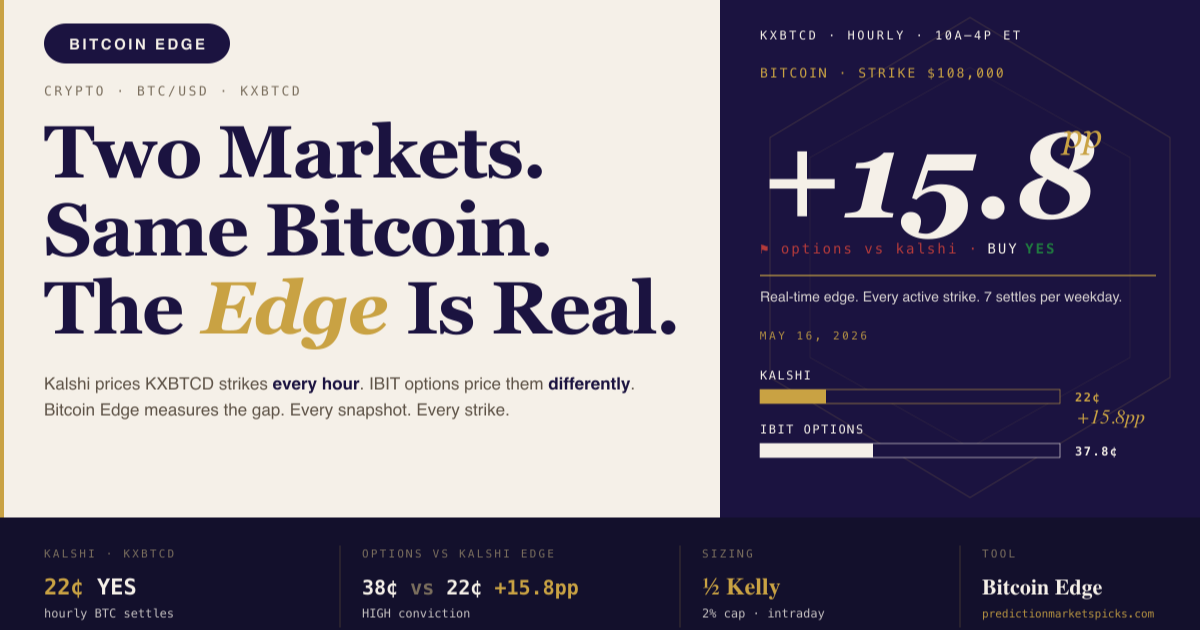
Kalshi's KXBTCD market settles a new bitcoin contract every hour, twenty-four hours a day. Bitcoin Edge only signals on seven of them — the ones at the top of each hour from 10 AM through 4 PM Eastern, when the IBIT options chain on BlackRock's spot-bitcoin ETF is trading live on the same underlying.
The other seventeen hourly settles fall outside the US equity-options session, when the IBIT chain is closed and any model-implied probability would be extrapolating from a frozen book. We don't publish signals there. The tool is dormant by design from 4:00 PM ET to 9:30 AM ET the next morning, and across weekends.
This article is the honest read on why the seven live-chain settles are the entire trading product, what the structural edge actually is, and exactly how the model prices it.
What is the thesis behind Bitcoin Edge?
That an options chain on the same underlying is an independent second opinion on a Kalshi price. A binary contract on Kalshi pays $1 if a condition resolves YES, $0 otherwise. The contract price is a probability statement: a 22¢ YES on "bitcoin above $108,000 by 2 PM ET" means the market is collectively saying there's a 22% probability of that outcome.
An equivalent statement is hidden inside any liquid options chain on the same underlying. Black-Scholes — the same equation that prices IBIT calls and puts on any US broker — contains a probability term: N(d2), the risk-neutral probability that the underlying ends above the strike. That number is exactly what a Kalshi YES contract is supposed to represent.
When those two numbers disagree by more than the round-trip trading cost, you have an edge.
Which hourly bitcoin settles does Bitcoin Edge cover?
Seven a weekday, 10 AM through 4 PM ET — the structural reason Bitcoin Edge only covers seven settles per weekday is a hard mismatch between Kalshi's 24/7 hourly cadence and the US equity-options session schedule. The comparison table:
| Hour (ET) | Kalshi KXBTCD | Pyth BTC spot | IBIT options chain | Bitcoin Edge |
|---|---|---|---|---|
| 9 AM | OPEN, settle at 9:00 | LIVE | CLOSED (opens 9:30) | dormant |
| 10 AM – 4 PM | OPEN | LIVE | LIVE | fires every snapshot |
| 5 PM | OPEN, settle at 5:00 | LIVE | CLOSED (closed at 4:00) | dormant |
| 6 PM – overnight | OPEN, hourly settles | LIVE | CLOSED | dormant |
| Weekends | OPEN, hourly settles | LIVE | CLOSED | dormant |
The first row is why even the 9 AM settle is dormant: the options chain opens at 9:30 AM, half an hour after the Kalshi 9 AM settle has already printed. By the time we have an IBIT data point, the contract is already resolved.
The last several rows are why we don't run an overnight product. The seventeen hourly settles between 5 PM and 9 AM the next morning are all real Kalshi contracts you can trade — they're just contracts where our model has no honest input from the comparison side. Publishing a signal off a 4 PM frozen IV surface against a 2 AM Kalshi book would mean asserting probabilities the model can't actually compute. We don't do that.
Why does the BRTI print anchor the model?
Because settlement source determines truth. Kalshi publishes the settlement source for every series in its settlement_sources metadata. For KXBTCD the source is the CF Benchmarks BRTI — Bitcoin Reference Rate Intraday — the same institutional-grade reference that anchors CME bitcoin futures and options. The print is deterministic: at the top of each hour, 60 BRTI prices over the prior minute are averaged into the settlement value.
Our spot reference is the Pyth Network BTC/USD feed, which aggregates from the same major exchanges that feed CF Benchmarks — Coinbase, Kraken, Bitstamp, LMAX. The two prints track to single basis points at any given second. The number on the Bitcoin Edge tool page is functionally the same number Kalshi will settle on.
That alignment matters more than it sounds. Most "bitcoin price" feeds you see online — TradingView crypto widgets, single-exchange tickers, broker quote screens — pull from one venue with its own latency. If your model uses a feed that's even one exchange away from the BRTI reference, you're modeling a slightly different question than the one Kalshi is settling.
Why are IBIT options the right comparison for a Kalshi bitcoin contract?
Because IBIT tracks spot bitcoin and carries the deepest options chain of any US spot ETF. IBIT is a physically-backed bitcoin ETF. BlackRock holds bitcoin in trust; share price tracks spot BTC with a small management-fee drag and tight tracking. Among the cluster of US spot-bitcoin ETFs (FBTC, ARKB, BITB, HODL), IBIT has by far the deepest options chain — tight spreads on at-the-money strikes, open interest in the tens of thousands of contracts at the front-month expiry.
Two reasons this beats other options sources:
- Same underlying.
- A Kalshi market on bitcoin spot and an IBIT option are both positions on the same asset. The translation is one multiplication: K_ibit = K_btc × (IBIT_price / BTC_spot). The ratio sits near $0.000580 per dollar of BTC, with sub-1% daily drift from management fees and creation/redemption flow.
- Honest IV.
- We don't trust scraped implied-volatility fields. We back-solve IV ourselves from each option's traded price using Brent's method on Black-Scholes, then build a smile across the chain. Numbers we publish are computed, not scraped. This matters more on bitcoin than on metals — BTC implied vol runs 50–80% annualized vs 25–35% for silver and gold, so any quantization error in a scraped IV field amplifies into multi-point probability errors.
How does Bitcoin Edge compute the edge, step by step?
For each Kalshi strike K on an active KXBTCD event whose settle is during the 10 AM – 4 PM ET window:
1. Translate K from BTC-$ to IBIT-$ space:
   K_ibit = K * (IBIT_price / BTC_spot)

2. Look up implied volatility at K_ibit from the IBIT smile.

3. Apply Black-Scholes to BTC spot directly:
   d1 = [ln(S/K) + (r - q + σ²/2)·T] / (σ·√T)
   d2 = d1 - σ·√T
   P(S_T > K) = N(d2)

4. Pull Kalshi's executable YES price:
   - tight book (≤10¢ spread): use mid
   - wide or one-sided book: use mid if both sides exist, else last
   - never trust a stale last_price over a live two-sided quote

5. Edge in percentage points:
   edge_pp = options_prob - kalshi_yes_implied
A positive edge means the options market thinks bitcoin is more likely above K than Kalshi prices. BUY YES. A negative edge means options think it's less likely. BUY NO.
Why are Bitcoin Edge's confidence tiers tighter than the metals'?
Because bitcoin's hourly window is a different animal — the bitcoin engine uses a different tier ladder than silver, gold, and oil. Here's why and what the thresholds are:
- HIGH — edge ≥ 15pp AND tight two-sided book AND strike within ±3% of spot
- MEDIUM — edge ≥ 10pp with reasonable liquidity, or any edge with a wide-spread caveat
- LOW — edge between 5pp and 10pp. Real but small after costs
- PASS — edge below 5pp or no executable book
- SKIP — IV could not be back-solved (typically because the IBIT strike is too far from the chain to interpolate)
The metals engines run 10pp HIGH / 8pp MED / 5pp LOW. Bitcoin is tightened by 5pp at the top of the ladder because BTC implied vol is 2–3× higher. A 10pp edge on silver represents a meaningful probability mismatch given silver's 25–35% IV regime. A 10pp edge on bitcoin — where IV runs 50–80% — is closer to noise. The ladder is calibrated so that a HIGH-tier bitcoin call carries the same conviction as a HIGH-tier silver call after volatility normalization.
The bitcoin board surfaces fewer HIGH-tier rows than silver or gold on a typical day. That's the design. We'd rather print fewer signals at higher quality than spray.
What does a Bitcoin Edge signal look like?
The engine just installed this week, so real worked examples will populate as snapshots accumulate. The shape the tool surfaces:
Event:           KXBTCD-26MAY1814  (closes 2:00 PM ET, May 18)
Spot:            $107,420 (Pyth BTC/USD, 17:23 UTC)
ATM IV:          62% annualized (IBIT June-monthly smile)
Time to settle:  43 minutes

Strike $108,000:
  Kalshi YES (mid):  22¢
  Options-implied:   37.8%
  Edge:              +15.8pp
  Direction:         BUY YES
  Tier:              HIGH
  Volume 24h:        1,840 contracts
The read on a row like that: Kalshi is pricing $108K-by-2-PM at 22% probability. The IBIT smile, translated through the ETF-to-spot ratio, is implying 37.8%. That's a 15.8pp gap, above the HIGH threshold, with a strike inside ±1% of spot and meaningful 24-hour volume. The model thinks Kalshi is underpricing the move. Take YES.
Sigma sanity-check: with spot at $107,420 and IV at 62%, the daily standard deviation is roughly $107,420 × 0.62 × √(1/252) ≈ $4,200. A move to $108,000 from $107,420 in 43 minutes is a 0.07-sigma move — well inside the noise band. Kalshi's 22% prices it as a meaningful unlikelihood. Black-Scholes prices that exact move at 37.8%. The gap is the trade.
Worked examples from real signals will land on the Bitcoin Edge tool page as soon as the engine fires its first HIGH-tier call inside the live-chain window.
What does Bitcoin Edge NOT do?
Four things, in case the framing is unclear:
- Not a 24/7 product. Bitcoin Edge covers seven hourly settles per weekday. The other seventeen daily settles and the entire weekend Kalshi calendar are not covered — by design, not by oversight.
- Not a price prediction. The model does not predict where bitcoin closes. It compares two pricing channels and surfaces gaps. If both channels are wrong by the same amount, the gap is zero and the tool reports no edge — even if bitcoin moves $5,000 that session.
- Not financial advice. Kalshi contracts are regulated by the CFTC. Position sizing, risk tolerance, and tax treatment are your problem. The tool surfaces a probability mismatch; what you do with it is on you.
- Not an options data feed. The tool publishes derived signals only: edge percentage, tier, recommendation, the Kalshi reference, and our spot reference. The options layer is internal calculation — raw option quotes aren't part of the public surface.
How do you use Bitcoin Edge in a trading workflow?
The pattern that works:
- Start with HIGH-tier rows. Those passed all four liquidity guards (edge magnitude, distance from spot, spread, volume). MEDIUM and LOW rows are actionable but carry caveats — read the rationale field before sizing.
- Trade only the in-window settles. The tool's grid only shows events whose settle falls between 10 AM and 4 PM ET on the current trading day. If you see an interesting Kalshi KXBTCD market outside that window, the tool isn't covering it — make your own call.
- Verify on Kalshi. Click through to the live book before entering. Snapshots refresh in real time during chain hours but books change second to second on liquid strikes.
- Size with fractional Kelly. Use the Kelly calculator at 0.5×. Full Kelly on bitcoin edges is a fast way to blow up — the model is good, but BTC can gap 5% in a single news cycle. Cap at 2% of trading account per position, 5% across correlated strikes.
- Hold to the hourly settle. Don't day-trade the Kalshi leg. The edge is structural and shows up at the BRTI print at the top of the hour, not on minute-to-minute price action.
How does Bitcoin Edge fit the rest of the Edge series?
Bitcoin is the fourth engine on the same architecture that powers Silver, Gold, and Oil:
| Engine | Kalshi series | Settlement | Underlying ETF | Spot source | Cadence |
|---|---|---|---|---|---|
| Silver Edge | KXSILVERW | Friday 5 PM ET | SLV | Pyth XAG/USD | Weekly |
| Gold Edge | KXGOLDW | Friday 5 PM ET | GLD | Pyth XAU/USD | Weekly |
| Oil Edge | KXWTI | Daily 2:30 PM ET | USO | WTI continuous | Daily |
| Bitcoin Edge | KXBTCD | Hourly, top of hour | IBIT | Pyth BTC/USD | Hourly (10 AM–4 PM ET) |
Same formula. Same tier-ladder concept (calibrated per asset). Same fractional Kelly sizing discipline. Same publication posture: derived signals only on the public surface. How our commodity engines work covers the cross-asset framework if you want the deeper take.
FAQ
What is Bitcoin Edge?
A real-time tool that compares the model-implied probability of bitcoin closing above each strike on Kalshi's hourly KXBTCD market against Kalshi's own YES contract price for that strike, for the seven hourly settles per weekday that are covered by a live IBIT options chain. When the two diverge by more than the round-trip trading cost, the tool flags the strike as a tradeable edge — BUY YES, BUY NO, or PASS — with HIGH / MEDIUM / LOW confidence.
How does Bitcoin Edge calculate the mispricing?
It pulls live BTC spot from Pyth, the live IBIT options chain, and the live Kalshi YES contract price for every active strike on a KXBTCD event whose settle falls inside the 10 AM – 4 PM ET window. Implied volatility is back-solved from the IBIT option price using Brent's method on Black-Scholes; the risk-neutral probability of spot finishing above the Kalshi strike is then N(d2). Edge = options-implied probability minus Kalshi YES price.
When does Kalshi settle KXBTCD?
KXBTCD settles a new contract at the top of every hour, around the clock. The settlement value is a 60-second TWAP of the CF Benchmarks BRTI bitcoin reference rate over the minute leading up to the hour. Bitcoin Edge only signals on the seven hourly settles per weekday from 10 AM through 4 PM ET, when the IBIT options chain on the same underlying is open for trading.
Why doesn't Bitcoin Edge cover overnight settles?
The IBIT options chain — which feeds the implied-volatility surface we compare against Kalshi — only trades during US equity market hours (9:30 AM – 4:00 PM ET on weekdays). Outside that window, the chain is frozen. Publishing a signal off a 4 PM frozen IV surface against a 2 AM Kalshi book would mean asserting probabilities the model can't honestly compute. We don't.
Is Bitcoin Edge free?
The headline row (top edge, direction, tier) is free. The full strike table with edges in pp on every active row is Pro.
What data source does Bitcoin Edge use?
Pyth Network BTC/USD for live spot. The IBIT options chain for the implied-volatility surface. Kalshi for the live KXBTCD YES book. The tool publishes derived signals only — edge percentage, tier, and recommendation. Raw option quotes are not published.
How accurate has Bitcoin Edge been?
The engine just shipped. Real-world calibration evidence will populate as snapshots accumulate. The companion methodology — same model class, two years of replayed silver/gold/oil signals — has held monotonic calibration across all confidence buckets, with strong-call hit rates of 90.3%, 94.2%, and 89.7% respectively. The bitcoin calibration will land once there's a comparable sample.
Use The Tool
The grid above is one snapshot from one trading hour. The tool rebuilds it in real time during chain hours from the Pyth BTC/USD print and the IBIT options surface. Pro subscribers get the full strike table, the daily Discord drop in #premium-alerts when a HIGH-tier call fires, and a public JSON API for embedding the snapshot anywhere.
See it live: the crew demos the Bitcoin Edge — reading the buy/sell signal and the cash-out discipline — on The 7 Oracles roundtable.
Two markets. Same underlying. The market that prices it wrong is the one paying you — and on Bitcoin Edge, we only fire on the hours where the model can honestly tell you which side is which.
Trade responsibly. Position size based on your edge and your bankroll, not on excitement. Prediction-market contracts on Kalshi are regulated by the CFTC.