


Kalshi has started listing commodity contracts that live for fifteen minutes. KXGOLD15M and KXSILVER15M each open a single up-or-down market every quarter hour — 96 of them a day — under a product certification covering 15-minute commodities, and the same shape now runs on WTI crude oil, natural gas, copper, platinum and palladium. This page starts with gold and silver, which PredictionMarketsPicks prices live, then covers the other five further down.
They are not smaller versions of the daily metals markets, and PredictionMarketsPicks prices them differently. The dailies are a strike ladder: a dozen or more contracts at different prices on the same expiry, which is what makes an options-implied second opinion possible. These are one binary per window. There is no ladder, and at a fifteen-minute horizon there is no options chain to lean on either — no listed option expires that soon, so there is nothing to extract a fifteen-minute implied volatility from.
That sounds like it should make them unpriceable. It doesn't, and the reason is worth understanding.
What does a Kalshi 15-minute gold or silver contract settle on?
The close of a 1-minute Pyth candle, against a reference price that locks at the window's open — each contract resolves against the close of a 1-minute Pyth candle. Specifically: YES if the candle close at the window's end is at or above the candle close at the window's open.
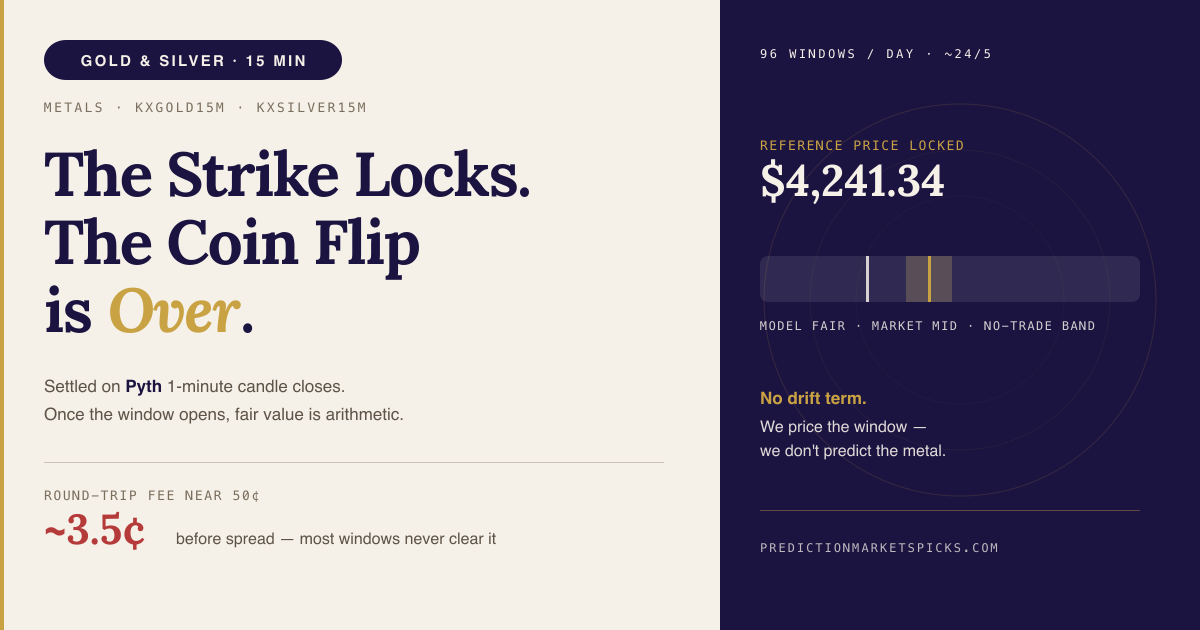
The important consequence is that the second the window opens, the reference price is fixed and public. Kalshi shows it as the target price — $4,241.34 on a gold window, $62.144 on a silver one. From that moment, the contract is not a question about where gold is going. It is a question about whether the price finishes above a number you already know, with a clock you can read.
At the instant of the open, that genuinely is a coin flip. The reference is set to the current price, so up and down are symmetric and 50¢ is right.
Three minutes later it is not. If gold is $1.80 above the locked reference with eleven minutes left, the odds are no longer even — and they are not a matter of opinion. They follow from three things you can measure: how far the price sits from the reference, how long is left, and how much gold has actually been moving lately.
That is the whole calculation:
P(YES) = Φ( (ln(S / K) − σ²τ / 2) / (σ√τ) )
where S is the live price, K the locked reference, τ the time remaining, and σ realized volatility. There is no drift term. We are not forecasting the direction of gold over the next eleven minutes, and neither should anyone else — when we tested a momentum-driven directional model at the hourly horizon, it scored worse than the market's own prices. At fifteen minutes it would be worse still. Setting drift to zero is not a simplification we apologize for; it is what keeps the number a measurement instead of a guess.
PredictionMarketsPicks built Gold Edge 15-Min and Silver Edge 15-Min to show that number live for whichever window is currently open.
Why does settling on Pyth make these markets priceable?
Because Kalshi names the exact feed and publishes the print, so any price we use can be checked against it. These contracts settle on Pyth's metals indexes — Metal.Index.GOLD/USD and Metal.Index.SILVER/USD, named directly in Kalshi's contract terms. Those indexes are gated: no free feed reads them.
So the tools price on a public interbank spot quote and score it against the settlement print Kalshi publishes on every window. Before switching to it on September 23, 2026, interbank spot called the same up-or-down result as Kalshi's own settlement 100% of the time across 244 gold windows and 98.8% across 256 silver windows. Every settlement since is scored automatically, and an alert fires if agreement drops below 95%. The fair value on those pages is computed against a measured proxy, not the settlement number itself — and the page says so.
The 15-minute bitcoin market has the same shape of problem from a different direction: it settles on a 60-second average of the CF Benchmarks Real-Time Index, so pricing it means modelling an average of exchange prices rather than a single print.
One caveat worth stating plainly: settlement reads candle closes, while a live price feed is a stream of ticks. For watching a window unfold that distinction does not matter. For grading what actually happened after the fact, it does, and the candle is what counts.
How much does the Kalshi fee cost on a 15-minute metals window?
About 3.5¢ round-trip near 50¢, before the spread — and that is the part that decides whether any of this is tradeable.
Kalshi charges a quadratic taker fee on these series: 0.07 × P × (1 − P) per contract. In cents:
| Price | Fee per contract |
|---|---|
| 50¢ | 1.75¢ |
| 60¢ | 1.68¢ |
| 70¢ | 1.47¢ |
| 80¢ | 1.12¢ |
| 90¢ | 0.63¢ |
The fee is largest exactly where these contracts spend most of their lives. Near 50¢, entering and exiting costs about 3.5¢ before you pay anything for the spread — and the books quote a few cents wide. Put together, the market has to be roughly two percentage points wrong, after the spread, before a round trip breaks even.
Ninety-six windows a day is a lot of chances to pay that. Trading every window is a reliable way to convert a small edge into a loss, and an excellent way to convert no edge into a large one. This is why both tools draw the cost as a dead zone around fair value rather than printing a signal: most of the time, the honest reading is that there is nothing there. If you want to check a specific entry, the Kalshi fee calculator does the arithmetic.
How much volume do the 15-minute gold and silver markets actually trade?
Roughly 20,000 contracts a window on gold and 7,000 on silver, against 1.8 million on bitcoin — sampling 200 settled windows in early August 2026:
| Series | Avg contracts/window | Median | Max |
|---|---|---|---|
| KXBTC15M | ~1,795,000 | ~1,763,000 | ~3,269,000 |
| KXGOLD15M | ~20,200 | ~19,700 | ~56,700 |
| KXSILVER15M | ~7,200 | ~5,900 | ~25,100 |
Gold runs on the order of one percent of bitcoin's 15-minute volume, and silver less than half of that. But twenty thousand contracts inside a fifteen-minute window is real retail participation, not a ghost market, and the books were quoted two-sided while we sampled.
These are new products, though, and day-three volume can be launch enthusiasm. Treat the table as a snapshot with a date on it rather than a settled fact, and re-check before sizing anything around it. Silver in particular is the thinner book of the two, and thin books are where the difference between a theoretical edge and a filled trade shows up.
The other five 15-minute commodity markets
Kalshi now runs the same up-or-down contract on five more commodities. Every one names Pyth as its settlement source and uses the same wording as gold: the close of the 1-minute Pyth candle at the window's end against the candle close at its start, with "at least" resolving a tie to YES. Contracts traded over each series' last 100 settled windows, read from Kalshi's public API on September 26, 2026:
| Series | Commodity | Contracts, last 100 windows | PredictionMarketsPicks page |
|---|---|---|---|
| KXGOLD15M | Gold | ~34.4 million | Gold Edge 15-Min |
| KXWTI15M | WTI crude oil | ~7.6 million | Coming; the daily ladder is on Oil Edge |
| KXSILVER15M | Silver | ~5.4 million | Silver Edge 15-Min |
| KXCOPPER15M | Copper | ~2.3 million | None yet |
| KXNATGAS15M | Natural gas | ~1.8 million | None yet |
| KXPALLADIUM15M | Palladium | ~1.1 million | None yet |
| KXPLATINUM15M | Platinum | ~1.0 million | None yet |
This is a different measure from the per-window averages above: total contracts across 100 settled windows, a single day's snapshot, not a trend. For scale, bitcoin's 15-minute market traded about 271 million over its last 100.
Crypto runs on a shorter clock too: every 5-minute bitcoin, ether, solana and XRP window's result is on our board of 5-minute crypto markets.
Two things differ by commodity. Hours: on the Friday this was read, gold, silver, copper, platinum and palladium stopped settling at the 5 PM ET close, while oil and natural gas kept settling into Friday night. Check which windows are actually listed rather than assuming a schedule. The oil feed: the Pyth feed Kalshi names for WTI stopped publishing in March 2026, and the front-month future is what reproduces its settlements. How Kalshi's 15-minute markets settle has the full measurement, and the source for every 15-minute series.
How should you actually use a 15-minute metals fair value?
As a question, not a trade: do not treat a gap between fair value and the market as a trade. Treat it as a question.
The plausible edge in a product like this is not prediction — it is a lagging order book during a fast move in the underlying. That is a microstructure claim, and it is testable. We are logging every window where the book sits outside the cost band, and we will grade those against what actually settled. If they beat the market's own pricing net of fees over a meaningful sample, that becomes a product. If they don't, we will say so on the page and leave the tools as what they already are: an honest live read on what the current window is worth.
Until then, nothing here is a pick. There are no alerts, and none of this is scored in our track record.
If you want the version of these markets with a real strike ladder and an options-implied second opinion, that is the daily rung — Gold Edge and Silver Edge. Different product, different question, and for most traders a more forgiving place to start than a contract that resolves before you have finished reading about it.
Trade responsibly. These are prediction-market contracts, not investment advice.
Bitcoin, ether, solana and XRP Up or Down, a new window every five minutes. Every window’s result is on the 5-Minute Board.
A new bitcoin 5-minute window closes every five minutes, on the :00, :05, :10 and so on.