

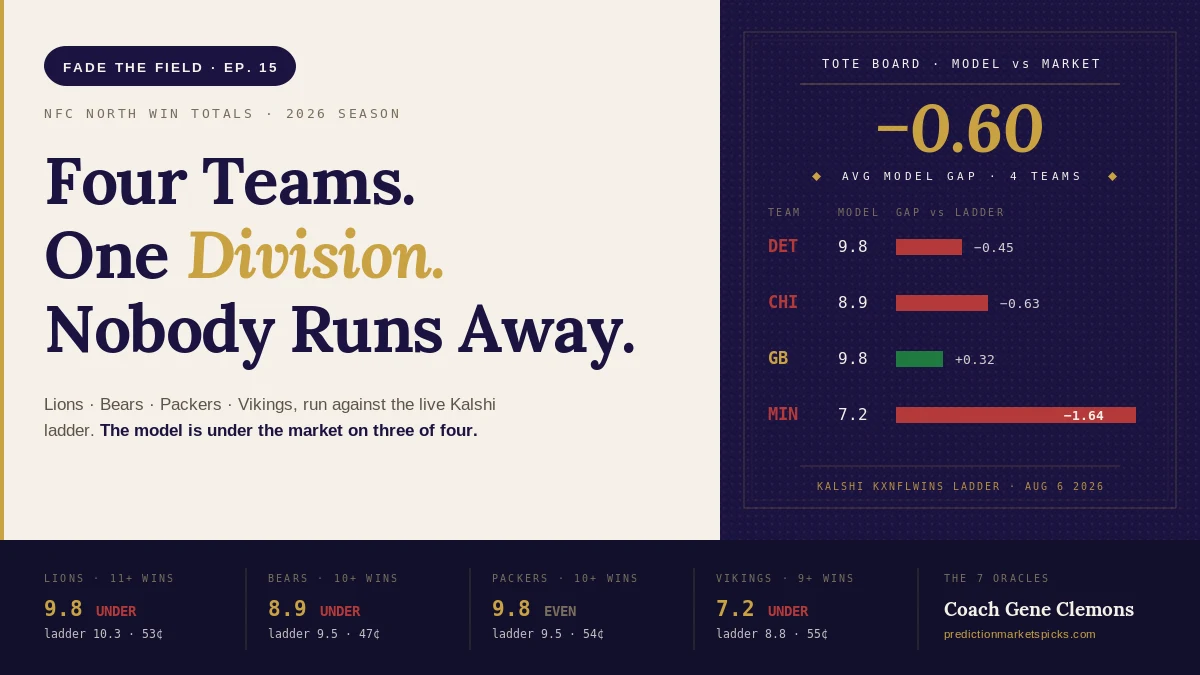
Coach Gene Clemons and Chris James spent Episode 16 of Fade the Field on the division nobody can price: the NFC North, where four teams play winning football and none of them looks like it will run away with anything. The model came back under the market on three of the four. The fourth is a coin flip. And the widest gap on the board is the one both hosts argue against.
The board
| Team | Contract | Kalshi price | Market wins | Model wins | CJ index | Read |
|---|---|---|---|---|---|---|
| Lions | 11+ wins | 53¢ | 10.3 | 9.8 | 9.64 | Under |
| Bears | 10+ wins | 47¢ | 9.5 | 8.9 | 8.87 | No position |
| Packers | 10+ wins | 54¢ | 9.5 | 9.8 | 8.82 | Even — wait |
| Vikings | 9+ wins | 55¢ | 8.8 | 7.2 | 8.92 | Depends on the QB |
"Market wins" is what the full KXNFLWINS ladder implies — every rung from "1 or more wins" through "17," summed. "Model wins" is the 7 Oracles Prediction number quoted on the show; "CJ index" is Chris James' independently built win index. Live prices sit on the NFL Win Totals page; this table is a snapshot from August 6 and the board moves daily.
Note the shape of it. Every team in this division is priced between 8.8 and 10.3 expected wins. That is the tightest band on any division board in football, and it is the single most important fact about trading these four contracts.
Lions — the bye week is the whole argument
The 11+ contract trades at 53¢, the ladder implies 10.3 wins, and the model projects 9.8. Chris James' index landed at 9.64 independently. Two different builds, same side.
The case is not that Detroit got worse. It is schedule shape. Detroit has a Week 6 bye, which sounds like a gift and is closer to a bill: they have to arrive at it already 4-1 for an 11-win season to stay on the table, and the run there is New Orleans, at Buffalo, home for the Jets, at Carolina, at Arizona. Then it does not get easier on the other side. The season closes with three road division games — in a division where every road game is a real game — and Chris James' honest read is they might go 0-3 in them.
There is a second, quieter argument. Detroit finished fourth in the division last year, which normally buys you a soft cross-division draw. This year it bought them New Orleans in Week 1 and Tennessee in Week 14, and both of those clubs are better than the last-place slot implies.
Gene's framing on the coaching seat is worth keeping too: a team this gifted offensively cannot keep coming up short forever before somebody decides the ceiling is the coach. That is not a projection input. It is context for how a 9-win season would get read in Detroit.
Neither host holds this one hard. Both said on air they will revisit before Week 1.
Lions win total on Kalshi → · Full Lions model, schedule & power rating →
Bears — the stay-away
The 10+ contract trades at 47¢, the ladder implies 9.5, and the model projects 8.9. Chris James' index came in at 8.87 — the closest the two builds landed on any team in the division.
And the verdict is still: don't touch it.
That is not a hedge, it is the actual read, and the reasoning is the most useful thing in the episode. Chicago won roughly six games last season that could have gone either way in the final minutes. Caleb Williams may well still have that in him — Chris James thinks he is ascending — but the question is whether the eleven other guys on the field do, every time, again. Chicago can be a better football team this season and post a worse record. Those two things are not in tension; they are the most common outcome for a team that outkicked its coverage.
The schedule pushes the same direction. The winnable games are at home, the difficult ones are on the road, and the opening stretch is Carolina, Minnesota, Philadelphia, at the Jets, then Green Bay — a run that can bury a good team's record before anyone has learned anything about them, and can trigger the kind of in-season overreaction that costs more than the losses did.
So: if you are short the 10+ and Chicago closes at nine or ten on late-game swings, you feel sick for reasons that have nothing to do with whether your analysis was right. When the price and both models agree inside a tenth of a win, there is no edge to collect. Pass.
Bears win total on Kalshi → · Full Bears model, schedule & power rating →
Packers — the only one where the model is above the market, and it still says wait
The 10+ contract trades at 54¢, the ladder implies 9.5, and the model projects 9.8. That is the one green bar on the board — and it is worth being precise about how small it is. A +0.3-win gap is noise, not an edge. The model is telling you Green Bay is fairly priced.
The hosts are still on the no, and the reason is timing rather than disagreement. Chris James' win index has Green Bay at 8.82 even while his record projection is 10-7 — a spread that tells you how much variance is packed into this roster. Micah Parsons is not expected back at anything like full strength until Week 5 or 6, and the back half of the schedule is genuinely unkind: Dallas, Detroit, Carolina, New England, then the Rams, Saints, Bills, at Chicago, Houston, Detroit. His call: halfway through the year they will look like a playoff team, and he does not think they make it.
The structure of the position is the part to steal. Take the no now, while the price still reflects preseason optimism. Then watch the opening four — at Minnesota, at the Jets, home for Atlanta, at Tampa Bay, before Chicago. At 3-1 or 4-1 you close it and reverse. At 2-2 you are already paid, and Green Bay is pressing, which is when they play their worst football.
That is not indecision. That is a plan with two exits, which is what you want on a contract the model calls even.
Packers win total on Kalshi → · Full Packers model, schedule & power rating →
Vikings — the widest gap, and the one to trust least
The 9+ contract trades at 55¢, the ladder implies 8.8 wins, and the model projects 7.2. A 1.6-win gap is the biggest disagreement in the division and the loudest signal on the page.
Both hosts are on the other side of it.
That is the honest headline, and it is more useful than the number. Chris James projects 10 wins, and his argument is hard to dismiss: last season was the floor for this roster. Minnesota played among the worst quarterback football in the league — his comparison was Nathan Peterman throwing more interceptions than completions — and still went 9-8. Brian Flores' defense and Kevin O'Connell's staff are worth nine wins before you name a quarterback. The schedule is awkwardly built, not brutal, and he cannot construct a season where they lose more than eight.
Gene makes the position conditional, which is the version most traders should copy. With Kyler Murray starting, he is on 9+ wins — Murray is motivated, one good year turns into another nine-figure contract, and the "he doesn't play on time" complaint describes a quarterback who never played on time and was an MVP candidate anyway. With JJ McCarthy starting, he wants nothing to do with it. The backfield is average enough that asking the defense to carry a non-playmaking quarterback is a lot to price at 55¢.
So the practical read: this is a depth-chart position, not a projection position. Watch who takes first-team reps in August, and note that the model's own confidence here should be lower than usual precisely because two people who built independent numbers both landed above it.
Vikings win total on Kalshi → · Full Vikings model, schedule & power rating →
Why this division breaks models
Four teams that all play winning football in one division is rare, and it does something specific to win totals: it removes the free games.
When a division is soft, a good team banks four or five wins inside it without playing well. That is how a roster with ten-win talent posts twelve. In this NFC North, the Packers are loading up, the Bears may or may not be real but are not a giveaway, the Vikings have an elite defense and a competent-quarterback problem rather than a roster problem, and the Lions are still the most gifted offense in the group. Six division games, none of them free.
Chris James' framing is the cleanest version: this is the bizarro NFC South. There, somebody has to win it. Here, somebody has to lose it — and last year's fourth-place team still went 9-8. Nobody in this division wins 13 or 14. Nobody wins six.
Compression is why the model sits under the market on three of four. The market is pricing four playoff-caliber teams. The math is pricing four teams that have to beat each other.
There is a roster-building note underneath it too. All four front offices have built through the offensive line and hit on drafted pass catchers rather than paying market rate for veterans — Green Bay paying Christian Watson like a good receiver instead of a top-ten one is the template. That discipline is what funded four simultaneously competitive rosters in one division.
The bill comes due
Not this season, but it prices the next two, so it belongs in the file.
Jahmyr Gibbs has to be paid, and he is going to want current running back money, not the number that was market rate two years ago. Green Bay has a defense full of expensive players and an offense full of guys about to be expensive. Chicago has roughly one more year before Caleb Williams' extension — Gene's number is that it starts at $70 million by the time it lands — and decisions on Rome Odunze and a running back room drafted outside the first round, meaning no fifth-year options to lean on.
Minnesota is the exception, and it is the quiet reason to like them: they have a quarterback playing on short money because a previous team still owes him most of his income. That is cap space nobody else in the division has.
How to work this board
The division is compressed, which means the edges are small and the discipline matters more than the read. Three things worth carrying:
Small now, size later. Every preseason projection in circulation, ours included, runs on last season's data plus offseason moves. Nobody has proprietary August information. Both hosts said outright they are revisiting these numbers before Week 1, and the Packers position is explicitly designed to be reversed after four games.
A wide gap is not automatically a big position. Minnesota is the widest disagreement on the board and the one both hosts fade. When the humans who built the inputs sit on the other side of the output, that is information about model confidence, not a signal to press.
When the price and the model agree, pass. Chicago is priced within a tenth of a win of two independent builds. There is nothing to collect there, and the temptation to manufacture a read is how a flat board turns into a losing month.
Every team here has a full model page with its 17-game schedule and per-game win probabilities under NFL team hubs, the division view sits on NFC North, and the rest of the season board — division, conference and Super Bowl markets — lives on NFL futures. If you are new to how these contracts settle, start with NFL markets on Kalshi. The five AFC and NFC West totals from Episode 15 are in Jets, Dolphins, Cardinals, Browns & Raiders, and Seattle's 11-win question is here. Detroit gets a single-team deep dive of its own in Will the Lions regress in 2026? — the case that the regression already happened and landed on the record, not the roster.
Run any of these prices through the Probability Converter to see what the market is actually saying, size the position with Kelly, or stack multiple win totals into one ticket with the Combo Edge Builder — free, no account needed.