

Everybody wants to know if the Lions regress in 2026. It's the wrong question, and the way it's wrong is worth money.
The regression already happened. It hit last season. And it landed on the record, not the roster.
▶ Watch on its own page, with the full transcript →
The 2025 Lions Were Better Than Their Record — and Not by as Much as You've Heard
Start with what actually happened, because most of the takes floating around right now are built on the standings and nothing else, and a few of the ones built on numbers are quoting numbers I can't check.
> Updated 2026-08-21. Two numbers corrected against our reconciled power-ratings board. Detroit's 2025 rank was published here as 8th; on the metric we publish it is 9th (10th on the retired GER scale the 2025 board was ranked by) — the original 8th matched neither. And their 2026 slate is the 4th-easiest, not the 6th — that figure moved again later the same day when we rebuilt the board from the full offseason roster picture, which is what the number is derived from. Neither moves the argument, but both were checkable and one was simply wrong.
Detroit went 9-8 and finished last in the NFC North. Our own power ratings — the same model that feeds the 7 Oracles Prediction board — had them 9th in the NFL for 2025. Not third. Not a secret Super Bowl team. Ninth: a good football team that finished fourth in its own division.
Their Pythagorean win total — what their points scored and allowed say they should have won — was 10.0, 10th in the league, against 481 points for and 413 against. They won nine. Then they lost three of their last four and watched January from the couch.
So the gap between what Detroit was and what Detroit's record said is about one win. That's the honest size of it. Anybody selling you a three-win gap is selling you a number, and I'd ask them where it came from.
What Broke — and Why It Isn't a Skill
One win doesn't sound like much. It's the whole reason this market is mispriced, so let me prove where it went instead of waving at "they were unlucky."
The coin flips came up tails, and this one is enormous. There were 32 fumbles available to Detroit last season — 10 of their own and 22 they forced. They recovered nine of them. 28.1%. The league average is 50.1%, and Detroit's recovery rate was the worst in the NFL, 32nd of 32. Fumble recovery is close to a coin flip, it does not repeat year to year, and finishing dead last in it costs roughly a game.
The offensive line was never the same line twice. Detroit used nine different starting five-man combinations across 17 games. Their most-used five started six of them. For a team whose entire offensive identity is built on running the ball and protecting Jared Goff with five guys who know each other's footwork, that is the season in one number.
The defense was banged up — but let's be accurate about it. Detroit's defensive starters missed 56 games, against a league average of 47. That's 8th-most in football: real, above average, and not the worst in the league. It's a tailwind for 2026, not a lottery ticket.
None of that is a skill. All of it regresses positively. That's the bull case, and it's real — it's just a one-win bull case, not a three-win one.
Here's where I get off the bus.
Positive Regression Gets You to Ten. The Calendar Caps It There.
Everyone stops at "the underlying team was better than 9-8" and jumps straight to "so they win 12." That skips the part where you have to actually play the schedule.
Detroit's 2026 slate is genuinely soft. Run every opponent on their schedule through our own 2026 power ratings and Detroit draws the 4th-easiest slate in the league, which is the prize for finishing fourth in the division. That's already in the price. Everybody can see it.
What's not in the price is the shape of it.
The bye is Week 6. That means to be on an 11-win pace when Detroit gets its rest, they have to come out of New Orleans, at Buffalo, the Jets, at Carolina and at Arizona at 4-1. Not 3-2. Four and one, with a road trip to Buffalo and two more road games inside the first five weeks. That is a real ask for a team replacing two offensive line starters and installing a new offensive coordinator.
And the back end is worse. Detroit closes with three road division games in its last four — at Minnesota in Week 15, at Chicago in Week 17, at Green Bay in Week 18 — in the most compressed division in football, where all four teams play winning football and the fourth-place finisher went 9-8. Those aren't games you pencil in. Those are games that decide whether the number is 9 or 12.
So the honest projection: the quality bounce-back is real, and it gets Detroit to about ten wins. The 7 Oracles Prediction model has them at 9.8. Chris James' independent win index landed at 9.64. That's the same team, a better injury year, and a record that looks awfully similar to last one.
Regression in record, not in quality. And here's the part that matters — the market is pricing the opposite.
The Market Read: Fair at the Floor, Rich Everywhere Above
This is where a ladder market earns its keep. Kalshi lists win totals as KXNFLWINS — one event per team, built as a stack of "at least N wins" contracts. You don't just get a midpoint. You get the whole distribution the market is pricing, and you can check each rung against your own number independently.
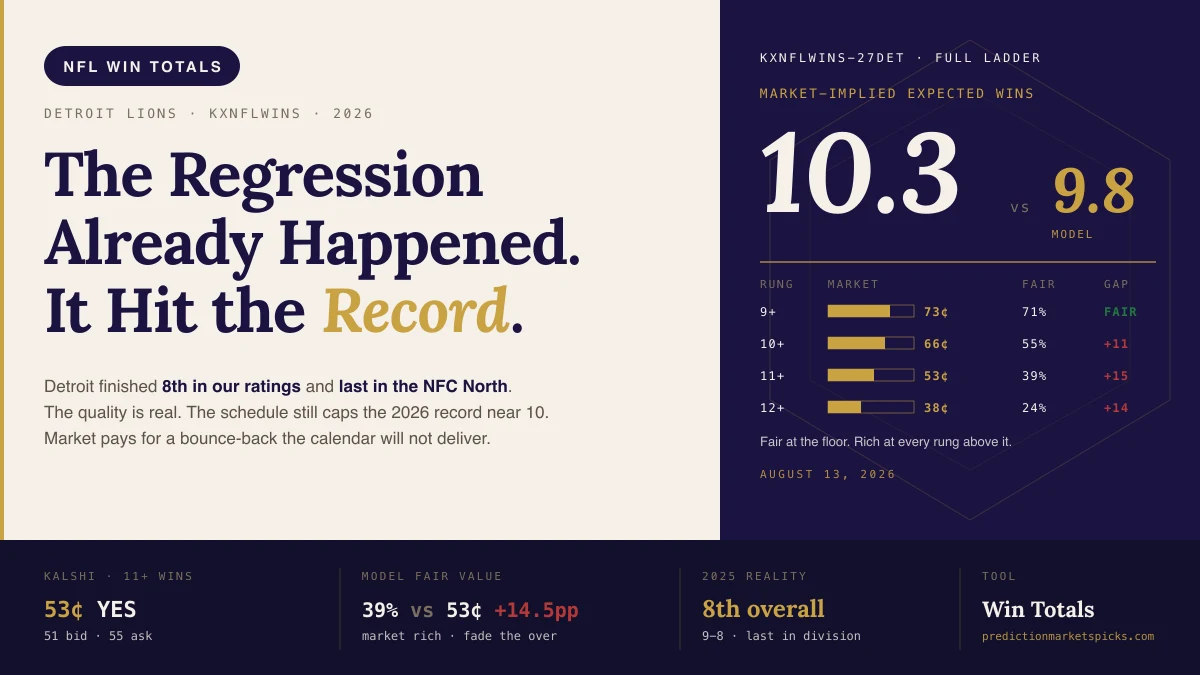
Here's Detroit's board as of August 13, 2026, run against a 9.8-win mean with a 2.4-win standard deviation:
| Rung | Market | Model fair | Gap |
|---|---|---|---|
| 9+ wins | 73¢ | 71% | fair |
| 10+ wins | 66¢ | 55% | +11pp rich |
| 11+ wins | 53¢ | 39% | +15pp rich |
| 12+ wins | 38¢ | 24% | +14pp rich |
Sum the full ladder and the market is pricing 10.3 expected wins. The model says 9.8. A half-win gap in the mean doesn't sound like much — but look at where it actually lives.
The market has Detroit's floor priced correctly. At 9-or-more wins, 73¢ against a 71% model read is inside the spread. There's no trade there and I wouldn't pretend there is.
Every rung above it is rich, and the gap widens as you climb. That's the market paying up for the quality bounce-back — pricing last season's efficiency profile, not the schedule that team has to play. It's the correct instinct applied without checking the calendar.
The cleanest expression is the 11+ contract. Taking the no side costs about 49¢ and the model says it's worth about 62¢ — roughly a 12-point edge paying the offer, on the rung with the widest gap and the tightest book on the board.
Run it yourself: drop 53¢ into the probability converter to see the market's implied number in whatever format you think in, then size it with the Kelly calculator. Quarter-Kelly on those inputs comes out around 6% of a bankroll, and I'd treat that as a ceiling rather than a target — the whole position rests on the model's mean being right, and no preseason win-total model has earned that much confidence in August.
What Kills This Position
I'd rather tell you than have you find out in December.
The defense gets healthy and re-rates. Fifty-six starter-games missed is a real tax, and the players coming back are the good ones. If Brian Branch comes back clean from a December Achilles instead of opening on PUP, and Kerby Joseph's knee is a short story, that safety duo alone changes the unit's ceiling. A top-five defense on that schedule is a 12-win team, and the 12+ contract is worth 24¢ for exactly that reason — not zero.
Petzing unlocks Goff. New OC Drew Petzing brings the under-center play action Goff is best at, and the split is stark: last season Goff averaged +0.37 expected points added per dropback from under center against +0.10 from shotgun, and Detroit ranked 2nd in the NFL in under-center efficiency. If the line gels faster than expected — Penei Sewell flipping to left tackle, first-rounder Blake Miller at right tackle, Cade Mays at center — the offense could jump a tier, and the model's mean is too low.
Gibbs as a true bell cow. With David Montgomery gone, Jahmyr Gibbs goes from roughly 55% of the backfield to a 70%+ share. Volume like that behind this line is a different kind of problem for defenses than what Detroit showed last year.
I'll also name the disagreement honestly: the market is at 10.3 and we're at 9.8, and the half-win between those two numbers is a real argument, not a mispricing anyone should feel smug about. The money on the other side is weighting the talent-and-health bounce-back more heavily; we're weighting the bye placement and the closing road division games. If you think Detroit's health regresses all the way back to neutral, you should be on the other side of this, not mine.
The Bottom Line
The Lions don't regress in 2026, because the regression already happened. Last season was the regression — a top-eight football team that finished fourth in its own division because it never fielded the same offensive line twice, played most of the year without a healthy back seven, and recovered fumbles at the worst rate in the National Football League.
Fix all of that and you get a ten-win team on an easy schedule with a hard calendar. That's a good football team. It is not the 11-and-12-win team the board is charging you for.
The market has the floor right and the ceiling wrong. Take the no on 11+, keep it small, and revisit the whole thing the week Branch and Joseph get cleared.
Detroit's full model page — the 17-game schedule, per-game win probabilities and the live KXNFLWINS ladder — is on the Lions team hub. Full division context in our 2026 NFC North win totals breakdown, and every team's ladder on the NFL win totals board.