

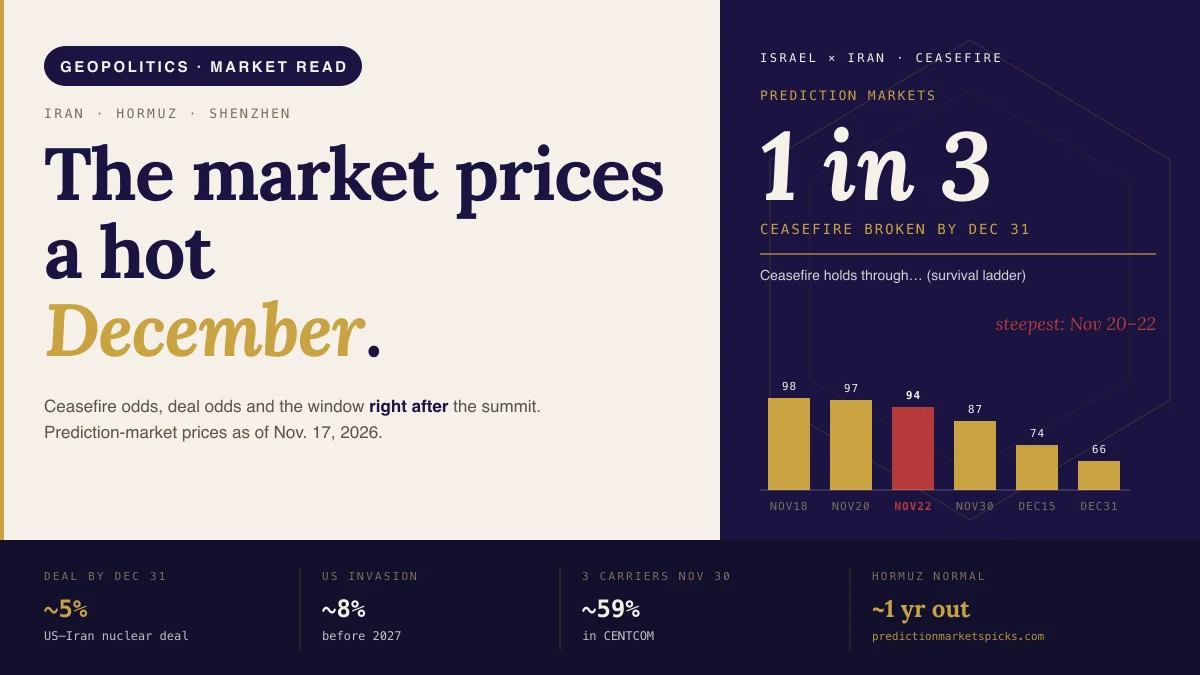

NEW YORK — Prediction markets have a one-line read on the Iran war going into Thursday's Trump–Xi–Putin meeting in Shenzhen: frozen conflict with a fuse. The market prices a hot December, with roughly a one-in-three chance the Israel–Iran ceasefire breaks by New Year's and the risk front-loaded into the two days right after the summit. A deal this year is near zero. A ground war is a tail. The money sits in the middle: strikes and blockades, no treaty, no invasion.
Prices as of 7:57 AM ET, Tuesday, Nov. 17, 2026. Polymarket US prices are the mid of a two-sided book read from the Polymarket US gateway; Polymarket.com prices are the mid of its order book; Kalshi prices are the bid and ask on its public API.
Sponsored by Polymarket US
US Users: Featured Price Not Available; Informational Use Only.
18+ Only. Restrictions and eligibility requirements apply. Not available in all jurisdictions. Trading is risky. 100% loss can occur. See https://polymarketexchange.com/files/legal/Polymarket%20US%20Rulebook%20(2026.09.30).pdf for more information. The Polymarket US App serves as an independent software provider and affiliate of Polymarket US and Polymarket Clearing, the CFTC-regulated exchange and clearing organization.
Where the war actually trades
The first thing to know about Iran war odds is that most of them are not on US-regulated venues at all.
| Question | Polymarket.com (international) | Polymarket US | Kalshi |
|---|---|---|---|
| Ceasefire breaks, strikes, invasion, war declaration, regime change | Yes, deep: $55.9M traded on the ceasefire ladder, $80.4M on "US invades Iran before 2027" | No | No |
| US–Iran nuclear deal | Yes | Yes: deal by date, and what a 2026 deal contains | No open market |
| Strait of Hormuz traffic | Yes | Yes: return to normal, traffic hits zero | Yes: KXHORMUZNORM (IMF PortWatch transits) |
| US embassy in Iran reopens | No | No | Yes: KXIRANEMBASSY |
US-regulated venues price the economic and diplomatic proxies. The kinetic questions, the ones that ask whether the shooting starts again, trade only on Polymarket.com.
There is a written reason. The Commodity Exchange Act lets the CFTC find an event contract contrary to the public interest if it involves unlawful activity, terrorism, assassination, war or gaming (7 U.S.C. 7a-2(c)(5)(C)), and the CFTC's own rule is flatter: a registered exchange "shall not list" a contract that "involves, relates to, or references terrorism, assassination, war, gaming, or an activity that is unlawful" (17 CFR 40.11). A deal or a shipping count is a contract about diplomacy and trade. A ceasefire break is a contract about war. Where that line sits for any single contract is the CFTC's call, but it explains the map.
The fuse: the ceasefire ladder
Polymarket.com runs a ladder on "Israel x Iran ceasefire continues through…?" with $55.9 million traded. Read it as a survival curve and it says when the market expects the risk, not just whether.
US Users: Featured Price Not Available; Informational Use Only.
| Ceasefire holds through | Yes | Drop from prior date | Implied break risk per day |
|---|---|---|---|
| Nov. 18 | 98.3% | — | — |
| Nov. 20 | 97.1% | 1.2 pts | 0.6% |
| Nov. 22 | 93.5% | 3.6 pts | 1.9% (peak) |
| Nov. 30 | 86.5% | 7.0 pts | 1.0% |
| Dec. 15 | 73.5% | 13.0 pts | 1.1% |
| Dec. 31 | 65.5% | 8.0 pts | 0.7% |
The per-day column is the conditional rate: the chance it breaks on a given day in that window, given it held to the start of it. Three things stand out.
- About one in three by year-end. 100 minus 65.5 is 34.5%.
- The steepest step is Nov. 20 to Nov. 22, the 48 hours right after Shenzhen, at nearly 1.9% a day, about three times the rate the market prices for the two days before.
- December stays warm. The Nov. 30 to Dec. 15 stretch runs at about 1.1% a day, above late November's pace.
The ships are part of that December read. The USS Theodore Roosevelt strike group left San Diego on Sept. 27 (Migflug) and reached Singapore on Nov. 6, with a US official saying it would not enter Central Command's area before mid-November (Army Recognition). It is expected to relieve the George Washington, alongside the George H.W. Bush, which means a possible temporary three-carrier overlap. Polymarket.com's "How many US aircraft carriers in CENTCOM on November 30?" prices three at 58.5% and two at 35% (informational only). It is a thin book, about $5,000 of resting liquidity per outcome, so treat it as a lean, not a measurement.
What the market won't pay for: a ground war or a deal
The tails are where the market is most decisive. On Polymarket.com (informational only):
US Users: Featured Price Not Available; Informational Use Only.
| Market | Yes |
|---|---|
| US invades Iran before 2027 | 7.5% |
| US officially declares war on Iran by Dec. 31 | 1.6% |
| Kharg Island no longer under Iranian control by Dec. 31 | 3.6% |
| Iranian regime falls before 2027 | 3.1% |
| Iran leadership change by Dec. 31 | 7.5% |
| US–Iran final nuclear deal by Dec. 31 | 5.5% |
| US announces end of the Iranian blockade by Dec. 31 | 18.5% |
| US announces end of the blockade by March 31, 2027 | 53.5% |
| Next senior US–Iran diplomatic meeting by Dec. 31 | 21.5% |
The deal number is worth a second venue. Polymarket US prices "US-Iran Nuclear Deal?" by Dec. 31 at 6 cents and by March 31, 2027 at 33 cents. Polymarket.com's separate final-deal book sits at 5.5% for Dec. 31. Two sets of traders on two books land in the same place: no deal this year, roughly one in three by spring. Polymarket US also lists what a 2026 deal would contain, and every line on it trades between 5 and 9 cents (dilution of Iran's uranium at 9, a 5% enrichment cap at 7), which is the same answer asked a different way.
Where would talks happen if they happen? Polymarket.com's venue market has "no meeting by Dec. 31" at 77%, with Qatar the favorite among the venues at 11.7% (informational only).
The Strait is a 2027 story
Shipping is where all three venues overlap, and it is the longest-dated read in the set.
- Kalshi
KXHORMUZNORMasks whether the 7-day average of transit calls through Hormuz, as IMF PortWatch reports it, goes above 60. Before Jan. 1, 2027 trades at 3.7 to 4.1 cents; before April 1, 2027 at 15 to 16; before July 1, 2027 at 36 to 37; before Dec. 1, 2027 at 52 to 53. The market's median for a normal Strait is about a year out. - Polymarket US "Strait of Hormuz Traffic Returns to Normal?" prices Dec. 31 at 4 cents, Jan. 31, 2027 at 11 and Feb. 28, 2027 at 14. Its separate "Strait of Hormuz traffic hits zero by Dec. 31?" market, zero ship transits on any day, trades at 55 cents.
- Polymarket.com has Hormuz back to normal by Dec. 31 at 4.5% (informational only).
That last Polymarket US number is the quiet one. The market thinks the Strait is slightly more likely than not to see at least one day with no transits at all before New Year's, and close to certain not to be back to normal. A Strait that stays disrupted is the market's base case. The daily lane boards are on the shipping lanes page.
Kalshi also lists "Will the US reopen its embassy in Iran before Jan. 1, 2027?" at 1.2 to 1.9 cents.
Shenzhen: what is on the table
The White House said Trump, Xi and Putin will meet Thursday in Shenzhen on the sidelines of the APEC summit, and a senior US official said Trump would discuss the Iran war and nuclear arsenals and steer away from Ukraine (AP via KPTV). Kremlin spokesman Dmitry Peskov told TASS the meeting is set for Nov. 19, with no agreements expected (Hürriyet Daily News). Shenzhen is 13 hours ahead of New York, so the meeting lands on Wednesday evening, ET.
The pressure on the Iran file is on the record. Israeli Prime Minister Benjamin Netanyahu pressed Trump for a new wave of strikes after the US midterms, and Trump would not commit; Secretary of State Marco Rubio said he "hasn't made a decision" (AP via the Anchorage Daily News). AP also noted that a return to full-scale war could help Netanyahu form an emergency government after his coalition lost its majority in Israel's election.
Polymarket.com runs a mention market on the meeting itself. "Nuclear/Nuke" and "Iran" each trade around 62.5%, "Ukraine" at 47% (informational only). With about $1,000 of liquidity per word, it is a read on what traders expect to hear, not a forecast to lean on.
The oil cross-current
Iran is not the only supply story. Ukraine's drone campaign has cut Russian oil refining capacity by around 30%, according to Reuters figures cited by the Atlantic Council, with nine of 35 major refineries hit in about 10 days. Pair that with a blockaded Hormuz and both shocks land on crude and diesel at once.
The markets on the Ukraine side don't price a quick fix either. On Polymarket.com (informational only), a Russia–Ukraine ceasefire agreement by Dec. 31 trades at 9.5 cents, by March 31, 2027 at 35.5 and by June 30, 2027 at 52.5; an energy ceasefire by Dec. 31 is at 14.5 cents. A crude oil all-time high by March 31, 2027 is also at 14.5 cents.
What would move these numbers
Four things you can watch, and the market each one would hit first:
- A readout from Shenzhen that names Iran. Any joint language on de-escalation hits the Nov. 20 and Nov. 22 rungs of the ceasefire ladder and the senior-meeting market. Silence on Iran is information too.
- The Roosevelt arriving in CENTCOM. A confirmed three-carrier overlap moves the carriers market and the December rungs.
- A resumed-strike announcement from either side. That is the event the ceasefire ladder exists to price; it would collapse every rung past the date at once.
- A date and a venue for senior US–Iran talks. That moves the meeting markets first, then the Polymarket US deal ladder's March rung.
None of this is a call on how the war goes. It is what the market is pricing, and where. The live boards are on the Iran war odds page and the geopolitics hub. New to reading a price as a probability? The probability converter turns any contract price into implied odds, and Learn covers how these markets settle.