

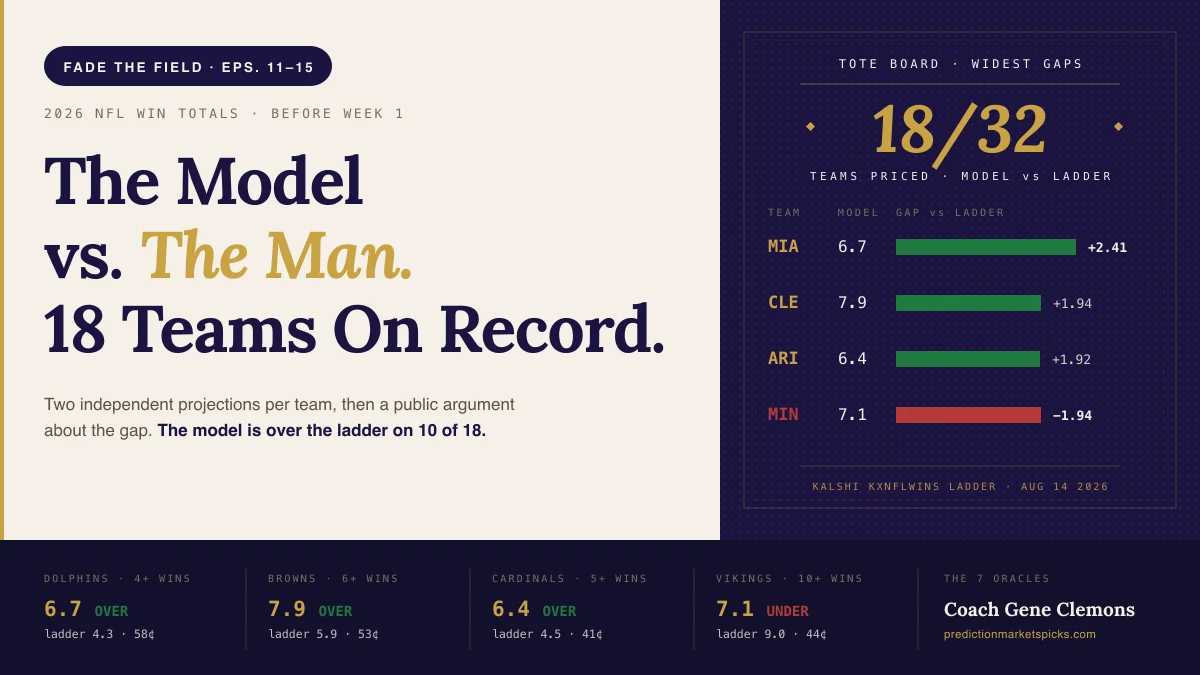
Across five episodes, Fade the Field has put a number on 2026 win totals for **18 of 32 NFL
teams** — every one of them on tape, before Week 1, with a stated position attached.
That is the part worth paying attention to. Not the show. The record.
Two numbers, and an argument about the gap
Most shows in this space give you one number and a take. Coach Gene Clemons and Chris James
run a different format, and it is the reason the series is worth indexing.
Every team gets two independent projections. The 7 Oracles model produces one from power
ratings and a simulated 17-game schedule. CJ produces a separate win index by hand, without
looking at the model first. Both get published. When they line up, that is a signal. When they
don't — Minnesota came back at 7.1 from the model and 10.0 from CJ — nobody averages them into
a mush. They argue it on tape, and somebody states a position anyway.
A spread and a disagreement is the actual shape of a market. One number and a take is not.
The board — all 18 teams
| Team | Contract | Kalshi | Ladder wins | Model wins | Gap | Ep. |
|---|---|---|---|---|---|---|
| Dolphins | 4+ wins | 58¢ | 4.3 | 6.7 | +2.41 | 15 |
| Browns | 6+ wins | 53¢ | 5.9 | 7.9 | +1.94 | 15 |
| Cardinals | 5+ wins | 41¢ | 4.5 | 6.4 | +1.92 | 15 |
| Patriots | 10+ wins | 58¢ | 9.8 | 11.0 | +1.17 | 12 |
| Jets | 6+ wins | 48¢ | 5.6 | 6.5 | +0.86 | 15 |
| Jaguars | 10+ wins | 46¢ | 9.0 | 9.5 | +0.48 | 13 |
| Buccaneers | 8+ wins | 57¢ | 8.0 | 8.3 | +0.32 | 14 |
| Seahawks | 11+ wins | 54¢ | 10.6 | 10.8 | +0.22 | 12 |
| Packers | 10+ wins | 54¢ | 9.6 | 9.7 | +0.08 | 16 |
| Steelers | 9+ wins | 44¢ | 8.1 | 8.2 | +0.06 | 13 |
| Saints | 8+ wins | 55¢ | 7.8 | 7.7 | −0.10 | 14 |
| Rams | 12+ wins | 56¢ | 11.6 | 11.3 | −0.38 | 12 |
| Lions | 11+ wins | 53¢ | 10.3 | 9.9 | −0.49 | 16 |
| Bears | 10+ wins | 50¢ | 9.6 | 8.9 | −0.64 | 16 |
| Texans | 11+ wins | 47¢ | 10.0 | 9.2 | −0.76 | 13 |
| Broncos | 10+ wins | 57¢ | 9.9 | 9.0 | −0.82 | 13 |
| Raiders | 7+ wins | 45¢ | 6.5 | 5.6 | −0.88 | 15 |
| Vikings | 10+ wins | 44¢ | 9.0 | 7.1 | −1.94 | 16 |
*"Ladder wins" is what the full KXNFLWINS ladder implies — every rung from "1 or more wins" to
"17," summed. "Kalshi" is the mid price on the pivot contract shown. Snapshot taken August 14,
2026; the board moves daily, and live prices sit on the
Ten over, eight under. The model is not systematically more optimistic than the market — but
the disagreements are lopsided in size. The three widest gaps are all overs, and all three are
teams the market has already written off.
The three the market has given up on
Miami, Cleveland and Arizona carry gaps of 1.9 to 2.4 wins. They are also the three cheapest
stories to tell: a team that lost its one-score games, a team that traded its best defender, and
a team nobody can find a favorable matchup for.
The structural argument the show keeps returning to is that **the market lets narrative price
contracts more than numbers do.** The Raiders get a Super Bowl-winning coordinator and the number
one pick and the story writes itself into the price. Cleveland loses Myles Garrett and the price
moves as if a middle-of-the-pack defense fell apart — when a premium edge rusher is what pushes a
contender over the top, not what turns a seven-win roster into a four-win one.
That is where a gap this wide comes from. It is not that the market is bad at football. It is
that a bad season is a much easier sentence to write than a mediocre one, and mediocre teams
still win games nobody allocated to them.
A caution that came straight off the air, though: on Arizona both hosts sat below their own
model. CJ walked the schedule and couldn't find the wins — "I don't think they're favored in a
single game prior to their bye" — and the quarterback situation carries a real downside tail the
midpoint doesn't capture. A wide gap is not automatically a large position.
Dolphins → · Browns → · Cardinals →
Minnesota — where the two numbers split hardest
The widest gap in the other direction is also the only place on the board where the hosts sit
above their own model, and it is the clearest illustration of why the format exists.
The model projects 7.1 wins. The ladder implies about 9.0. On its face that is a fade — the
biggest one available.
CJ wrote down 10. His case: last season was the floor. Minnesota still went 9-8 with the worst
quarterback play in the league, behind Brian Flores' defense and Kevin O'Connell's staff. A team
that wins nine games at its worst does not project to seven.
Gene refused to state an unconditional position at all. His answer was the quarterback: over if
Kyler Murray starts, under if JJ McCarthy does.
Three legitimate numbers on one team — 7.1, 10.0, and "it depends who takes the first snap." An
average of those would have been the least useful output available.
Vikings win total on Kalshi → · Full Vikings model & schedule →
Where the model and the man actually agreed
Worth flagging, because agreement is a different kind of signal:
- Lions — model 9.9, CJ's index 9.64. Both on the no against the 11+ contract at 53¢. The
case is schedule shape: a Week 6 bye that requires Detroit to be 4-1 beforehand, and three road
division games in the closing month.
- Bears — model 8.9, index 8.87. So close that the verdict was no position at all. Chicago
won roughly six coin-flip games last season and can be a better football team with a worse
record.
- Packers — model 9.7, index 8.82. Micah Parsons isn't expected back at full strength until
Week 5 or 6, and the closing stretch is brutal. The stated play was the no now, with an
explicit plan to reverse after the first four games.
- Raiders — model 5.6 against a ladder at 6.5. The lone fade where hosts and model agreed
outright. Rookie quarterback, rookie head coach, three double-digit-win teams in the division.
That Packers line is the one to copy as a habit. **A position with a stated reversal condition
attached is a better position than a confident one.**
Tanking is a fan theory
One thing worth killing, because it misprices these contracts every single year.
Nobody inside a building is trying to lose. Coaches on the hot seat cannot afford it — you lose
fourteen games, you earn the number one pick, and then you are fired and somebody else drafts the
quarterback. The only real tanking is a half-time decision in Week 18 when the pick is
mathematically live and the season is already dead.
That matters directly here, because several of the widest gaps on this board sit on teams priced
as though losing were somebody's plan. It isn't. It is just what happens to rosters without
infrastructure — and rosters without infrastructure still win games the market never allocated to
them.
The 14 teams still to come
Bills, Eagles, Ravens, Cowboys, 49ers, Falcons, Colts, Bengals, Chiefs, Chargers, Giants,
Panthers, Commanders, Titans.
Fourteen teams left, and then it is a complete board — 32 teams, two independent numbers each,
every one of them stamped before a snap was played. At that point it stops being a podcast series
and becomes something you can grade in public, which is what this brand already does everywhere
else and hasn't yet done here.
How to actually work this board
Three rules the series has earned:
- Trade against the story, not against the team. The gap lives where the narrative is
easiest to write.
- Size for August, not for December. Every projection in circulation — ours included — runs
on last season's data plus offseason moves. Nobody has proprietary information right now.
Start small; size up around Week 4 when real games have repriced the ladder.
- Write down the reversal condition before you enter. If you can't name the thing that would
make you flip, the position isn't finished.
Each of these teams has a full model page with its 17-game schedule and per-game win
probabilities under NFL team hubs, the rest of the season board sits on
NFL futures, and if you want to size a position properly the
Kelly calculator and probability converter are
free to use. New to how these contracts settle? Start with
The episodes
- Ep. 16 — Lions, Bears, Packers, Vikings ·
- Ep. 15 — Jets, Dolphins, Cardinals, Browns, Raiders ·
- Ep. 14 — Buccaneers, Saints, plus LSU and a LeBron destination ·
- Ep. 13 — Broncos, Jaguars, Steelers, Texans ·
- Ep. 12 — Rams, Seahawks, Patriots ·
Analysis, not advice. Contracts settle after Week 18. Trade responsibly.