

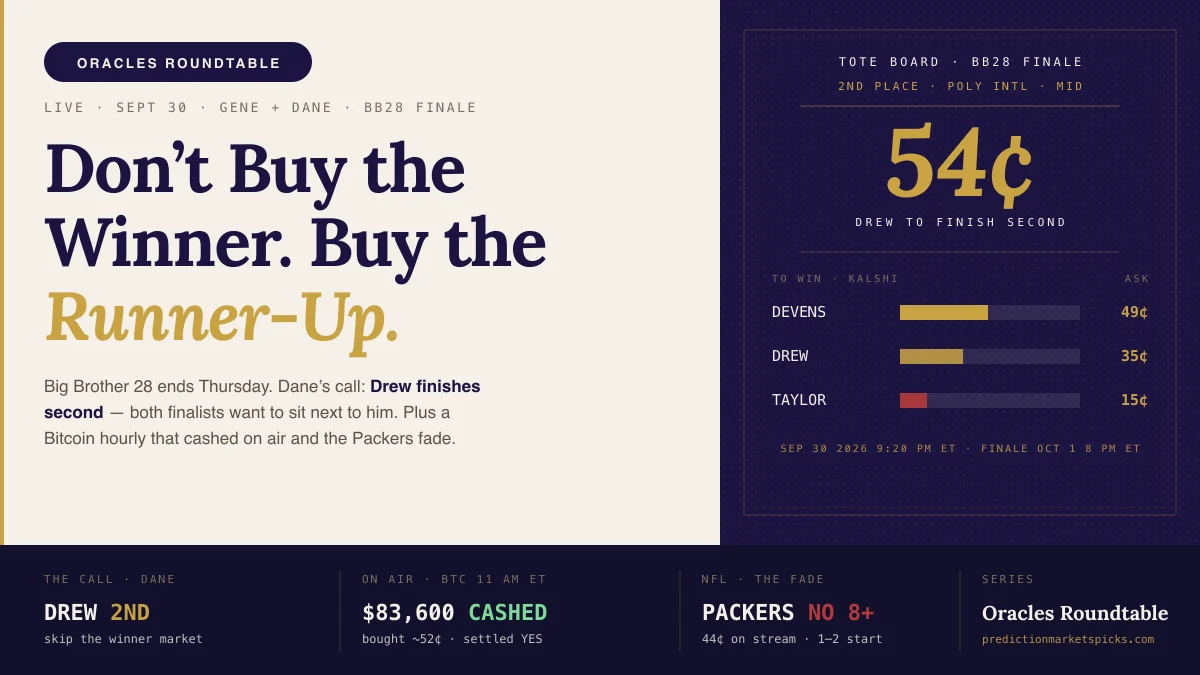
The cleanest trade on this week's roundtable never touched the market everyone was looking at.
With Big Brother 28 ending Thursday, Dane Martinez skipped the winner board entirely and went to the second-place market. Coach Gene Clemons did the same thing with Dancing with the Stars: don't pick the champion, pick who survives the week. The rest of the hour ran on the same idea — a Kalshi Bitcoin hourly that cashed on air, a rushing-touchdown price that has already doubled, and a Packers win total that both hosts want to fade.
▶ Watch on its own page, with the full transcript →
What's in this episode
| Chapter | ||
|---|---|---|
| 0:00 | Intro + what's on the board | watch → |
| 3:20 | Dancing with the Stars: Taylor Hanson out, the Tatyana Ali play | watch → |
| 9:59 | Fan vote vs. judges — why big fan bases survive | watch → |
| 14:38 | Big Brother 28 finale: skip the winner, buy second place | watch → |
| 17:41 | Why Survivor 51 has no markets | watch → |
| 22:00 | Live: the Kalshi Bitcoin hourly | watch → |
| 26:57 | Strike selection: the "hook" on a Bitcoin strike | watch → |
| 31:00 | NFL after three weeks: what's real | watch → |
| 32:38 | Derrick Henry, rushing-TD leader: 14% → 31% | watch → |
| 35:08 | Fading the Packers win total | watch → |
| 40:03 | The Bitcoin hour settles | watch → |
| 41:38 | iOS app on the way + wrap | watch → |
Big Brother 28: why Dane skipped the winner market
Three houseguests are left — Rick Devens, Drew Campbell and Taylor Brown — and the finale is a 90-minute live show Thursday, Oct. 1, at 8 p.m. ET on CBS. The last Head of Household picks who sits next to them in front of the jury.
Dane's read starts from that one decision:
- If Devens wins the final HOH, he takes Drew. He knows a Taylor final two "could be something of a tossup," and he believes he beats Drew.
- If Taylor wins it, she cuts Devens, because she does not want to face his résumé, and takes Drew. The jury, Dane argues, leans toward the alliance Taylor ran with in the middle and late game.
- Either way, Drew is sitting in the final two — and in Dane's view, he loses that vote.
"Both of the other players want to sit next to Drew because they both think they can beat Drew," Dane said. Put it in one line: Drew finishes second.
Here is what the boards said at 9:20 p.m. ET on Sept. 30:
| Houseguest | To win · Kalshi (bid–ask) | To finish 2nd · Polymarket International (bid–ask) |
|---|---|---|
| Rick Devens | 47–49¢ | 4–8¢ |
| Drew Campbell | 34–35¢ | 50–57¢ |
| Taylor Brown | 14–15¢ | 36–40¢ |
Two things jump out.
The market already agrees with Dane on second place — but not on the jury. Drew is the favorite to finish second at about 54¢. But Kalshi still prices Drew to win at about 35¢. Dane's whole argument is that the jury won't pay Drew. If you share that view, the 35¢ Kalshi gives Drew to win is the number you disagree with — and a Drew-runner-up contract near 54¢ is where that disagreement pays.
Devens is a win-or-cut proposition. He is near 48¢ to win and only about 6¢ to finish second, which leaves roughly 45% for third place. That is Dane's tree in prices: either Devens takes the last HOH and wins, or someone sends him to the jury bench.
Dane is not touching the winner board. "There's all sorts of variables and surprises and catches that happen in these reality TV shows," he said. The runner-up market lets you own the strategic read without needing the jury to do anything you can't see.
Two cautions. The second-place price is on Polymarket International — it is not the same order book as Polymarket US, and the prices are not interchangeable. And the spread on Drew's runner-up contract is 7¢ wide; use a limit order near the bid instead of paying the ask.
For the full season of weekly reads, start with Dane's final-four breakdown and the entertainment hub.
Dancing with the Stars: trade the survivors, not the champion
Gene opened with Tuesday night's surprise, Taylor Hanson's elimination, and the play he has run all season: don't try to predict the winner — find the contestants the market keeps underrating to survive each week.
His example is Tatyana Ali. Before Tuesday's results, the market had her about 41% to be eliminated, so the No side cost about 59¢. She survived. Gene's point is that her winner price barely matters — she sits at 0–1¢ to win on Kalshi — because the money is in the weekly No. As the hosts put it: if she gets through six more episodes, you go six-and-one on that approach, and the one loss doesn't erase the five wins.
Why it works: the vote is 50% judges, 50% fans. Tatyana Ali and Julia Stiles bring 20-year fan bases from The Fresh Prince and 10 Things I Hate About You. Guillermo gets a nightly push from Jimmy Kimmel Live! on the same network. Fan bases like that keep weaker dancers alive longer than the judges' scores suggest.
Gene added one more angle: athletes tend to go deep because voters know them and watch them improve. The Kalshi Season 35 winner board, as of 9:20 p.m. ET Sept. 30, already leans that way:
| Contestant | To win · Kalshi (bid–ask) |
|---|---|
| Ezra Frech | 44–45¢ |
| Amber Glenn | 12–13¢ |
| Maura Higgins | 12–13¢ |
| Harry Shum Jr. | 11–12¢ |
| Jenna Dewan | 10–11¢ |
| Guillermo Rodriguez | 2–3¢ |
| Tatyana Ali · Julia Stiles | 0–1¢ |
A Paralympic champion at 44¢ and a figure skater near the top is the athlete story, already priced. That is Gene's point exactly: the winner market is crowded, and the weekly survival contracts are where you can still find a price.
Survivor 51: no live show, no market
Survivor 51 premiered without a prediction market, and Dane explained why: it's taped. Big Brother and Dancing with the Stars resolve live. Survivor's result exists months before the first episode airs.
Last season, Dane said, one of 24 contestants was priced at 87% to win at the very start. "That math ain't mathin'." Dane's read: when a pre-taped result is priced like that, somebody already knew. Gene's rule follows from it: if you're not watching it live, stay away unless you are the one with the information. Nando broke down the Survivor 51 gap in a separate piece.
The Bitcoin hourly that cashed on air
At about 10:40 a.m. ET, Nando pulled up the hourly Bitcoin edge board for the 11 a.m. ET Kalshi hour. The board said Yes on $83,600 and pass on $83,700 and $84,000.
- Gene and Dane grabbed the $83,600 Yes on air near 52¢ — close to even money.
- Dane explained the "hook." He often takes one strike lower than the board's pick — $83,500 instead of $83,600 — which moves the price toward 60¢. You get paid less per contract, but you win more often. "Can't go broke making a profit." Gene tends to go the other way, a strike or two higher for a bigger payout.
Then Gene watched the last stretch of the hour on the 15-minute board, where the price moves every second, to decide whether to hold or cash out early. With about 90 seconds left, the board on screen had Bitcoin above $83,800.
Kalshi settled the 11 a.m. hour above $83,700. The $83,500, $83,600 and $83,700 strikes all paid $1 a contract. The $83,800 did not.
One trade is one trade, not a track record. What the segment shows is the process: take the strike the board recommends, choose how much cushion you want, then manage the last 15 minutes. Kalshi's fee is charged on every fill, at 7% × price × (1 − price) per contract — about 1.75¢ at 52¢ — so count it before you calculate your return.
NFL after three weeks: Henry is real, the Packers aren't
Dane asked the question everyone has three weeks into the season: which starts are real, and which are small-sample noise?
Derrick Henry is real. Before the season, Henry to lead the NFL in rushing touchdowns was one of Fade The Field's "no-brainer" plays. Through three weeks, Henry has 6 rushing touchdowns, tied with Josh Allen for the league lead. His Kalshi leader contract has moved from 14% before the season to 24¢ bid / 31¢ ask. Gene credits Lamar Jackson: "He is okay with Derrick Henry getting a direct snap at the goal line." Dane's add: if you hold the season-long contract, a No on Henry scoring in a single game works as a hedge. A quiet week hurts the futures price, and the No pays for it.
The Packers aren't. Dane is down on Green Bay, and his reason is not the receivers — it's the offensive line. "You are not gonna find offensive linemen off the street." Without Josh Jacobs, he doesn't see a run game with any identity, so Jordan Love throws 40 to 50 times a game. That's good for fantasy and for Christian Watson props. It's bad for the win total.
- On the stream, 8+ wins was about 55¢ Yes / 44¢ No. Dane likes the No at 44¢: better than even money that a 1–2 team in this division doesn't reach .500.
- Gene went further: 7+ wins No at about 31¢.
- Gene walked through the schedule: at Tampa Bay on Sunday (matchup page), then Dallas, Carolina, New England, the Rams, New Orleans, Buffalo, Miami and Houston. Dane doesn't see them beating a division rival the way they're playing, and the out-of-division slate doesn't make up the difference.
Those Packers prices are what was on screen during the show, not a fresh snapshot — re-check the board before you enter. If you want to stress-test either side against your own number, run it through the EV calculator.
Also on the show
- Midterms: Dane pointed to the 2026 midterms board, which tracks the gap between where polls forecast races and where markets price them.
- The app: an iOS app is on the way, with Android after that.
- The newsletter is free. The newsletter lands in your inbox several times a week with entertainment, politics, Bitcoin and sports reads like these.
Pro is $150/yr — $111 your first year with code NFL26. Go annual →
More from the collective on the Oracles hub. Trade responsibly.


