


Your order didn't fill because the price moved? That's a different rule: why Kalshi says your order didn't match. A game that ended tied? Kalshi's tie rules. All of it on one page: Kalshi settlement rules.
The rule, in Kalshi's words
Every Kalshi NFL player-prop market carries this note above its rules (quoted from the Seattle vs Denver receptions market, October 14, 2026):
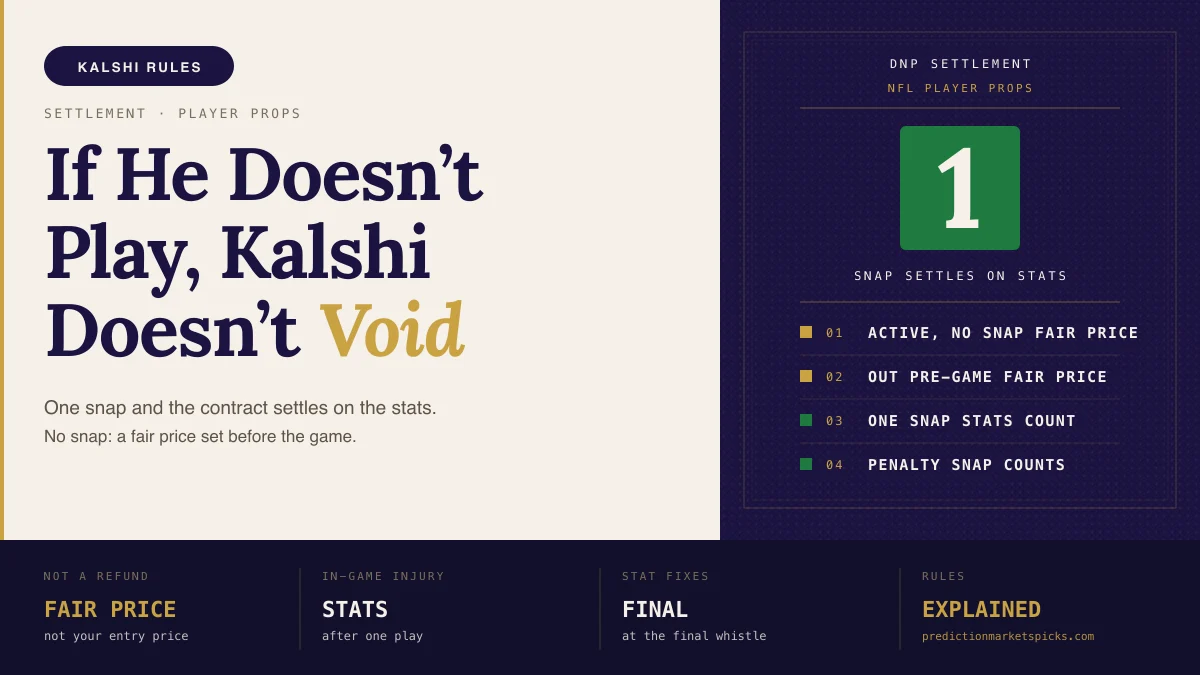
> "If a player is active but never takes a snap, the market settles to a fair price before game start."
The full contract terms (document FOOTBALLENTITYSTAT, which covers player stat markets) spell out the cases:
- Active, no snap: all contracts on that player for that game resolve to the last fair price as determined by Kalshi.
- Ruled out before the game (withdraws, removed or otherwise unable to take part before kickoff): the contracts on that player resolve to the last fair price as determined by Kalshi.
- At least one play: the contract settles on his actual statistics, despite any in-game injury, ejection or removal.
What counts as playing
The rules define participation precisely:
- A play nullified by penalty counts. If he was on the field for it, he played.
- Lining up when a penalty is called before the snap does not count, if he then returns to the bench without taking part in a later play.
- After one play, an injury, ejection or post-game suspension changes nothing. The contract settles on his end-of-game statistics.
"Fair price" is not a refund
"Void" usually means your money comes back. Kalshi does something different: it settles your contract at a fair price it determines, as of before game start, in its sole discretion. You receive that price per contract, whatever you paid.
| You held | You paid | Fair price at settlement | Result per contract |
|---|---|---|---|
| Yes, 60+ receiving yards | 55¢ | 40¢ | −15¢ |
| No, 60+ receiving yards | 45¢ | 60¢ | +15¢ |
The numbers are illustrative; the fair price is set per market. Entry fees are not returned.
How each venue handles a player who sits
| Venue | Player does not play | Source |
|---|---|---|
| Kalshi | Settles at a fair price, not a refund: "will resolve to the last fair price" | FOOTBALLENTITYSTAT terms |
| Novig | Void or push, paid at Fair Market Value: "A trade is voided if the event is cancelled, a player doesn't participate" | Novig settlement help |
Novig's article says the sport-specific conditions sit in each market's contract, so check the contract you are buying.
If the game ends in a tie
On an NFL game-winner contract with no Tie strike listed, the game terms say: "'Yes' holders are paid $0.50, and 'No' holders are paid $0.50." If a Tie strike is listed, that strike resolves Yes and the team strikes resolve No. The full version, with the worked example, is in Kalshi's tie rules.
If the game is postponed
Game-winner contracts get a 48-hour window. A postponed game played inside it keeps the market open, and the terms say it "will resolve based on the official final result." A game not played in that window resolves to the last fair market price.
Player stat contracts run on the same clock: a delay of 48 hours or less keeps the markets open, and a cancelled game, or a delay of more than 48 hours, sends them to the last fair price. A game suspended before 55 minutes of play and not resumed within 48 hours also goes to the last fair price. The same documents cover forfeits and venue changes.
Using the rule before kickoff
The practical risk sits with questionable players. If news breaks that a player will be active but limited, his contracts can still settle on a single snap, so a player who plays one series and finishes with zero catches settles at zero. Our NFL prop board and The Ladder show every Kalshi strike for the week, and the market moves on injury news before the fair price is set. If you're stacking multiple legs on a slate, see how multi-leg pricing works in how Kalshi combos work, and run any posted price through our probability converter or EV calculator before you commit.
If your order on a fast-moving prop wouldn't go through, see why your Kalshi order didn't match.
Rules quoted from Kalshi's published contract terms and market pages, read October 14, 2026, with the tie and postponement terms and Novig's help article read November 4, 2026. Venues can change market rules; the rules panel on each contract governs.