

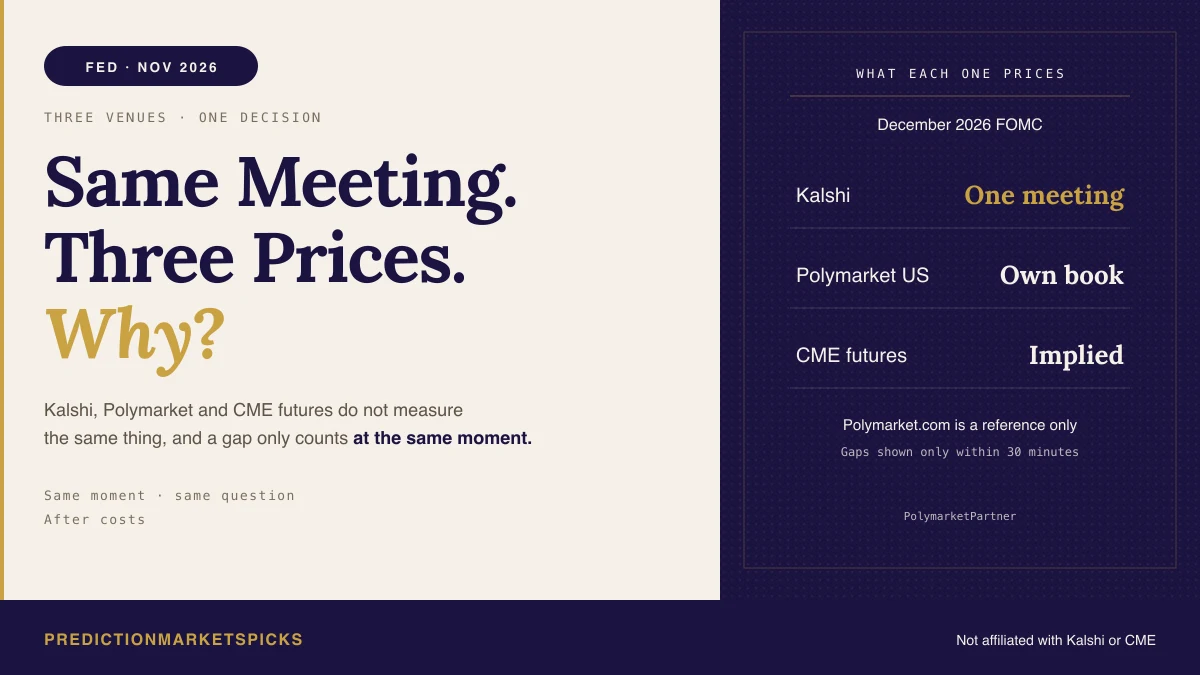
Three venues price the next Fed decision, and on any given day they rarely print the same number. Most of the difference is about what each one measures and when it was read, not a mistake waiting to be traded. As of about 8:35 AM ET on Nov. 6, 2026, Kalshi's December 8–9 decision market was quoted 78¢ to 79¢ on a 25 bps hike, 21¢ to 22¢ on a hold, and 1¢ to 2¢ on a 25 bps cut. The December tracker has the live board.
What each venue is measuring
| Venue | What it prices | What it isn't |
|---|---|---|
| Kalshi | A contract on the decision at one meeting | A forecast of the rate level, which is the separate KXFED series |
| Polymarket US | Its own contracts, one per outcome | The same order book as Polymarket.com |
| Polymarket.com | The international book, shown as a reference | Available to US traders |
| CME futures | An implied probability calculated from fed funds futures | A traded yes-or-no contract |
When a Fed gap means something
A gap is only worth reading if three things hold.
Same moment. Fed prices can jump in minutes around a data release. Two reads taken half an hour apart can look like a disagreement when one venue has simply caught up. Our divergence tool shows no gap when the reads are more than 30 minutes apart, for that reason.
Same question. A per-meeting contract and a cumulative rate-level strike ask different things, so they have to be converted before you compare them.
After costs. A one-point gap can disappear once fees are in. Run it through the fee math before calling it an edge.
How we show the Fed gap
The tracker lays out all of this for the next meeting, and the same read is available to an AI agent through fed_rate_odds. For how the contracts themselves settle, see how Kalshi settles Fed decision markets.
PolymarketPartner: PredictionMarketsPicks is a paid Polymarket partner.
Trade responsibly.