

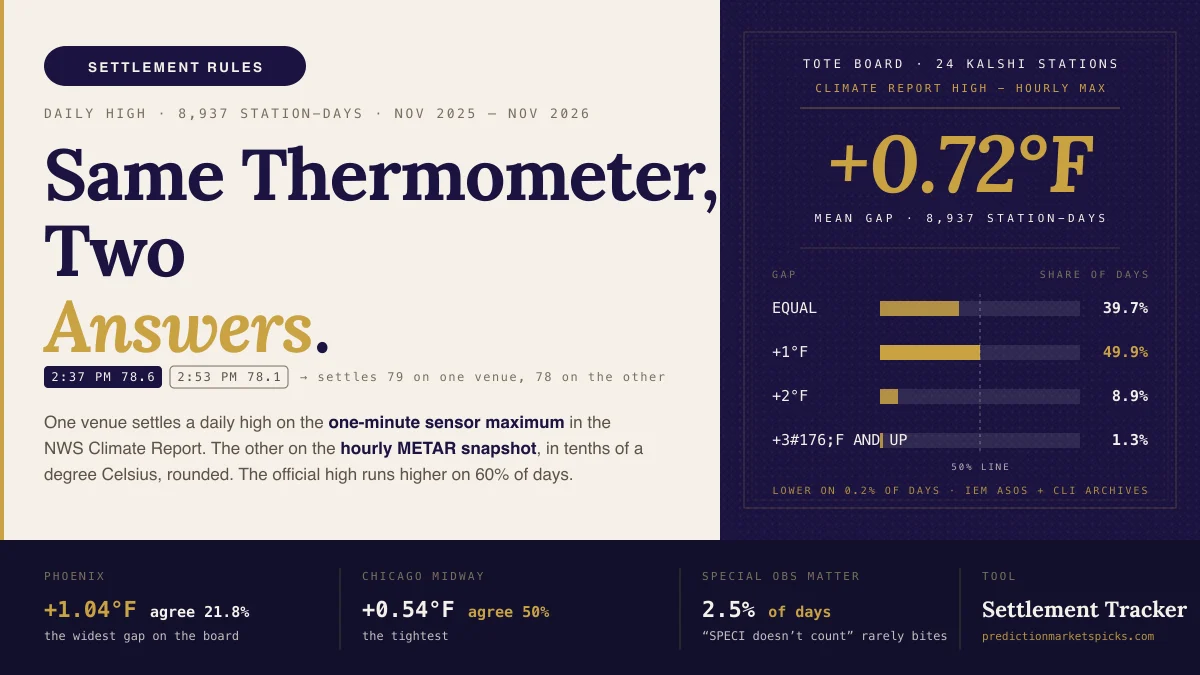
Picture an afternoon at LAX. The sensor touches 78.6°F for a minute at 2:37 PM. The hourly report at 2:53 reads 25.6°C, which is 78.1°F. Kalshi settles the day at 79. Polymarket.com settles it at 78. Both are right.
Kalshi settles on the one-minute sensor maximum in the NWS Climate Report. Polymarket.com settles on the hourly METAR snapshot — tenths of a degree Celsius, rounded half-up, special observations excluded. Same thermometer, two definitions of "the high," and over 8,937 station-days the Kalshi number is higher 60% of the time. In Phoenix the two agree on only 22% of days.
If you trade temperature on either venue, this is the rule that decides more contracts than the forecast does. Here it is in full.
The rules, verbatim
Kalshi, from the market rules for every KXHIGH series (read November 9, 2026): "If the maximum temperature recorded at New York City (CLINYC) for Nov 9, 2026, is greater than 64° fahrenheit according to The Weather Company, then the market resolves to Yes." The secondary rules add that the official value is the maximum temperature as reported by The Weather Company, and that preliminary data may be subject to rounding and conversion differences. Kalshi's help center spells out the source behind that: daily markets settle on the final NWS Daily Climate Report for the station, which uses the local standard-time day — during daylight saving time the day runs 1:00 AM to 12:59 AM. We checked The Weather Company's figure against the Climate Report high on 997 of 998 station-days; they matched. The number to model is the Climate Report high, which is the maximum of the station's one-minute readings.
Polymarket.com, from the resolution text shared by all 48 of its city markets: "The qualifying value is the highest temperature reported in the hourly temperature remark of any routine (METAR) observation for the station on that date, in tenths of a degree Celsius as reported. A report whose line begins with SPECI is a special observation and does not count." If there is no tenths remark, the body temperature group in whole degrees Celsius is used. US events convert with °F = °C × 9/5 + 32, rounded half-up; international events settle in whole-degree Celsius buckets. The day is the station's local clock day. The source is the aviationweather.gov METAR archive, with Weather Underground as the fallback, and corrected reports count.
Polymarket US — the CFTC-regulated venue, a different product from Polymarket.com — does not use the METAR rule. Its daily-high markets for New York, Chicago, Los Angeles, Miami and San Francisco settle on the NWS Climatological Report (Daily) for the same stations Kalshi names: Central Park, Midway, LAX, Miami International, SFO. For those five cities the official high is the same number on both exchanges; what differs is the ladder, which is offset by a degree on most days.
The gap, measured
We pulled a year of routine METARs and a year of Climate Reports for all 24 of Kalshi's US stations and took the difference, Climate Report high minus the routine-METAR maximum under Polymarket.com's rounding, for every day from November 2025 to November 2026.
| Stations | Days | Mean gap | CLI lower | Equal | +1°F | +2°F | +3°F or more |
|---|---|---|---|---|---|---|---|
| All 24 Kalshi stations | 8,937 | +0.72°F | 0.2% | 39.7% | 49.9% | 8.9% | 1.3% |
| 8 stations both venues list | 2,980 | +0.79°F | 0.1% | 35.6% | 51.5% | 10.5% | 2.2% |
| Phoenix | 372 | +1.04°F | 0% | 21.8% | 54.3% | 22.3% | 1.6% |
| Chicago Midway | 373 | +0.54°F | 50% | ||||
| New York Central Park | 373 | +0.58°F | 46% |
Denver, San Francisco, Los Angeles and Miami sit in between at +0.89, +0.88, +0.82 and +0.79°F, agreeing on roughly a third of days; San Francisco hits three degrees or more 4.3% of the time. The season matters too: December through February the gap averages about +0.6°F and the venues agree on half the days; June through August it runs +0.8°F and August agreement falls to 30%, because a desert or coastal afternoon spikes between hourly reports and the one-minute sensor catches what the snapshot misses.
Two smaller findings. Special observations carry the day's maximum above the routine maximum on only 2.5% of days, so Polymarket.com's "SPECI doesn't count" rarely bites. And an hourly watcher that counts every METAR, routine and special, still under-reads Kalshi's settlement by 0.67°F on average and matches it only 41.5% of the time — which is why same-day Kalshi belongs to whoever has the one-minute data.
Three cities, two airports
For eight of the eleven US cities Polymarket.com lists, both venues read the same instrument. Three do not.
New York: Kalshi settles Central Park; Polymarket.com settles LaGuardia. LaGuardia's hourly maximum is above Central Park's official high on 43% of days and below it on 31%, with a mean difference near zero and a wide spread. Chicago: Kalshi settles Midway; Polymarket.com settles O'Hare, which runs 0.83°F cooler than Midway's official number on average. Dallas: Kalshi settles DFW; Polymarket.com settles Love Field, 0.74°F cooler.
A Kalshi price for New York, Chicago or Dallas is therefore a weak guide to the Polymarket.com contract with the same city in its name. It is a strong guide for Polymarket US, which uses Kalshi's stations and Kalshi's settlement report.
Why the rule is written that way
Hourly METAR is public, machine-readable and archived in one place, which makes a resolution source anyone can check. It also makes the resolution a snapshot rather than a maximum, and snapshots can be gamed or broken. In April 2026 Polymarket.com moved its Paris market from Charles de Gaulle to Le Bourget after a disputed station reading swung a market worth roughly $590,000; French press reported that Météo-France filed a criminal complaint. The resolution text now carries a clause holding a market for up to seven days on suspected tampering.
The Climate Report is a maximum over 1,440 one-minute readings, produced by the National Weather Service after the day closes. It is the better definition of "the high," and the harder one to anticipate from a public feed, which is exactly the asymmetry the gap table measures.
What to do with it
Know which number your contract settles on before you look at a forecast. On Kalshi and Polymarket US, model the Climate Report high and expect it to sit about three-quarters of a degree above anything an hourly feed shows you, more in Phoenix, less in Chicago. On Polymarket.com, model the hourly snapshot and remember the city in the title may not be the airport in the rule.
The settlement tracker does this arithmetic live: for every city and each venue's rule, the observation that currently sets the high, the bucket that resolves if nothing beats it, and the countdown to the next routine report. The accuracy scorecard shows how well the market itself reads these numbers, hour by hour, and the weather hub carries the board.