

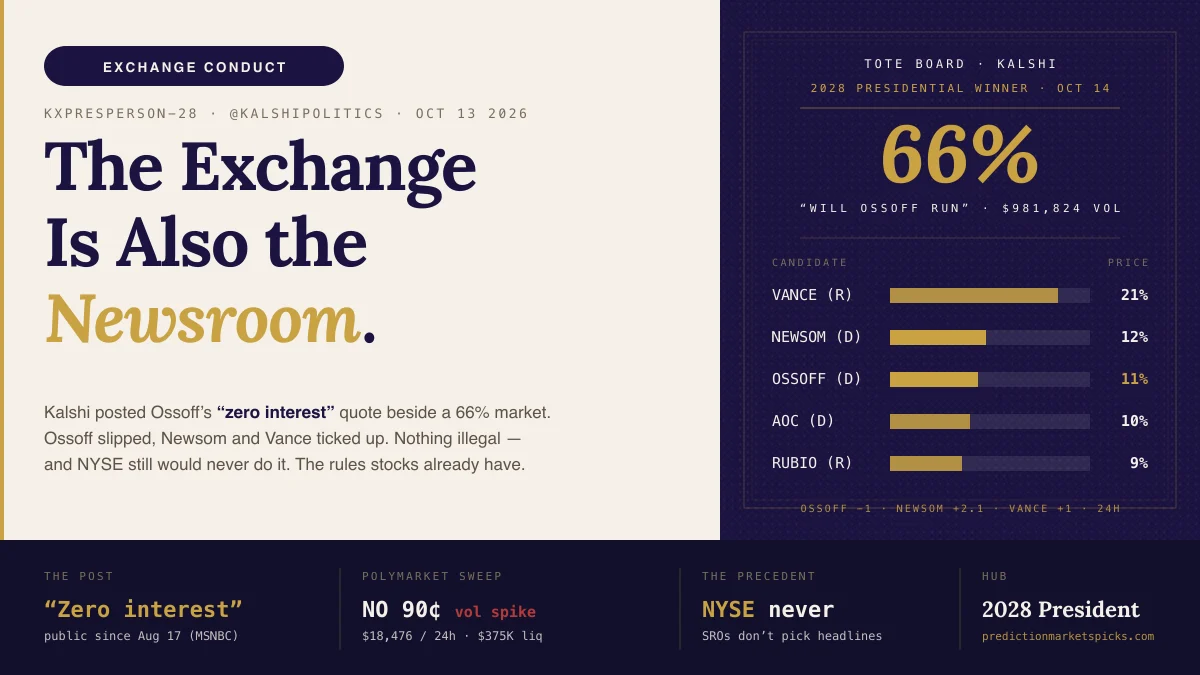

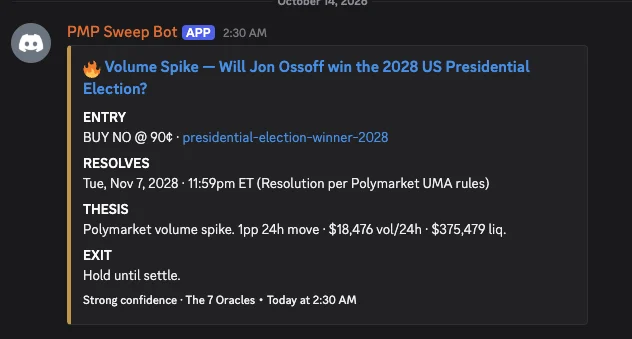
I was standing at the bus stop with my son this morning, scrolling the 7 Oracles Discord, when the sweep bot fired on Ossoff.
Then I remembered where I had seen Ossoff's name the night before. Not a news site. Kalshi's own politics account.
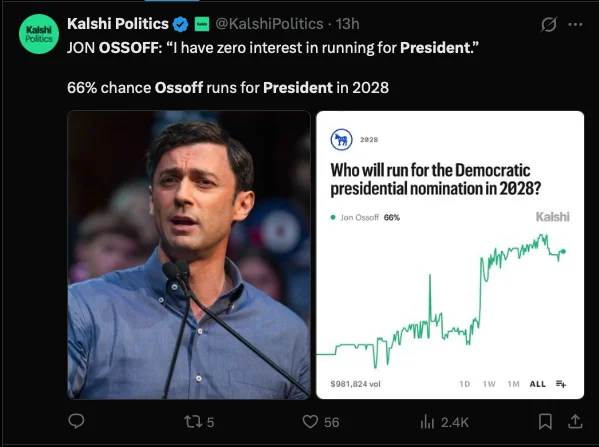
Read that post the way a trader reads it. "He says he isn't running" plus "the market says 66% he runs" is not a news update. It is a trade idea. And the account that posted it belongs to the venue that collects a fee on every contract that trades on it.
What the board did next
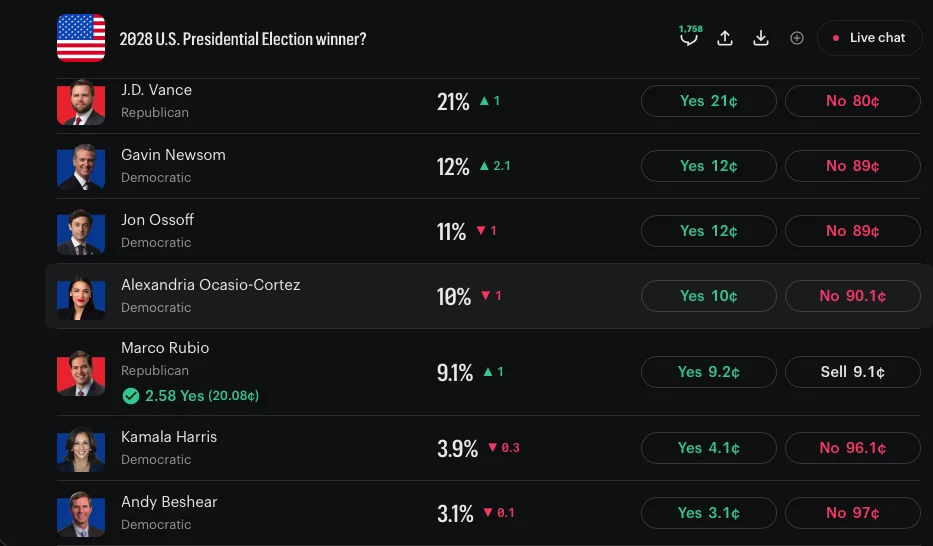
Here is the 2028 winner market the next morning. Ossoff down a point to 11%. Newsom up 2.1. Vance up 1. Rubio up 1.
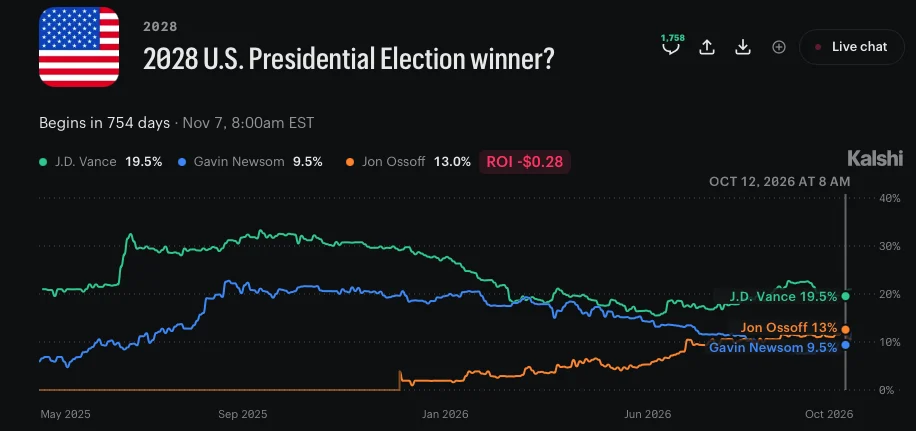
I want to be careful here. A one-point move on a 754-day market is noise on most days, and I cannot prove the post caused it. What I can say is that the sequence (exchange posts a curated quote beside its own price, the price moves, volume follows) is one that the NYSE would never allow itself to be part of. Which is the actual subject of this piece.
Every argument makes Kalshi money
Think about who that post is for.
- Ossoff YES holders read it and think about getting out. That is a trade.
- Value hunters read it and think: if Ossoff is inflated at 12¢, Newsom at 12¢ or Nando's dark horse Beshear at 3¢ is the cheaper way to own the same Democratic lane. That is a trade.
- The right side of the board reads it as one less serious Democrat and nudges Vance and Rubio. Also a trade.
It does not matter which argument you buy. Kalshi does not care either. They want you to put dollars behind your opinion, and every one of those opinions clears through their book. That is a business, and I am not knocking a business for wanting volume. I am asking whether the business that runs the venue should also be the one choosing which public facts get amplified next to the price.
The stock market answered this decades ago
This is not insider trading. Ossoff said it on MSNBC two months ago. The information was public, reported, and old. So the usual prediction-market compliance conversation (members of Congress trading, campaign staff with non-public polls) does not apply, and Kalshi's rulebook already covers that stuff anyway.
This is a different question: what is an exchange allowed to say about its own listings?
Securities markets have a settled answer. The NYSE and Nasdaq are self-regulatory organizations. They list, they surveil, they halt, they publish data. They do not post "the CEO says the quarter is fine, the market says 66% he misses, here's the ticker." Not because a statute names that sentence, but because the whole structure assumes the venue is neutral about which way its listings trade. The exchange's commercial interest is in the integrity of the market, not in the next print.
The futures world, which is Kalshi's actual regulator, is a little messier and worth being honest about. CME publishes FedWatch, a probability table derived from its own rate futures, and markets it heavily. That is the closest real precedent for an exchange broadcasting its own implied odds. The difference is that FedWatch is a derived number with a published methodology. It does not pick a Powell quote, pair it with the number, and post it at 9 PM. The curation is the issue, not the data.
If they are financial instruments, use the financial-instrument playbook
Kalshi's entire legal position, the one it has defended in federal court against state gaming regulators, is that event contracts are CFTC-regulated financial instruments, not gaming. I agree with them. I also think you do not get to make that argument and then operate with the rulebook of a fantasy sports app.
So take the argument at face value and ask what already exists for stocks, bonds and futures:
Exchange conduct. A standard for what a designated contract market may and may not publish about its own listings. Derived odds and data feeds, fine. Curated headlines selected to move a specific contract, not fine. This one costs Kalshi almost nothing and buys them an enormous amount of credibility.
Separation of church and state. The venue and the tout cannot be the same account. The NYSE does not run a newsletter telling you which of its listings is mispriced, and it is not because nobody there has opinions. The exchange sees the order book, writes the rules, halts the market and settles the contract. The moment it also picks the headline, everyone relying on a neutral venue has to ask whether that headline was chosen for them or for the book. Publish the derived number all day. Leave the take to people who do not own the plumbing.
Who knew the post was coming. This is the part that should keep Kalshi's compliance desk up at night. A post like that gets drafted, approved and scheduled. Everyone in that chain knows, minutes to hours ahead, that a curated quote is about to land next to a 66% price in front of a real audience. That is material information about the market's next move, and it was generated inside the building. Nothing in the public rulebook today says an employee, a contractor, or a friend of either cannot be long NO before it posts. Maybe nobody was. The structure is the problem: it makes the question reasonable, and in a financial market a reasonable question about the house is already the damage. Broker-dealers solved this decades ago with restricted lists, pre-clearance and blackout windows around their research desks. An exchange that publishes editorial content about its own listings needs the same wall, and it needs to show it.
If that sounds ridiculous for a market where you can buy a contract on whether it rains in Central Park, I agree. It also sounded ridiculous for stocks in 1933. The rules in equities and bonds have been there for decades, revised, updated, with minimum standards everyone can see. That is why there is capital in those markets. If Washington wants real money in prediction markets, and the midterm volumes say it is coming, people have to believe the game is free and fair. No one wants to play in a rigged one, and more to the point, no one wants to play in a game that looks like it could be rigged.
I have seen this movie
I had a front-row seat to the DFS rocketship in the mid-2010s. In the fall of 2015 the two big operators were spending more on television than the beer companies, and they carried themselves like the law could not touch them. Then an employee at one of them posted lineup data early and cashed a big score on the other that same week. Nothing he did was clearly illegal under the rules that existed. It did not matter. Within a month the New York Attorney General had sent cease-and-desist letters, and the industry spent the next three years and nine figures buying back the legality it had assumed it already had.
That is the exact shape of the Ossoff post. Nothing illegal, information generated inside the building, a market that moved. Nothing more has to have happened for people to start sniffing, and once they start sniffing they do not stop at the one thing.
The cockiness was the downfall. Not the product. The product was great.
Kalshi, I want you to win. I am invested in prediction markets succeeding, literally and otherwise. This site exists because I believe they are a better way to price the world than pundits and polls, and our markets-vs-pundits scorecard keeps making that case for us. But you are a target now, whether you like it or not. State regulators, the sports leagues, the tribal gaming interests, half the Senate on a slow news week. Every one of them is looking for the opening, and "the exchange tweets things that move its own markets" is the kind of opening that writes its own hearing title.
Pick up the phone before someone with a vendetta makes the call for you. Draw the line on exchange conduct yourself, split the venue from the commentary, and put the same pre-clearance wall around your content team that every broker-dealer puts around its research desk. It will cost you some volume this quarter. It is a lot cheaper than the hearing.
Where the 2028 board stands
For the record, the prices in this piece are from Kalshi's 2028 presidential winner market on October 14, 2026: Vance 21%, Newsom 12%, Ossoff 11%, Ocasio-Cortez 10%, Rubio 9.1%, Harris 3.9%, Beshear 3.1%. The separate "will Ossoff run" market was 66% on $981,824 of volume. Both venues are tracked live on our 2028 president page, the Democratic lane deep-dive is in AOC's 2028 odds, and the Republican side in the Trump Jr. nomination thesis. Ossoff's own Georgia Senate race resolves 20 days from now, which is a far better use of your attention than a market that settles in 2028.
If you want the numbers without the opinion, the politics hub and the elections MCP server carry every race, both venues, no tweets.
Benny Ricciardi is an FSWA Award Winner and published author. He ran 4Deep Sports as CEO, led marketing at FTN Network as CMO, and traded bonds on Wall Street. He founded PredictionMarketsPicks. He is not a lawyer, and nothing here is legal or investment advice.