

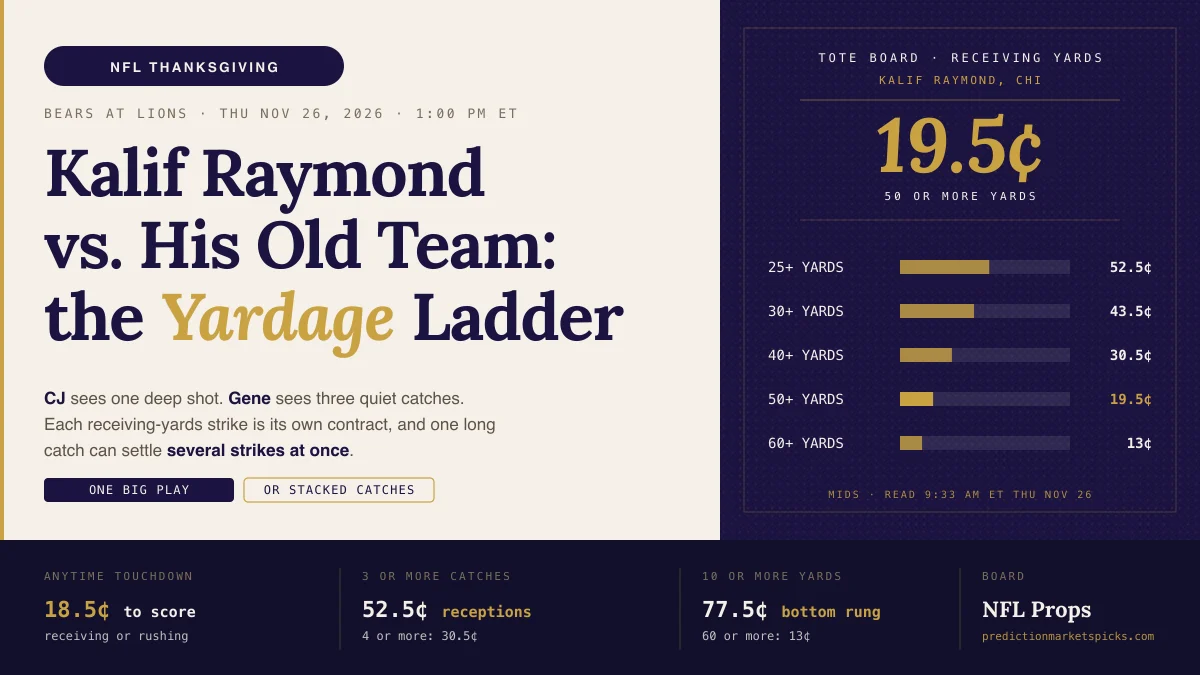
Kalif Raymond spent years in Detroit. On Thanksgiving he lines up for the Bears against the Lions, in an offense run by Ben Johnson, who called plays in Detroit before he took the Chicago job. That is the angle CJ and Gene take in the video: not a hot take on a star, but a cheap, specific question about a role player on a short slate.
▶ Watch on its own page, with the full transcript →
The case for the over
CJ's argument is about attention. Defenses will spend their energy on the headline receivers, and Johnson's offense is the kind that builds one or two special calls for a player like Raymond. His picture: Rome Odunze runs a deep dig, Luther Burden flashes short, and Raymond comes around on a wheel route for a 65-yard touchdown.
That matters for how you read the market. Raymond does not need a big target share to hit a number. He needs one play.
The case for stacking catches
Gene's version is quieter. Raymond can be forgotten in coverage, catch a ball in space and pick up yards after the catch. Three catches for 75 yards is a normal good day for a player in his role, and it can come on three plays instead of one.
Gene's point on timing is the useful part. If you hold a yardage strike before kickoff and Raymond sits at 45 yards with a 60-yard strike still open, the contract has appreciated because he only needs 15 more. That is where the decision lives: you can hold for the finish, or sell into the move.
What the market is pricing
Kalshi prices, read at 9:33 AM ET on November 26, 2026 (the full NFL props board updates through kickoff):
| Raymond (CHI) market | Kalshi |
|---|---|
| 10 or more receiving yards | 77.5¢ |
| 25 or more receiving yards | 52.5¢ |
| 30 or more receiving yards | 43.5¢ |
| 40 or more receiving yards | 30.5¢ |
| 50 or more receiving yards | 19.5¢ |
| 60 or more receiving yards | 13¢ |
| 3 or more receptions | 52.5¢ |
| 4 or more receptions | 30.5¢ |
| Anytime touchdown | 18.5¢ |
| 2 or more touchdowns | 2.5¢ |
Two things stand out. First, the prices are tight: no strike on Raymond shows a 5-cent gap against the consensus of other books, so nobody is giving away an edge here. Second, the show floated a 45-yard strike at 37%. Kalshi lists no 45-yard strike. The nearest two are 40 or more at 30.5 cents and 50 or more at 19.5 cents, so a 45-yard price would sit in the mid-20s at these numbers, below the figure quoted on the show. Treat the 37% as a talking point, not a live quote.
The ladder shape is the real takeaway. The step from 25 or more down to 50 or more is 33 cents. If you think Raymond's day is one big play, the top end is your contract. If you think it is a few quiet catches, the lower strikes and the receptions markets do more of the work.
Two ways to play it, and the anytime touchdown
CJ's route is the binary: one deep shot and a high strike settles. Gene's route is volume: more targets lift every strike below the top. The two views even hedge each other, as CJ pointed out. If Gene is right, the yardage climbs anyway, and if CJ is right, one play does it.
The anytime touchdown at 18.5 cents covers a receiving or rushing score, so it catches the end-around Raymond is not known for. The tradeoff, as the show noted, is that a touchdown contract pays only on the score. A yardage strike can gain value on the way there.
One rule to know before any player contract: if Raymond is inactive, the contract does not simply lose. Kalshi's did-not-play rules explain what happens.
The rest of the holiday slate, with every game's price, is on the NFL Thanksgiving page.
See the Bears at Lions receiving-yards ladder on Kalshi →
Trade responsibly. Educational analysis, not financial advice. Prices change; check the live board before kickoff. Pro subscribers get the full ladder and edge tools: code BLACK takes 40% off your first Pro payment.