

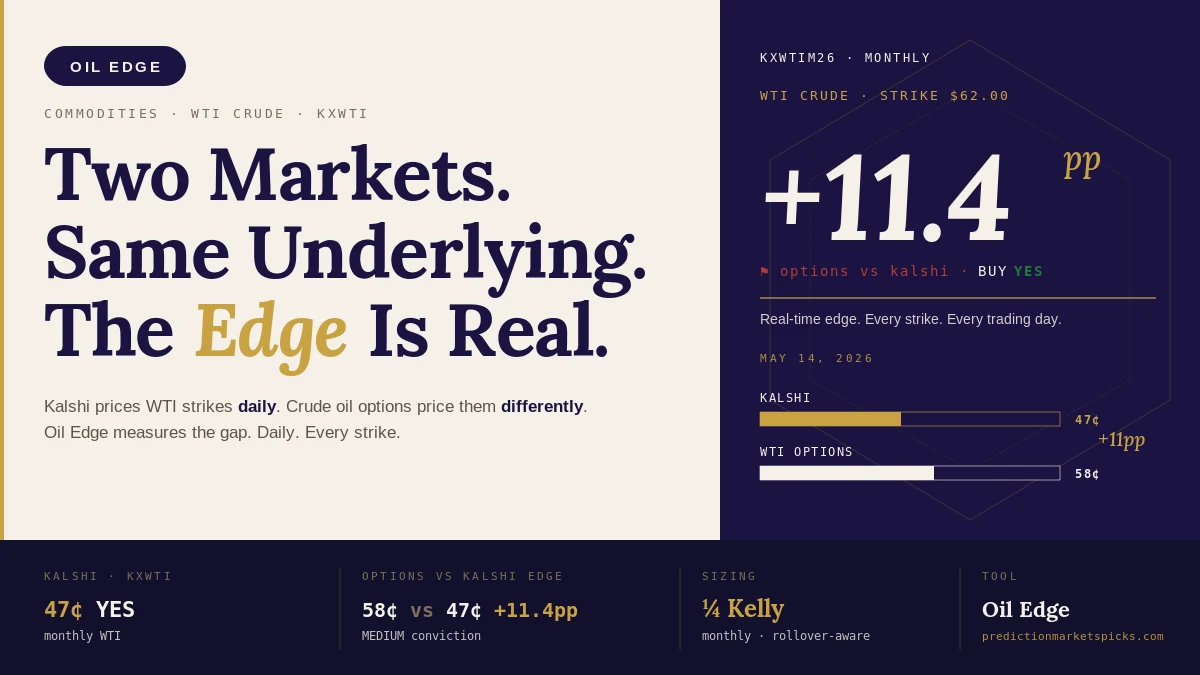
The Kalshi KXWTI series settles on the front-month CME WTI Crude Oil futures contract. Every month, that "front-month" rolls forward — June becomes July, July becomes August, and so on. The mechanic looks simple on the surface and gets surprisingly messy in the seams. If you trade Kalshi oil markets without paying attention to the calendar, you can lose money to something that has nothing to do with the price of oil and everything to do with which piece of paper Kalshi is using to settle.
What "front-month" means
CME WTI futures trade in monthly contracts that expire on a specific Last Trading Day, or LTD. The LTD rule is the third business day before the 25th calendar day of the month preceding delivery. For the June 2026 contract — JUN26 — that lands on Monday, May 18, 2026. After LTD, JUN26 is done. The new front-month is JUL26.
Kalshi doesn't wait until LTD to roll. They roll two calendar days before. For the JUN→JUL transition, that means Kalshi's settlement source flips from JUN26 to JUL26 effective Sunday, May 16. Friday's market settles on JUN26. Monday's settles on JUL26. The weekend in between is the entire transition.
Where the basis risk hides
The basis is the difference between two contracts on the same underlying. JUN26 WTI and JUL26 WTI are both contracts on West Texas Intermediate crude, but they price slightly differently because they expire a month apart — storage costs, OPEC announcement risk, refinery seasonality, anything that affects the next 30 days of crude flows. In normal contango, the later month trades a few cents to a dollar above the front month. In stressed backwardation, it can flip the other way.
If your data sources don't roll on the same day as Kalshi, your "edge" against Kalshi can be entirely basis noise. Three sources matter for our Oil Edge tool: the WTI spot price, the USO ETF that backs our options-implied probability calculation, and Kalshi's settlement source itself. None of them roll on the same day.
Kalshi rolls on the Sunday two days before CME LTD. CME's continuous front-month ticker — what Yahoo calls CL=F — rolls overnight after LTD. And the USO ETF, which holds front-month WTI on behalf of equity-account investors who can't trade futures directly, rolls per its sponsor's published schedule. USCF rolls USO over four business days starting roughly the fifth business day of the month before front-month expiry. For the JUN→JUL transition, USO was finishing its roll while everyone else hadn't started.
The three-day mismatch window
There's exactly one day per month where Kalshi has rolled but CL=F continuous hasn't. For the May 2026 cycle, that's Monday, May 18. The Kalshi market is pricing JUL26 settlement. Our spot reference is still reading JUN26. If JUN-JUL contango is fifty cents, an at-the-money strike on the Kalshi market looks fifty cents out of the money to our spot — and the comparator generates a spurious 10–15 percentage point edge that evaporates the moment settle hits.
We could publish those edges. They'd look great in a screenshot. They'd settle at zero.
Why we pause
The Oil Edge tool pauses actionable rows from Saturday at 00:00 UTC through Tuesday after the NYMEX close. That covers the Kalshi roll, the dead Sunday, the Monday mismatch, and the Tuesday morning when CL=F finally rolls to match. Four calendar days, three trading days, one ambiguous day. Everything else in the tool — the spot, the implied volatility, the USO chain — stays visible. We just don't tell you what to do during the window where the math is structurally broken.
That's three days a month, twelve times a year, give or take a holiday. Roughly ten percent of the trading calendar where the tool stays quiet. We'd rather be quiet than wrong.
The permanent fix
The pause is a guard rail, not a solution. The right answer is to drive the engine's spot reference off Kalshi's settlement source directly. Kalshi publishes the contract month for every series — for May 16 onward, KXWTI settles on JUL26. If our spot pulls JUL26 (CLN26.NYM on Yahoo's specific-month tickers) on May 16 instead of waiting for CL=F continuous to flip on May 19, the mismatch never opens. We're working on that change. Until it ships, the pause stays.
What to do while we're paused
Three things, in order. First, look at the Kalshi book itself — the mid is still a real market price even when our comparator is on holiday. Second, watch the JUN-JUL calendar spread (any commodity broker shows it; Yahoo lists it as CL.1-CL.2). The wider it is, the more your downside on a Monday trade is calendar exposure rather than directional. Third, wait. The tool resumes Tuesday after NYMEX closes, and the rest of the month is clean.
Authentic data is the whole product. We'd rather pause three days than publish edges that don't exist.