

When Kalshi and Polymarket price the same event differently, one of them is wrong. That's the entire premise of cross-platform arbitrage. The hard part isn't the idea — it's building a detector that separates a real gap from two markets that merely look alike. Here's the mechanic PredictionMarketsPicks’ Arbitrage Scanner runs.
The gap is measured, then graded
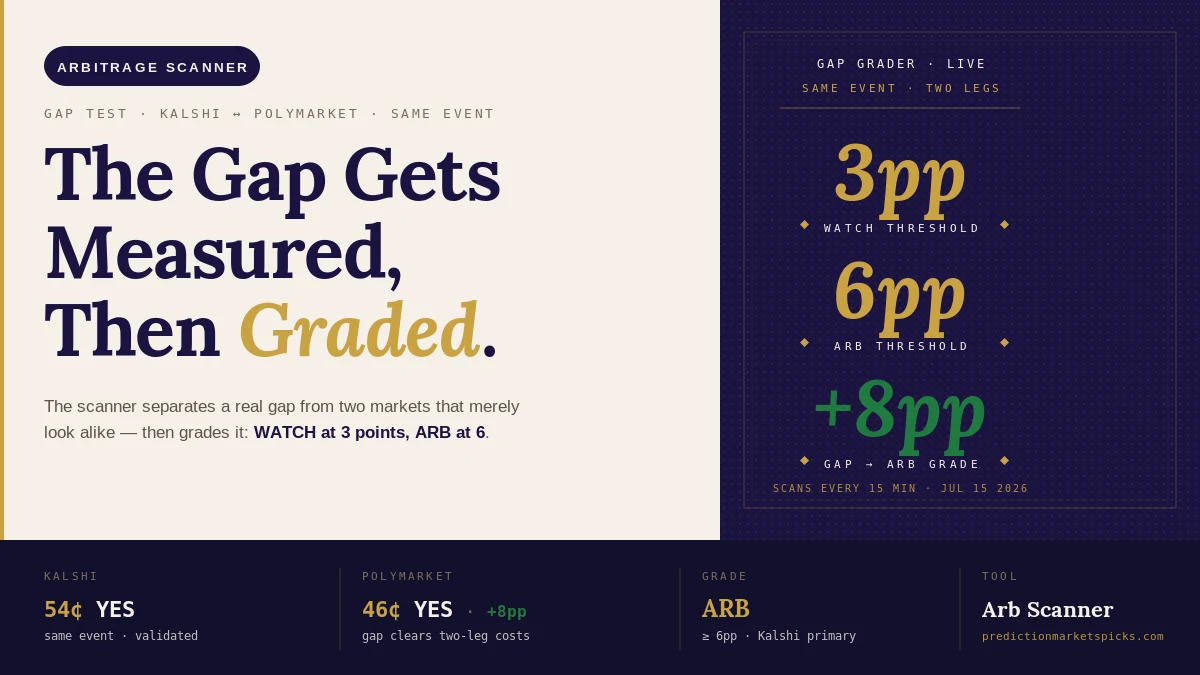
The scanner pulls the live implied probability on each platform for the same event and measures the distance between them in percentage points. That raw gap is then graded against two thresholds:
- Gap ≥ 3pp → WATCH — a divergence worth keeping an eye on, but too thin to act on after costs.
- Gap ≥ 6pp → ARB — wide enough that, if the two contracts truly resolve identically, one price is likely wrong by more than it costs to trade both sides.
Why 6 points and not 2? Because a gap you can't afford isn't an edge. Every cross-platform position is a two-leg trade — you buy the cheap side on one venue and hedge the expensive side on the other. Each leg carries a fee and some slippage. A 6pp floor is set so the gap has room to clear both legs' costs and still leave something on the table. Anything tighter is noise dressed up as opportunity.
Same-event validation is the whole game
The failure mode of every naive arb scraper is the look-alike. "Will X win in 2026?" and "Will X win by November?" can trade 15 points apart and it isn't arbitrage — it's two different questions. Detection that keys on fuzzy title matching will fabricate gaps all day.
So PredictionMarketsPicks only runs the gap test after the two contracts are confirmed to settle on the same underlying event and resolution criterion. Same resolution source, same cutoff, same YES condition. This is the same discipline the mispricing engine uses on its Kalshi cross-check — a validated match, not a string match. No validation, no flag, no matter how juicy the number looks.
Why the scanner routes Kalshi-first
When a real gap clears the ARB threshold, the scanner treats Kalshi as the primary venue for the trade. Kalshi is a CFTC-regulated exchange available in all 50 states, while the Polymarket price that reveals the gap comes from its international book, which is closed to US persons — US traders execute on the separate Polymarket US exchange. So the actionable leg for most readers is the Kalshi side, with the international book serving as the reference price. The tool surfaces the gap; it does not assume you can freely transact on both venues.
What a flag is, and what it isn't
An ARB flag is a candidate, not free money. Before you act, three things have to hold:
- Identical resolution — confirm both contracts really pay on the same outcome. (Validation narrows this, but you make the final read.)
- Depth — the order books have to be deep enough to fill both legs near the quoted prices, or the gap evaporates in slippage.
- Timing — prices move; a gap the scanner caught at 8am can close before you place the second leg.
If all three hold, you have a genuine two-sided position, and you can size the actionable leg with the quarter-Kelly calculator. If any fail, the flag was a candidate that didn't survive contact — which is exactly what the three checks before you trade are for.
Soccer is a good worked case. Our Kalshi vs Polymarket Premier League board prices home, draw and away on both exchanges and shows what the complete set costs after each venue's fee, so you can see how little room a fixture usually leaves.
The scanner's job is to find the handful of gaps worth that scrutiny. Yours is to run the checks and decide. For the deeper reason most flagged gaps don't survive, read why most prediction-market "arbitrage" isn't real.