

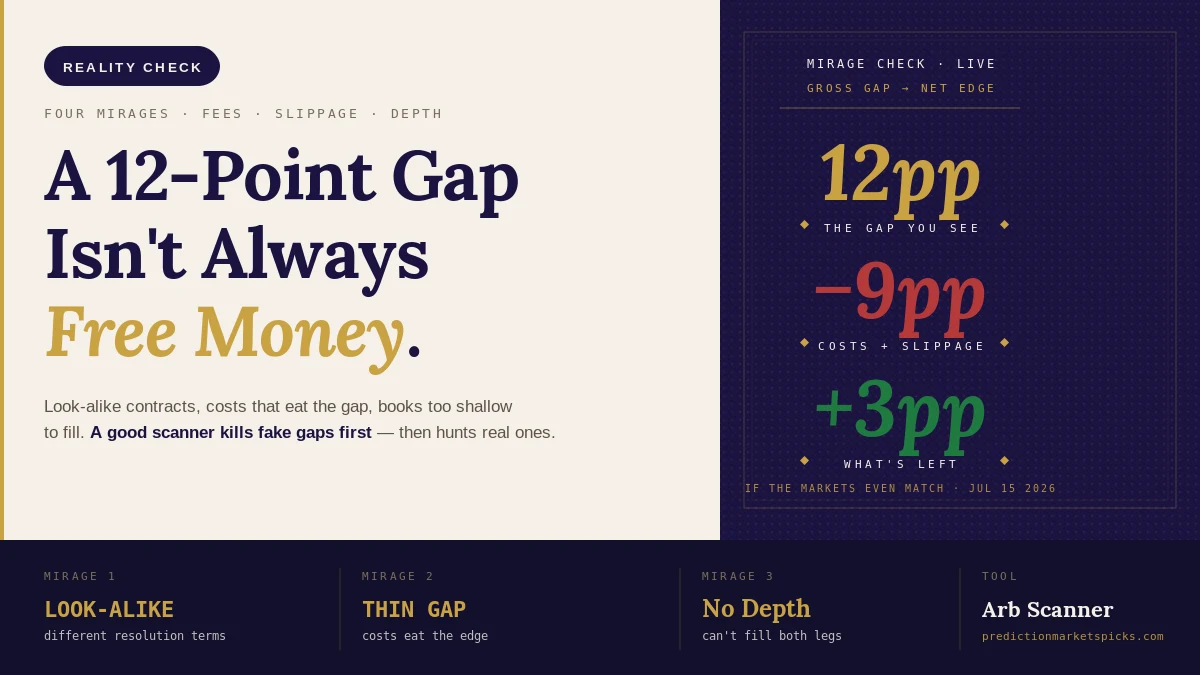
Two platforms, one event, a 12-point price gap. It looks like the market is handing you free money. It almost never is. PredictionMarketsPicks’ arbitrage scanner exists as much to kill fake gaps as to find real ones. Here are the four mirages, in the order they fool people.
Mirage 1: The look-alike market
The most common fake gap comes from two contracts that aren't the same contract. "Will the Fed cut rates in 2026?" and "Will the Fed cut at the next meeting?" can sit 20 points apart forever, and there is no trade — they resolve on different conditions. Any tool that matches on headlines will show you a wall of these.
The only defense is same-event validation: confirm both contracts settle on the identical outcome, source, and cutoff before you believe the gap. This is the same reason a serious mispricing engine fails closed rather than trusting a loose match. If you can't verify the two questions are one question, the gap isn't real — the rule PredictionMarketsPicks applies before a gap is ever shown.
Mirage 2: The gap that costs more than it pays
Say the match is genuine and the gap is 4 points. You still might have nothing. Every cross-platform position is two legs — buy one side, hedge the other — and each leg pays a fee and eats some slippage. A 4-point gap can vanish entirely into two-leg costs, leaving you fully hedged for a guaranteed loss.
This is why a scanner worth using sets its ARB threshold well above zero — around 6 points — so a flagged gap has room to survive costs. A gap below that floor is a WATCH, not a trade. Thin gaps are the ones that quietly bleed accounts that don't do the arithmetic.
Mirage 3: The book that won't fill
Now the gap is 8 points and the markets are truly identical. You go to place the legs and discover the cheap side has $60 of depth at the quoted price. You fill a sliver, the rest of your order walks the book, and the effective gap you captured is a fraction of what the screen promised.
Displayed price is not fillable size. Before treating a flag as tradeable, look at the depth on both legs. A beautiful gap on a shallow book is a screenshot, not a position.
Mirage 4: The gap that's already gone
Prices move. A gap the scanner caught at 8am can close before you place your second leg, and now you're holding one naked side of a trade that was supposed to be hedged. Cross-platform arbitrage is a race against the market correcting itself, and you're rarely the fastest one in it.
There's also a structural catch for US readers, and it survived Polymarket's US launch: the Polymarket price that reveals a gap is almost always quoted from the international book, which is closed to US persons. US traders execute on Polymarket US — a separate exchange with its own order book — so the reference leg and the tradeable leg are not the same venue and the gap you measured may not exist at the one you can reach. The actionable side is usually Kalshi, which is why the detection mechanic routes Kalshi-first.
So what *is* real?
A real arbitrage clears all four: validated same event, gap wide enough to beat two-leg costs, books deep enough to fill, and fast enough execution to lock both sides before the gap closes. Those exist — they're just rarer than a raw gap list makes them look. The full pre-trade checklist is how you separate them.
You can watch the four tests run on a single sport. Our Kalshi vs Polymarket Premier League board prices each fixture's home, draw and away on both exchanges and shows what the complete set costs after each venue's fee, so a gap that does not clear costs reads that way.
The scanner's value isn't the long list of gaps. It's the short list that survives all four filters — and the discipline to size only those, and pass on the rest.