

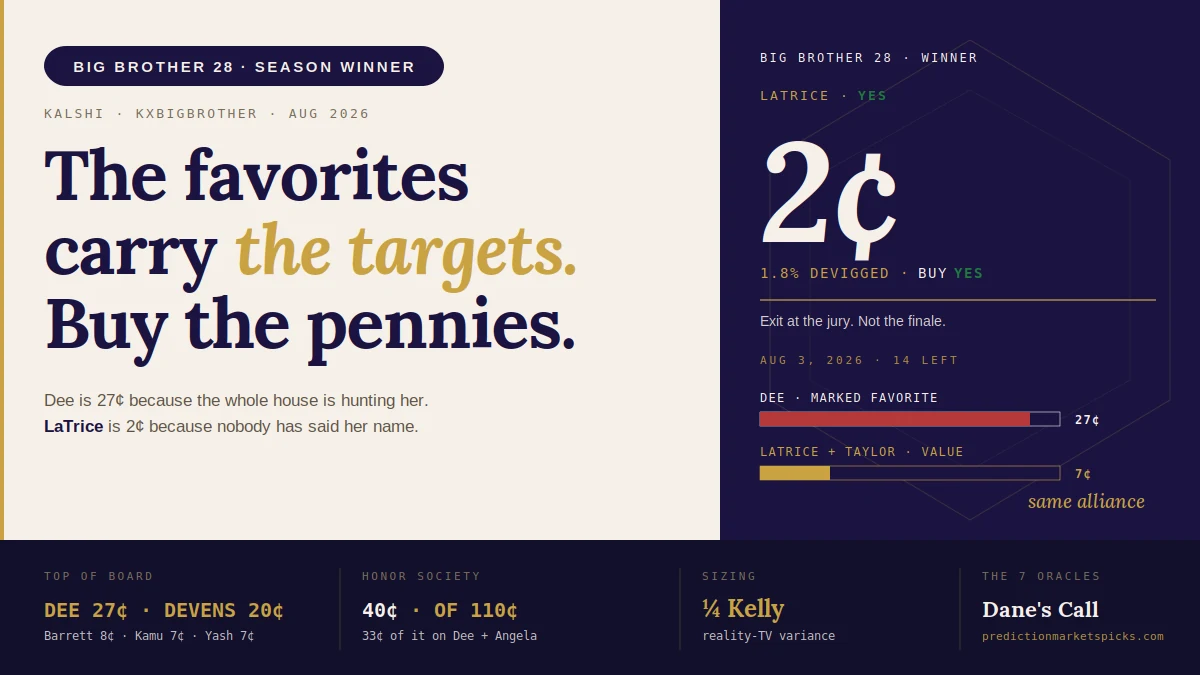
Kalshi has Dee Valladares at 27¢ to win Big Brother 28 and Rick Devens at 20¢. Those are the two returning reality icons, the two names every houseguest has been trying to get out since the doors closed, and the two most expensive contracts on the board.
LaTrice Verrett is 2¢. Taylor Brown is 5¢.
That gap is the whole trade. The season-winner market is pricing who you have heard of. Big Brother evicts who you have heard of. Those are not the same thing, and the spread between them is where the money is.
The Position
Market: Who will win Big Brother Season 28? (Kalshi · KXBIGBROTHER-26DEC31)
Positions: LaTrice Verrett — YES · Taylor Brown — YES
Entry: LaTrice 2¢ (bid 1 / ask 2) · Taylor 5¢ (bid 4 / ask 5)
Implied probability: 2% and 5% raw · roughly 1.8% and 4.5% after the overround
Exit: the jury-stage re-price, not the finale
Resolution: settles when the winner is announced — expected Dec 31, 2026
This is not a lottery ticket. You are not paying 2¢ hoping LaTrice wins the season. You are paying 2¢ for a contract that has to re-rate every single week she is not on the block, in a market where fourteen people are still alive and three have already walked out.
The Call Is Already Working
Dane recorded this the night Jason De Puy went out in a unanimous vote — the third eviction of the season, after Ashley Trail in Week 1 and Rome Seymour in Week 2. Here is what the board looked like on the video versus where it sits now.
| Name | On the video | Now (Aug 3) | Move |
|---|---|---|---|
| Dee Valladares | 19¢ | 27¢ | +8¢ |
| Rick Devens | 18¢ | 20¢ | +2¢ |
| Taylor Brown | 3¢ | 5¢ | +2¢ |
| LaTrice Verrett | 2¢ | 2¢ | flat |
| Drew Campbell | — | 3¢ | on the block |
Two things happened in four days, and both of them were the thesis.
Taylor got nominated and saved herself. Haley Thogmartin won Week 4 Head of Household and put up Taylor Brown, Drew Campbell and Melody Morris. Taylor then won the Power of Veto, pulled herself off the block, and Lyric Medeiros went up as the replacement. A 3¢ contract survived a direct nomination and printed a 5¢ price. That is a 67% move on the entry, and it happened in the worst week she has had.
Drew is the target. On the video, Dane's argument against Barrett Pfeiffer and Drew Campbell was that middle-riders get targeted, not protected — the second the Toolshed splits, the guys playing both sides are the ones with nowhere to stand. Drew is now the house's primary target this week and his contract is 3¢. Barrett is still 8¢, which is a full nickel more than Drew for the same structural problem.
And LaTrice is still 2¢. Never nominated. Never the target. Never the conversation. Four days of house chaos and the price has not moved a tick, which is the entire reason it is still worth owning.
The Full Board
Kalshi, August 3, 2026. Last traded price on each contract.
| # | Houseguest | Price | Book |
|---|---|---|---|
| 1 | Dee Valladares | 27¢ | 25 / 26 |
| 2 | Rick Devens | 20¢ | 19 / 20 |
| 3 | Barrett Pfeiffer | 8¢ | 7 / 8 |
| 4 | Kamu Kirk | 7¢ | 6 / 7 |
| 5 | Yash Patel | 7¢ | 6 / 7 |
| 6 | Mallory Aurichio | 6¢ | 5 / 6 |
| 7 | Angela Murray | 6¢ | 5 / 6 |
| 8 | Chuk Anyanwu | 5¢ | 4 / 5 |
| 9 | Lyric Medeiros | 5¢ | 4 / 5 |
| 10 | Taylor Brown | 5¢ | 4 / 5 |
| 11 | Haley Thogmartin | 4¢ | 3 / 4 |
| 12 | Drew Campbell | 3¢ | 3 / 4 |
| 13 | LaTrice Verrett | 2¢ | 1 / 2 |
| 14 | Melody Morris | 2¢ | 1 / 2 |
Ashley Trail, Rome Seymour and Jason De Puy are all still listed at 1¢ and will settle at zero.
Read the overround before you read anything else. Those prices sum to about 110¢, so there is roughly a 10% cushion baked into the board. Divide any quote by 1.10 for the vig-free number — LaTrice's 2¢ is really about 1.8%, Dee's 27¢ is really about 24.5%. On a penny contract that adjustment is noise. On the favorites it is most of the reason they are bad value. Our Probability Converter does this for you.
The Honor Society Math
During Week 3 four players formed an alliance called the Honor Society: Dee Valladares, Angela Murray, LaTrice Verrett and Taylor Brown. Nobody outside the house is pricing it, and it is the single best structural argument for this position.
Add up what the market says that alliance is worth:
- Dee Valladares — 27¢
- Angela Murray — 6¢
- Taylor Brown — 5¢
- LaTrice Verrett — 2¢
40¢ of a 110¢ board. More than a third of the entire winner market sits inside one four-person group. And 33 of those 40 cents sit on Dee and Angela — the two returning icons who take every shot the house fires.
That is the trade in one number. You can own the same alliance's back half for 7¢, or its front half for 33¢. The front half is the half that gets evicted.
Why the Favorites Are the Wrong Side
The Toolshed — the eight-person bloc of Devens, Dee, Angela, Kamu, Chuk, Haley, Drew and Barrett — has already fractured. Drew and Barrett are on the outs. Haley just used her HOH on two of her own alliance members. When a dominant bloc breaks apart, three things happen in order, every season:
- The visible players go first. Not the dangerous ones — the legible ones. A house that cannot agree on anything can always agree that the returning icon is a threat. Dee has been that person since day one and she is 27¢.
- The middle gets crushed. Barrett and Drew spent three weeks being useful to both sides, which reads as loyal right up until the week it reads as untrustworthy. That week is now.
- The quiet ones inherit the endgame. Somebody has to sit in the final two, and it is almost never the person who was the story in Week 4.
Dee at 27¢ is not a bad player. She may well be the best player in the house. That is precisely the problem — the market is charging you a quarter for someone whose skill is the reason she is a target every single week from here to the finale. At 27¢ you need her to survive roughly eleven more eviction cycles as the house's most obvious threat, and you are being paid 3.7x to take that.
LaTrice at 2¢ needs to survive the same eleven cycles as a person nobody has said a bad word about, and you are being paid 50x.
The Edge
- Survival equity is mispriced on winner boards. A season-winner contract has to re-rate on every eviction that is not you. With fourteen players left, a 2¢ contract that simply survives four more weeks is mechanically worth more, regardless of whether the holder ever wins a competition. The market prices the finale; the money is in the path.
- The re-price is the exit, not the win. Nobody in this position needs LaTrice to win Big Brother 28. You need her to be alive at the jury with a price in front of a 5. That is a 2.5x on a contract where the downside was already capped at two cents.
- Retail flow buys names. Reality-TV markets attract flow from viewers, not traders, and viewers buy the person they know from another show. That is exactly the bias that leaves a well-positioned unknown at 2¢ while a marked favorite trades at 27¢.
- Taylor already proved the model. Nominated, won the veto, saved herself, price up 67%. That is the mechanism working in real time on a four-day sample.
Run the numbers yourself with the Expected Value Calculator and size it with Kelly.
The Downside (Be Honest About It)
Most penny contracts expire at zero. That is not a caveat, it is the base case. Fourteen people are alive and thirteen of them lose. A 2¢ price is the market saying "almost certainly not," and the market is usually right about that. This position is only sound because the loss is capped at the entry and the exit does not require a win.
LaTrice's invisibility cuts both ways. The same profile that keeps her off the block — quiet, liked, unthreatening — is the profile that gets carried to the end and then loses the jury vote 7-2. She has to convert at some point, and she has shown no evidence yet that she can win a competition when it matters.
The Honor Society is not solid. The people who track the feeds closely describe it as loose at best, with Dee running several overlapping deals at once. If it dissolves, LaTrice and Taylor lose their shield and become the easy vote instead of the safe one.
Taylor is now visible. Winning a veto to save yourself is a great outcome for the contract and a bad outcome for the anonymity. She was nominated in Week 4 for a reason, and she is a known competition threat as of Monday. Some of that 5¢ is already priced for a player who is no longer under the radar.
Liquidity is thin down the board. LaTrice is 1 bid / 2 ask. That is a 50% spread in percentage terms. You will not be scaling out of size gracefully, and the exit you are counting on requires someone on the other side at the jury stage.
Sizing It
Kelly will hand you an aggressive number on a 2¢ contract with any bullish read, and you should ignore most of it. Reality television is the highest-variance market on the exchange — one conversation on the live feeds at 3 a.m. resets the entire board, and there is no model that sees it coming.
Treat this as quarter-Kelly or less, and think of it as a basket rather than a position. On a $1,000 bankroll, a reasonable expression is somewhere around $20–$40 total across both names — call it 1,000 LaTrice contracts at 2¢ and 200 Taylor contracts at 5¢ for $30. The whole thing is capped at $30 and the upside on a jury-stage exit is multiples of it.
Use limit orders. LaTrice is 1 bid / 2 ask with real size on the offer — there is no reason to lift when you can sit at 1¢ and let the week come to you.
How to Take the Position
- Open the Big Brother Season 28 winner market on Kalshi and find the individual houseguest contracts.
- Buy YES on LaTrice Verrett at 1–2¢ and YES on Taylor Brown at 4–5¢. Limit orders only.
- Set your exit before you enter. The plan is to sell into the jury-stage re-price, not to hold to the finale.
- Re-check the board every Thursday after the live eviction — that is when the whole thing re-prices at once.
Trade Big Brother 28 on Kalshi →
Update, August 11, 2026: LaTrice won the Week 5 Head of Household and trades at 4¢. Taylor is 8¢. Dee went 27¢ to 26¢ and Devens went 20¢ to 18¢ — both fades moved backwards. The graded board and the Week 5 read are in Big Brother 28 Week 5: the 2¢ won HOH, and Kalshi still prices a nominee above the Head of Household.
Prices quoted are Kalshi last-traded and best bid/ask as of August 3, 2026, and move fast — check the live board before entering. Nothing here is financial advice. Trade responsibly.


