

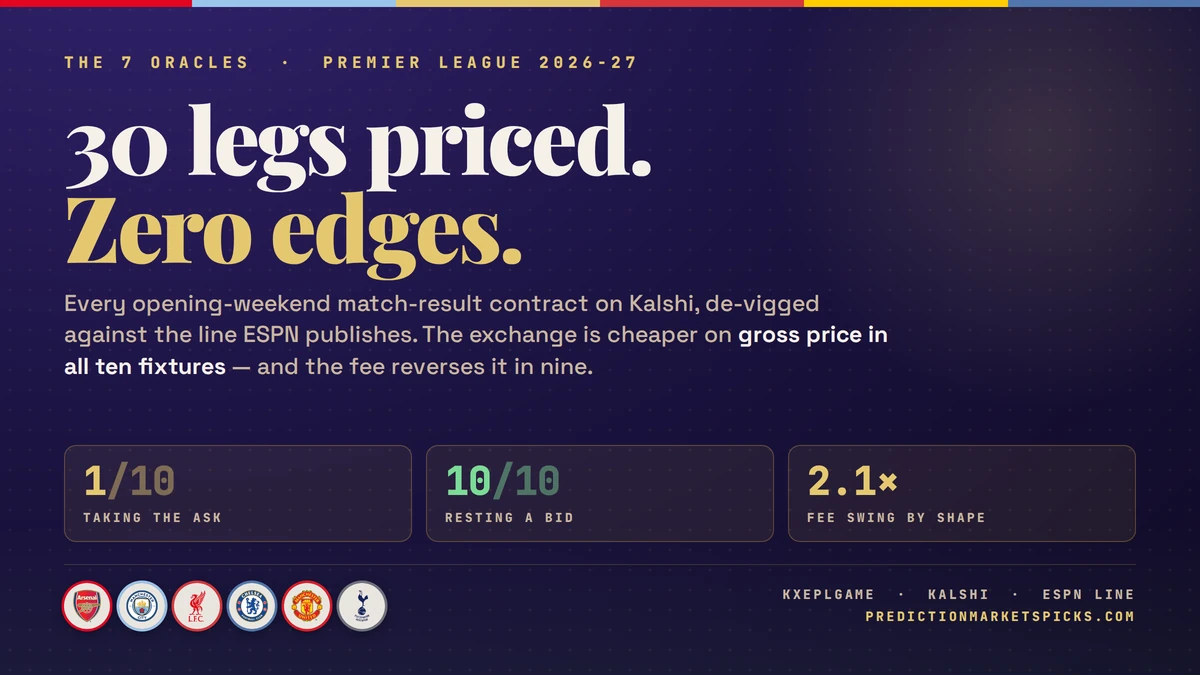
We ran every Premier League contract Kalshi has listed for opening weekend against the line ESPN publishes on its scoreboard, de-vigged it two different ways, and added the trading fee. Thirty match-result legs across ten fixtures. Ten match totals. Both directions on every one.
Nothing is underpriced. Not one leg.
That is a real answer, and it is worth more than a manufactured edge, because the reason nothing is underpriced turns out to be a structural fact about this board that we have not seen written down anywhere — and it points at where the money on Kalshi's soccer market actually is.
> The finding in one line. Kalshi's raw prices beat the DraftKings line on all ten fixtures. The fee reverses it on nine. As a taker, Kalshi's complete set is cheaper on 1 of 10. As a maker, it is cheaper on 10 of 10. The edge on this board is a queue-position question, not a handicapping one.
How we did it, so you can check us
ESPN's scoreboard carries a DraftKings line on every Premier League fixture: home, draw and away in American odds. Converting each to an implied probability gives three numbers that sum to more than 100% — the overround, the margin priced into the line. Removing it fairly is the whole game, and there is no single correct way to do it, which is why we did it twice.
Proportional de-vigging divides each implied probability by the total. It is the standard method and it is known to flatter favorites. Power de-vigging solves for the exponent k that makes the three probabilities sum to one, which pushes margin back onto the longshots where the research says books actually put it. The two methods disagree by up to 2.6 points on the same fixture, and that disagreement is the honest error bar on this entire exercise. A leg only counts if it clears both.
On the Kalshi side we take the ask — what buying actually costs, not the mid — and add the real fee: 0.07 × P × (1 − P) per contract, the published general schedule. Every number below is a live ask read Friday, August 21.
The ten fixtures, all-in
The clean comparison is the complete set: one contract on each of home, draw and away. Exactly one pays a dollar. What the set costs all-in is a direct measure of the venue's total take, and it is the only way to put an exchange that charges a fee next to a book that prices its margin into the line.
| Fixture | Kalshi asks | Ask sum | Fee | Kalshi all-in | DK implied | Kalshi vs DK |
|---|---|---|---|---|---|---|
| Arsenal v Coventry (Fri) | 82 / 13 / 6 | 101.0 | 2.22 | 103.22 | 104.8 | +1.58 |
| Nottm Forest v Leeds | 41 / 28 / 31 | 100.0 | 4.60 | 104.60 | 104.6 | 0.00 |
| Hull City v Man United | 11 / 19 / 72 | 102.0 | 3.17 | 105.17 | 104.7 | −0.47 |
| Everton v Crystal Palace | 44 / 28 / 29 | 101.0 | 4.58 | 105.58 | 104.7 | −0.88 |
| Fulham v Chelsea (Mon) | 25 / 25 / 52 | 102.0 | 4.37 | 106.37 | 105.4 | −0.97 |
| Ipswich v Sunderland | 35 / 29 / 37 | 101.0 | 4.67 | 105.67 | 104.4 | −1.27 |
| Brentford v Tottenham | 40 / 26 / 36 | 102.0 | 4.64 | 106.64 | 105.2 | −1.44 |
| Brighton v Aston Villa | 44 / 27 / 31 | 102.0 | 4.60 | 106.60 | 104.9 | −1.70 |
| Newcastle v Liverpool | 25 / 25 / 52 | 102.0 | 4.37 | 106.37 | 104.4 | −1.97 |
| Man City v Bournemouth | 67 / 20 / 16 | 103.0 | 3.61 | 106.61 | 104.4 | −2.21 |
Read the third column before anything else. Kalshi's ask sum is 100 to 103 on every fixture. DraftKings implies 104.4 to 105.4 on every fixture. On gross price this is not close — the exchange is a third to a half cheaper than the retail line across the entire board, which is exactly the structural argument for trading a match result as a contract instead of taking a price from a house.
Then look at the fee column, and watch the argument fall over.
The fee is a variance term, and that changes where it bites
Kalshi's general trading fee is 0.07 × P × (1 − P) per contract. That P(1−P) is the variance of a coin flip. It peaks at 50 cents — 1.75 cents a contract — and collapses toward zero at both extremes. A 6-cent contract costs 0.39 cents to trade. A 44-cent contract costs 1.73.
Most people know that. What almost nobody has priced is what it does to a three-outcome market.
A football match has three contracts, and on an evenly matched fixture all three sit in the 25-to-45-cent band — the fattest part of the fee curve. You pay near the maximum, three times over. On a lopsided fixture the legs scatter to 82 / 13 / 6, far out on the tails, and the fee falls off a cliff.
| Fixture shape | Complete-set fee | |
|---|---|---|
| Cheapest | Arsenal v Coventry — 82 / 13 / 6 | 2.22¢ |
| Dearest | Ipswich v Sunderland — 35 / 29 / 37 | 4.67¢ |
Same size. Same market. Same exchange. 2.1 times the execution cost, and the only variable that changed is how even the game is.
That is a rule you can act on immediately and it runs against instinct. A trader looking for value goes hunting in the tight fixtures, because that is where a model is most likely to disagree with a market. On Kalshi's Premier League board, the tight fixtures are precisely where your execution cost is highest — you need more edge to clear the fee in exactly the games where edge is hardest to find. The lopsided fixtures nobody wants to trade are the cheap ones.
The part that actually pays: stop lifting the ask
Kalshi's maker fee is 25% of the taker fee. That single line in the schedule is the whole article.
Rest a bid instead of crossing the spread and the complete-set fee drops from 2.22–4.67 cents to 0.55–1.17 cents. Re-run the table on maker pricing and every sign flips:
| Kalshi cheaper than the DraftKings-implied set | |
|---|---|
| Taking the ask | 1 of 10 fixtures |
| Resting a bid | 10 of 10 fixtures, by 0.50 to 3.45¢ |
There is the answer to "where is the edge on Kalshi soccer." It is not in the handicapping. It is in the queue. You do not need a better model than the market to beat the retail line on this board — you need the patience to be filled instead of the impatience to fill, and the exchange hands you two-thirds of its own margin advantage back for it.
That is also the honest caveat: a resting bid is not a free lunch, it is an option you have written. You get filled when the market moves against you and you sit unfilled when it moves your way, and on a fixture that kicks off in six hours you may simply not trade at all. The maker discount is compensation for that risk, not a loophole. But on a board where the taker fee is the only thing standing between you and a structurally cheaper price than the retail line, it is the lever that matters and it is the one nobody is pulling.
Two curiosities worth your attention
Nottingham Forest v Leeds sums to exactly 100.0. Three asks — 41, 28, 31 — and no overround at all before fees. That is the market maker quoting a Premier League fixture with a theoretical margin of zero. After fees the set lands at 104.60 against a DraftKings-implied 104.60. A dead heat to the penny, which is a coincidence, but a pleasing one.
Arsenal v Coventry is the only taker win, and it is the least interesting game on the board. Arsenal at 82 cents against a promoted side. Nobody wants that contract. It is also the single fixture this weekend where Kalshi's complete set is genuinely cheaper than the line ESPN carries — 103.22 against 104.8 — and it is cheaper because nobody wants it. The price is lopsided, so the fee is small. The structure rewards you for trading the boring game.
The two legs that looked positive, and why we cut them
Full disclosure on the only two numbers that came out green under one method:
| Leg | Kalshi all-in | Proportional | Power | Verdict |
|---|---|---|---|---|
| Coventry to win | 6.39¢ | 6.8¢ (+0.4) | 5.7¢ (−0.7) | Cut |
| Hull City to win | 11.69¢ | 11.9¢ (+0.2) | 11.0¢ (−0.7) | Cut |
Both are deep longshots, and longshots are exactly where the two de-vigging methods disagree most — proportional under-taxes them, power over-taxes them. A finding that lives entirely inside the gap between two defensible methods is not a finding, it is a method choice. Somebody else would have published these two as "value plays." We are not going to.
The totals board tells the same story
Ten match totals, compared the same way. Kalshi's Over sits 1.4 to 3.5 points above the de-vigged DraftKings number on every single fixture, and the Under side is the mirror image once you price the fee on the No leg. Same shape, same cause: a 1-cent spread plus a two-way fee is roughly 2.7 cents round trip, and the retail overround on totals is 4.5 to 6.2%. Nothing clears.
The tightest of the ten is Manchester City v Bournemouth, Over 3.5 at 45 cents against a de-vigged 45.3 — a 1.4-point gap after fees on a board averaging more than two. Which brings us to Sunday.
Sunday, 9:00 a.m. ET: the one number both markets agree on
DraftKings set nine of these ten fixtures at a total of 2.5 goals. It set two at 3.5: Newcastle–Liverpool, and Manchester City–Bournemouth.
Erling Haaland is why. He is the mechanism that moves a total a full goal, and he is the reason the market prices a home fixture against a mid-table side as a potential four-goal game rather than a three-goal one. Both venues have arrived at the same conclusion independently — Kalshi's Over 3.5 at 45 cents, DraftKings' de-vigged 45.3 — and on a weekend where these two markets disagree by more than two points on almost everything, that agreement is the signal. When the exchange and the retail line converge on a number, the number is usually right, and the trade is not there.
The match result itself: Manchester City 67, draw 20, Bournemouth 16. The complete set costs 106.61 all-in, the second-dearest on the board, because the 67-cent favorite drags one leg toward the fee peak while the other two sit far out. If you want City on Sunday, rest the bid.
And the season-long number to sit with, live on Kalshi as of Friday:
| Club | Title contract |
|---|---|
| Arsenal | 47¢ |
| Manchester City | 20¢ |
| Liverpool | 13¢ |
| Chelsea | 11¢ |
| Manchester United | 10¢ |
| Tottenham | 3¢ |
Arsenal at 47 cents is the shortest opening-day title price this market has carried in several seasons. Manchester City at 20 — with Haaland, in a squad that has won more of these than anyone — is the contract that will look either obvious or absurd by May, and there is no third outcome.
What we would actually do this weekend
Nothing, at the ask. That is the whole point of running the numbers rather than writing around them.
If you are trading this board, the three things that survive the analysis are: rest bids instead of crossing (it is worth 1.7 to 3.5 cents a complete set and it flips every fixture in your favour); prefer lopsided fixtures when your edge is thin, because the fee is structural and it is smaller out on the tails; and stop treating the exchange price and the retail line as interchangeable — Kalshi is cheaper before fees on every fixture on this board and dearer after fees on nine of them, and which of those two facts applies to you is decided entirely by whether you are the one crossing the spread.
The live board is on the Premier League page, updating every fifteen minutes with both US venues side by side and the cheaper venue marked leg by leg; the season board does the same for the title, top-four and relegation contracts. The fee math above is the same math in our Kalshi fee calculator, and the de-vigging runs through the probability converter.
All prices read live from Kalshi and from ESPN's published scoreboard line on Friday, August 21, 2026. Prices move. The board page is the current version of every number here.