

"Is Kalshi legit" and "is Kalshi rigged" are the same question asked in two moods. The first comes before a deposit, the second after a loss. Both get answered by four facts you can check yourself: who regulates the exchange, who is on the other side of your trade, who decides the result, and how Kalshi gets paid.
Everything below was checked on October 21, 2026, against Kalshi's help center and the CFTC's public registers. Where we could not verify a claim, we left it out.
Who regulates Kalshi
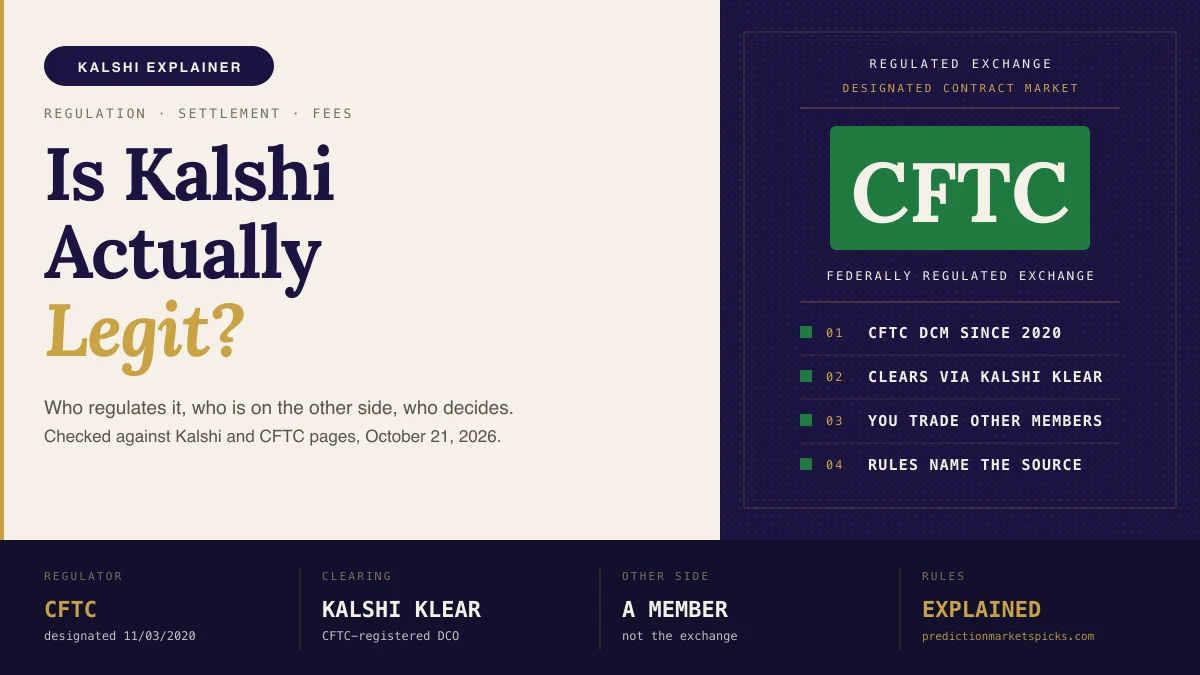
Kalshi is regulated by the Commodity Futures Trading Commission as a Designated Contract Market (DCM), the same federal category as the exchanges that list futures. Kalshi's help center says so in its article "How is Kalshi regulated?", and the CFTC's own list of trading organizations shows Kalshi with the status Designated, dated 11/03/2020. The same CFTC entry notes that on January 17, 2025, the Commission granted Kalshi's petition to modify its order of designation to permit intermediated futures trading.
Trades also have to clear. Since March 2026, Kalshi's contracts clear through Kalshi Klear LLC, a Kalshi affiliate (before that, MIAXdx cleared them for three years, per Kalshi's help center). The CFTC's register of clearing organizations lists Kalshi Klear LLC as Registered, formerly known as LedgerX, and permitted to clear fully collateralized futures, options on futures and swaps.
That is what separates Kalshi from an offshore site with a slick app: a federal regulator has designated the exchange and registered its clearinghouse, and both entries are public. State-level access is its own question. See where Kalshi is available, state by state before you open an account.
Who is on the other side of your trade
This is the part most "rigged" theories get wrong. Kalshi's help center is direct about it: "On Kalshi, you are always trading against another member of the platform, not the exchange itself."
Every fill pairs two members:
- The maker posted an order on the book: a side (Yes or No), a price and a quantity.
- The taker matched the best available order.
Some members are designated market makers, who agree to keep two-sided quotes up and earn the spread between them. Kalshi describes them as generally having no view on where the price goes. Most of the rest, per Kalshi, are retail traders with a directional view or a hedge.
So when your contract loses, the money does not go to Kalshi. It goes to whoever held the other side.
Who decides who wins
The market's rules do. Every Kalshi contract has a rules panel and, usually, a linked rules document. That text names the source that settles the market (official league statistics, a government release, a named price index) and, for some markets, a determination time that can come later than the moment the event seems to end. Kalshi's markets team finalizes the result once the source confirms it, and winning contracts are paid to your cash balance.
Two details from Kalshi's market FAQ matter when a result feels wrong:
- A market staying open is not a signal about the outcome. Kalshi says it does not re-settle a market because an event appeared to have ended while trading was still available.
- If you think a market should be settled, the app has a Request to Settle option, and the markets team reviews every request.
The two rules people call "rigged"
Most of the "rigged" complaints we read trace to one of two settlement rules working exactly as written.
Bitcoin 15-minute contracts settle on an average, not the last print. Kalshi's Bitcoin contracts settle on a 60-second average of the CF Benchmarks index, so the price you watched in the final seconds is not the number that decides the contract. We tested the "rigged" claim across 3,320 windows and found the prices honest and the settles matching the index: Is Kalshi's Bitcoin market rigged?
A player prop does not refund when the player sits. If a player is ruled out before the game, or is active but never takes a snap, every contract on him resolves to the last fair price as determined by Kalshi. Once he plays a single snap, the contract settles on his actual statistics, injury or not. The full rule, quoted: what Kalshi does with a player who doesn't play.
Two more that come up: an NFL tie on a team contract pays 50 cents to each side (Kalshi tie rules), and a game that is cancelled or suspended early resolves to the last fair price as determined by Kalshi under its NFL contract terms. All of them are collected on one page: Kalshi settlement rules.
How Kalshi makes money
From fees, not from your losses. Kalshi's help center says the exchange has no financial stake in whether an outcome goes one way or the other and that its revenue comes from transaction fees rather than positions.
The fee is a taker fee at the fill of 7% × price × (1 − price) per contract, rounded up to the cent, and it is paid whether the position wins or loses. It is largest at a 50-cent price (1.75 cents a contract) and shrinks toward the edges of the range. Run your own size through the Kalshi fee calculator before you trade.
What "legit" does not mean
A regulated exchange guarantees a fair process, not a good price. Three things stay on you:
- The price can be wrong. A market at 70 cents can be a bad buy if the true chance is 60%. Price it first with the EV calculator.
- Thin books cost money. A wide spread is a real cost even when the fee is small.
- Nobody's edge is guaranteed, ours included. We publish every graded call, wins and losses, on our track record.
Checked October 21, 2026, against Kalshi's help center ("How is Kalshi regulated?", "Who are you trading with?", "How does Kalshi make money?", "What is Kalshi Klear?", "Market FAQs") and the CFTC's public registers of trading organizations and clearing organizations. Kalshi's market rules govern each contract; read the rules panel before you trade.