

One note before the data. This week's headlines about Kalshi's crypto volume are about its perpetual futures, mainly the Ether perp (CoinDesk, Sept. 21). This piece is about something else: whether Kalshi's Bitcoin price contracts settle fairly.
We read 22,066 posts and replies on Kalshi's Bitcoin market pages. One complaint drowns out everything else. It shows up as "rigged," "scam," "it was above at 6" and "3 seconds left and it dropped $40." About one in seven of the substantive comments is some version of it.
It's a fair question, so we treated it like one. If Kalshi's Bitcoin markets were rigged, the evidence would have to show up in at least one of three places:
- The settle number wouldn't match the index it's supposed to come from.
- The prices would lie: a 90-cent favorite would lose far more than one time in ten.
- The results would lean one way.
We checked all three.
What decides a Kalshi Bitcoin contract
This is the part most traders learn the hard way. Kalshi doesn't settle on the price at the top of the hour, and it doesn't use Coinbase or whatever chart is open on your phone. Every Kalshi Bitcoin contract settles on the simple average of the 60 one-second prints of CF Benchmarks' Bitcoin Real-Time Index (BRTI) in the minute before the close. Kalshi's own rule for each hourly contract reads: "If the simple average of the sixty seconds of CF Benchmarks' Bitcoin Real-Time Index (BRTI) before 5 PM EDT is above [the strike] at 5 PM EDT… the market resolves to Yes." The 15-minute contract compares that closing average with the same average taken at the window's open.
That one word, average, explains most of the anger:
- If Bitcoin sits under your strike for 50 seconds and spikes over it for the last 10, you lose. Those 10 seconds are one-sixth of the average.
- Your chart can honestly show one number at 6:00:00 while the contract settles on the other side of the strike, because the minute averaged lower.
- It cuts both ways. Sometimes the last print goes against you and you win anyway.
The full mechanics are in How Kalshi settles Bitcoin, on the KXBTCD settlement page and in our explainer on which Kalshi clock fits your view.
Test 1: Does the settle number match the index?
This is the test that matters most, and the one we haven't seen anyone else run.
Starting Sept. 9, 2026, PredictionMarketsPicks recorded the settlement index live at every Bitcoin settle and computed the 60-second average ourselves. We then compared our number to the settle value Kalshi published.
| Hourly (KXBTCD) | 15-minute (KXBTC15M) | |
|---|---|---|
| Settles compared | 442 | 1,796 |
| Median gap, ours vs. Kalshi's | 13 cents | 13 cents |
| Within $1 | 98.4% | 98.0% |
Bitcoin traded between about $75,000 and $87,000 over our sample, so a 13-cent gap is a rounding error. Across all 2,238 settles from Sept. 9 to Sept. 27, 2026, we found one where our number and Kalshi's put a strike on opposite sides. That window was decided by 10 cents, and our own capture was missing one of the 60 prints that minute. That's our miss, not evidence of theirs.
What it rules out: Kalshi making up the settle number, or "closing 60 seconds early" to dodge a late move. The number it publishes is the index average.
Test 2: Does the price tell the truth?
If Kalshi were leaning on outcomes, the prices would stop meaning what they say. A 90-cent contract would lose far more often than one time in ten.
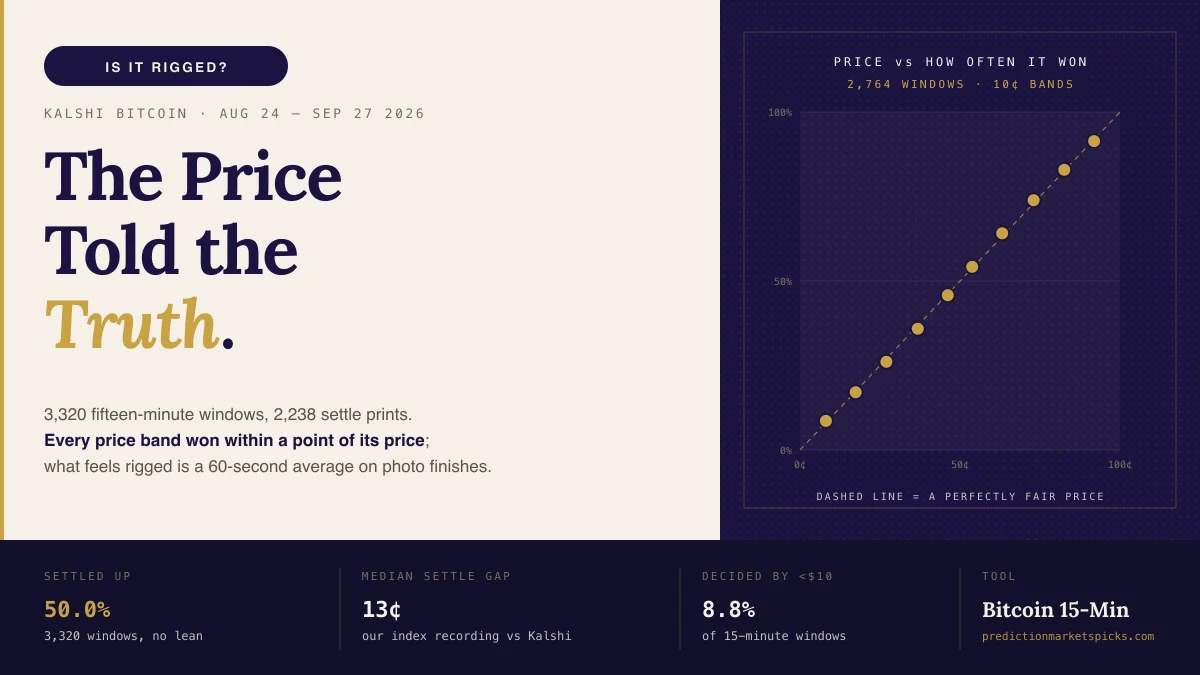
So we took every Kalshi Bitcoin 15-minute window we graded from Aug. 29 to Sept. 27, 2026 (2,764 of them). For each side of each window, we noted the first time its price (the midpoint of the order book) reached each 10-cent band, then checked whether that side won.
| Price band | Times priced there | Avg. price | Won |
|---|---|---|---|
| 0–9¢ | 2,566 | 8.1¢ | 8.6% |
| 10–19¢ | 2,941 | 17.4¢ | 17.1% |
| 20–29¢ | 3,426 | 27.0¢ | 26.1% |
| 30–39¢ | 4,071 | 36.8¢ | 35.9% |
| 40–49¢ | 4,836 | 46.2¢ | 45.8% |
| 50–59¢ | 4,838 | 53.8¢ | 54.2% |
| 60–69¢ | 4,069 | 63.2¢ | 64.1% |
| 70–79¢ | 3,427 | 73.0¢ | 73.9% |
| 80–89¢ | 2,941 | 82.6¢ | 82.9% |
| 90–99¢ | 2,566 | 91.9¢ | 91.4% |
Every band landed within one point of its price. That's what a fair market looks like. It's also why nobody gets rich just buying favorites: you get about what the price says, and then you pay the fee.
The last-minute favorite
The angriest posts come from traders who were at 90-something cents with a minute left and lost. Here's how 95–99-cent favorites actually did as the clock ran down:
| Time left | Windows | Avg. price | Won | Lost |
|---|---|---|---|---|
| ~3 minutes | 906 | 97.6¢ | 98.2% | 16 |
| ~90 seconds | 807 | 97.8¢ | 97.8% | 18 |
| ~45 seconds | 558 | 97.7¢ | 98.9% | 6 |
Roughly one in 45 to one in 90 of those favorites still lost, which is about what a 97–98-cent price says should happen. With 96 windows a day, that works out to an "I had it at 97%" post about every other day. Every one of them is true, and none of them is evidence of anything. As one trader put it: "gain .17c or loose it all." That's the trade you're making at 98 cents. The price is honest about it.
Test 3: Do the results lean one way?
Of 3,320 settled 15-minute windows from Aug. 24 to Sept. 27, 2026, 1,660 settled up: exactly 50.0%. No lean.
So why does it feel rigged?
Because photo finishes are everywhere.
- About one 15-minute window in 11 was decided by less than $10 of Bitcoin, on an asset trading above $75,000. 142 windows were decided by less than $5, and 23 by less than a dollar.
- On the hourly ladder, strikes mostly sit $100 apart. In 92 of 444 hours (21%) from Sept. 9 to Sept. 27, 2026, some strike was decided by less than $10, and in more than half the hours (54%) one was decided by less than $25.
- The comments line up with this. In the posts we read through Sept. 23, the contracts behind "rigged" and "settled wrong" complaints landed a median of about $31 from their strike, and nearly half were within $25. Across all the positions traders shared, only one in six was that close.
Add three more things:
- The average. Anyone watching a spot chart, not the 60-second index average, gets surprised on close calls.
- Speed. When the average is sitting on the line, automated traders reprice the contract faster than any person can tap. That's an edge, and it's annoying, but it isn't a fake result.
- Who posts. Of the 8,673 results traders shared on these Bitcoin pages through Sept. 23, 92.5% were wins. The feed is a highlight reel, and the losses show up as complaints instead.
What would change our mind
We can't certify that nobody has ever done anything wrong on any market, and neither can anyone else. We can say what real evidence would look like:
- A settle number that doesn't match the index average for that minute.
- Prices that stop meaning what they say.
- Results that lean one way.
We'll keep running all three. The settlement comparison updates as new settles come in on the KXBTCD and KXBTC15M settlement pages.
For the record, Kalshi has made settlement mistakes on other kinds of markets. In September 2026 it settled a Western Michigan vs. Michigan football market before the game was over, then clawed the payouts back and paid the right side (NBC Sports). The checks above are about Bitcoin price contracts, and on those we found nothing.
What to do instead of getting mad
- Read the settle. Every closed Kalshi market shows its official settle value. Our KXBTC15M settlement page explains how that number is built and why the chart looked different.
- Know what your price means. The Bitcoin 15-minute cockpit shows which way Bitcoin is moving right now, plus how often a price like yours has actually won with this much time left. Every other quarter-hour series is on the Kalshi 15-minute markets board.
- Stay out of the final minute unless you mean it. That's when the average is mostly locked in and the fastest traders are at their best.
- Count the fee. At 97 cents your upside is 3 cents. Run it through the Kalshi fee calculator before you tap buy.
- Size so a one-in-45 loss doesn't hurt. If losing a 97-cent contract ruins your day, the position is too big. The Kelly calculator will tell you how big is big enough.