


Why there's no single answer
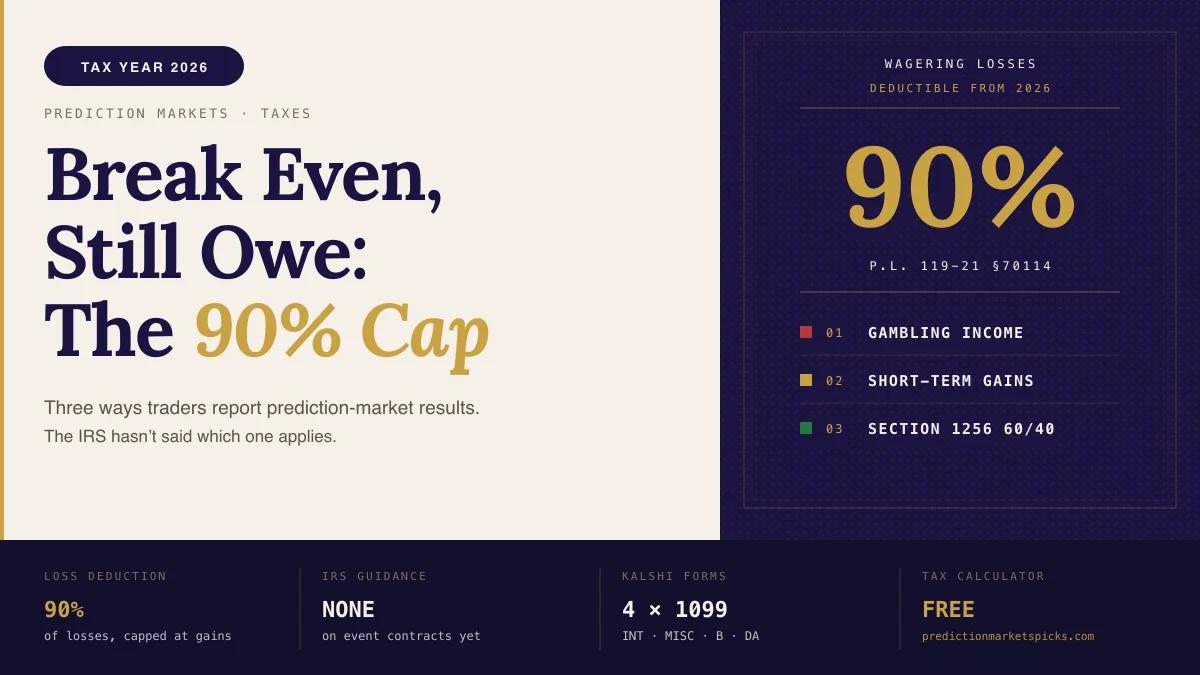
Kalshi and Polymarket US are CFTC-regulated exchanges, and the IRS has not published guidance on how their event contracts are taxed. In that gap, three readings get used. We don't pick one; the point of laying them side by side is to see what is at stake in the choice.
Treatment A: gambling income
Winnings count as ordinary income. Losses come back only as an itemized deduction, so if you take the standard deduction ($16,100 single, $32,200 married filing jointly for 2026, per IRS Rev. Proc. 2025-32), your losses do nothing for you.
For 2026 there is a second hit. Public Law 119-21, section 70114, rewrote the wagering-loss rule for taxable years beginning after December 31, 2025. The deduction "shall be equal to 90 percent of the amount of such losses during such taxable year" and is allowed "only to the extent of the gains from such transactions."
Take a trader who wins $10,000 and loses $10,000. They made nothing. Under this treatment, $10,000 of winnings is income, and if they itemize, only $9,000 comes back off, so $1,000 is taxed that they never made. If they don't itemize, all $10,000 is.
Treatment B: short-term capital gains
Here the year nets out first: winnings minus losses. A net gain is taxed at ordinary rates. A net loss offsets up to $3,000 of other income ($1,500 if married filing separately), and the rest carries forward to next year. Break-even owes nothing.
Treatment C: Section 1256, the 60/40 rule
Section 1256 contracts, which include regulated futures, tax a net gain as 60% long-term and 40% short-term capital gain, whatever the holding period. On a net gain this is usually the lowest of the three, because most of it is taxed at the 0%, 15% or 20% long-term rates. A net loss is a capital loss under the same $3,000 limit, with an option to carry it back three years against earlier 1256 gains.
The forms to expect
Kalshi's help center lists four forms for users who hit IRS reporting thresholds: 1099-INT for interest, 1099-MISC for credits and rewards, 1099-B for broker transactions (crypto transfers) and 1099-DA for digital-asset transactions. It also gives you a profit-and-loss statement under Account, then Tax Info, computed first-in, first-out with fees included. Polymarket US had no tax-form page in its public FAQs when we checked on November 11, 2026, so look in your account and keep your own trade history.
Whatever arrives, your own records matter more: every treatment starts from your total winnings and total losses.
What to do with this
- Pull your full 2026 trade history and your Kalshi profit-and-loss statement.
- Run the totals through the tax calculator and note the gap between the highest and lowest treatment.
- Take that range to a CPA who knows trader taxation. The gap is the size of the decision.
Fees cut into every one of these numbers before tax does; the Kalshi payout and fee calculator shows profit after fees on any contract. If you think about positions the way a bond desk does, reading Kalshi like a bond desk covers the pricing side.
Figures from IRS Rev. Proc. 2025-32 and Public Law 119-21, read November 11, 2026. Federal only; state tax, the alternative minimum tax and the net investment income tax are not covered. Not tax advice.