

At about 3:54 p.m. ET on Friday, the FAA held every departing flight at every airport in the United States. The FAA and the Transportation Department pinned it on a telecommunications problem hitting the regional air traffic control centers. It's the first nationwide stop since the January 2023 NOTAM failure.
If you were sitting at a gate, the question wasn't "why." It was "am I sleeping here tonight?"
That's exactly the question Kalshi turned into a market.
The Market: When Will the FAA Lift the Ground Stop?
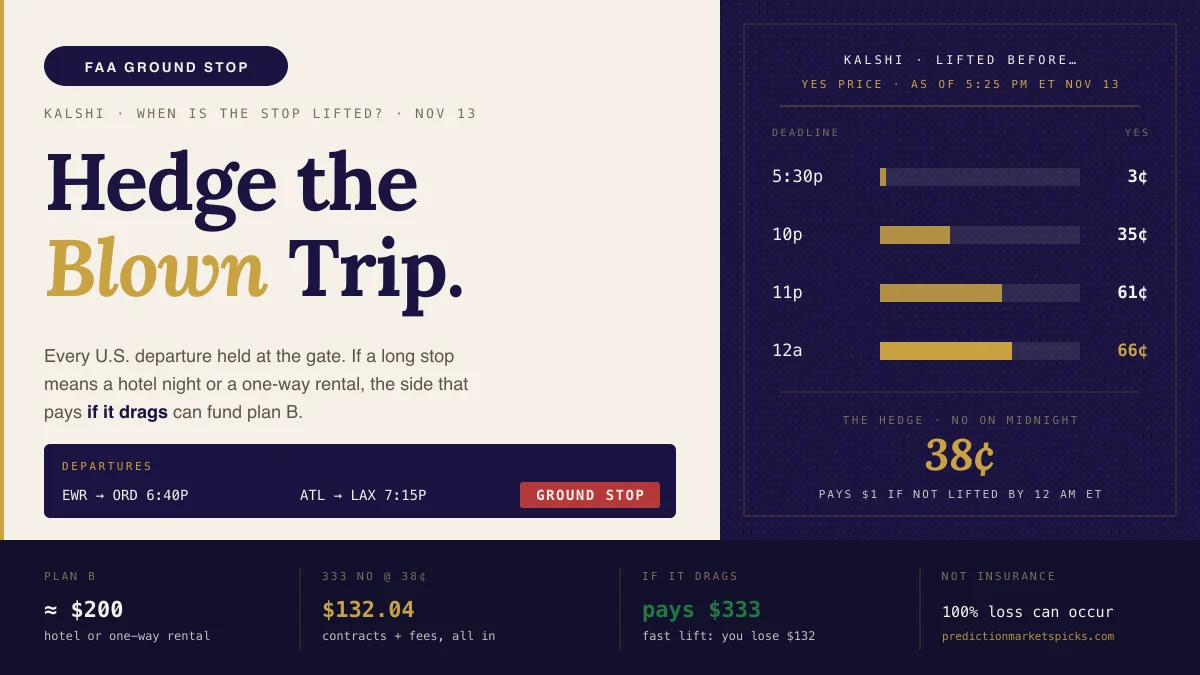
Kalshi listed "When will the FAA announce the ground stop is lifted?" with a ladder of deadlines. Each rung pays $1 if the FAA announces the lift before that time, $0 if it doesn't. The price is the market's read on the odds.
Here's what the ladder looked like at about 5:25 p.m. ET on Nov. 13 (prices move fast; check the live market):
| Lifted before… | YES | NO | What NO is really saying |
|---|---|---|---|
| 5:30 p.m. ET Nov. 13 | 3¢ | — | "It's not clearing in the next five minutes" |
| 10:00 p.m. ET Nov. 13 | 35¢ | 67¢ | "Evening flights are toast" |
| 11:00 p.m. ET Nov. 13 | 61¢ | 43¢ | "Late flights are toast too" |
| 12:00 a.m. ET Nov. 14 | 66¢ | 38¢ | "You're sleeping somewhere tonight" |
Roughly $116,000 had traded by then. Real money, real-time read on a question every stranded traveler was asking.
The Point: This Is What Prediction Markets Are For
Forget the picks for a second. This is the cleanest use case there is.
A ground stop is a bad event that costs you money if it drags on:
- An extra hotel night in a city you didn't plan to be in.
- A rebooked flight at Saturday-morning walk-up prices.
- A one-way rental car to drive from Point A to Point B yourself.
- A missed shift, a missed meeting, a missed wedding rehearsal.
- The vacation day you already paid for and won't get back.
You can't stop the FAA from holding planes. You can take the side of the market that pays if the stop runs long, so the bad outcome comes with a check attached.
That's a hedge. You're not trying to win. You're trying to make the bad scenario hurt less.
How the Hedge Works
Step 1: Find your break point. What time, if the stop is still on, wrecks your plans? Say your last connection out tonight is gone if the stop isn't lifted by midnight.
Step 2: Buy NO on that rung. NO on "lifted before 12:00 a.m. ET Nov. 14" pays $1 per contract if the FAA hasn't announced the lift by midnight. That's your bad scenario.
Step 3: Size it to the bill, not to a dream. Figure what plan B costs: hotel, rental car, the shift you'll miss. That's your target payout.
The Math, Using the 5:25 p.m. Prices
You figure plan B (a one-way rental and gas, or a hotel night and a rebooked seat) runs about $200 out of pocket.
- NO on midnight costs 38¢. Kalshi charges a per-contract trading fee at the fill, win or lose (run it in our Kalshi fee calculator).
- 333 contracts: about $126.54 for the contracts plus roughly $5.50 in fees = $132.04 out the door.
Two ways it plays out:
| What happens | Your trip | Your position | Net |
|---|---|---|---|
| Stop runs past midnight | Plan B: hotel or rental car, ~$200 | Pays $333 | Position nets +$200.96, which covers plan B |
| FAA lifts before midnight | You fly | Pays $0 | You're out $132.04, but you got home |
Either way, you've bounded the damage. The worst night you can have is the one where you're stranded and broke. The hedge takes that one off the table.
This is an illustration of how the payoff works, not a recommendation to take the position. Prices in this market moved by double digits inside an hour.
The Fine Print Nobody Reads (Read It)
- It settles on the announcement. The market resolves on when the FAA announces the stop is lifted. Airlines can keep running delays and cancellations long after. Planes taking off at 10 p.m. doesn't mean your 7 p.m. flight is going anywhere.
- It pays on the event, not your loss. If the stop lifts at 11:58 p.m. and your airline cancels anyway, NO on midnight pays nothing. Pick the rung that matches your break point, and give yourself room.
- The hedge costs money when things go right. That's the deal. A fast lift means you lose what you paid. That's the premium for not getting wrecked.
- Read the contract rules on Kalshi before you trade. Deadlines, time zones and the settlement source are in there.
- It's not insurance. It's an event contract. You can lose 100% of what you put in. Trade responsibly.
The Bigger Picture
Every year people pay for trip insurance with exclusions they never read. A prediction market on a single, specific, public event (the FAA lifting a ground stop) is a cleaner tool for one specific risk: you know what you're covering, you know what it costs, and you know exactly when it pays.
Weather delays. Strikes. A government shutdown that guts air traffic control staffing. If it can be written as "will X happen by Y," it can be hedged. That's the part of prediction markets that doesn't get talked about enough.
Not a pick. A tool. The call is yours.
Check the live ground stop market on Kalshi →
Separately: Polymarket US
The section below is a sponsored offer and is not connected to the ground stop market or the hedge above. Polymarket US does not list this market.
<PolymarketUsBlock />