

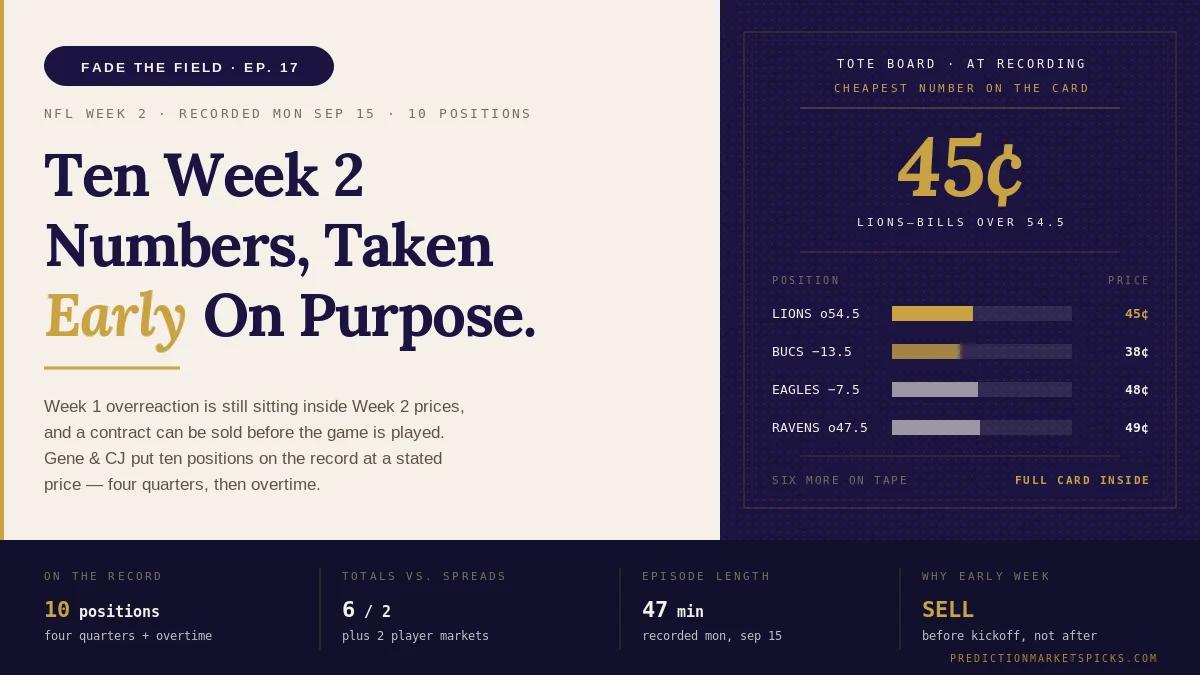
Coach Gene Clemons (@geneclemons) and Chris James (@CJFlorida9) recorded Episode 17 of Fade the Field on the Monday after Week 1 — on purpose. The entire premise of the show this week is a timing argument: the Week 2 board is still carrying Week 1's overreaction, and the overreaction has a shelf life measured in days.
Ten positions went on the record at a stated price. Here is the card, and here is the reasoning behind it.
The card
Every price below is what the board read at recording, Sept. 15, 2026. They will not hold — that is the point of the episode, not a disclaimer on it.
| Quarter | Position | Price on tape | Implied |
|---|---|---|---|
| Q1 | Saints at Ravens, over 47.5 | 49¢ | 49% |
| Q1 | Vikings at Bears, over 48.5 | ~1.97x | ~51% |
| Q2 | Lions at Bills (Thu), over 54.5 | 45¢ | 45% |
| Q2 | Steelers at Patriots, under, 40.5 rung | ~2.1x | ~48% |
| Q3 | Commanders at Cowboys, over 51.5 | 51¢ | 51% |
| Q3 | Packers at Jets, over 44.5 | ~2.0x | ~50% |
| Q4 | Eagles −7.5 at Titans | 48¢ | 48% |
| Q4 | Buccaneers −13.5 vs. Browns | ~2.66x | ~38% |
| OT | Lamar Jackson over, total + rush yards | — | — |
| OT | Allen / Henry / Barkley anytime TD combo | Allen 48¢ | 48% |
Why Monday, not Sunday
This is the part that does not translate from a traditional oddsboard, and it is the reason the show exists in this format.
A prediction-market contract is a tradeable instrument, not a locked ticket. Buy the Giants at 42¢ on Monday, watch the number walk to 52¢ by Sunday, and you are already up — you can take the whole position off, or take half off and let the rest ride into kickoff. Gene's framing on the episode: you get more control over when you pull your money out. The game is one way to get paid. It is not the only way.
That matters most right now because of how slowly a market corrects early in a season. CJ's line on the show is that when the market gets a team wrong in the first three weeks, it usually does not fully correct until Week 4 — there is not enough football underneath the price to force a repricing. He compares those markets to cruise ships: hard to pivot, hard to turn, and the whole time they are turning you can stand on the other side of the trade.
The teams themselves are just as slow. That is the second half of the thesis.
The bogey
Gene's organizing idea is borrowed from fantasy football, where you stream a defense against the weakest offense on the slate and stream a kicker off an offense that stalls at the 25. When you find the bogey, you keep going at the bogey.
Week 1 handed him two of them. New Orleans and Detroit played a game that started as a rock fight and ended as a track meet, and it exposed both secondaries at once. Neither is fixable inside three weeks. Neither has a personnel answer sitting on the roster.
So Gene takes the over on New Orleans at Baltimore at 47.5, priced 49¢, and the argument is not about Baltimore's ceiling — it is that the Ravens' offense has three separate ways to beat you and the Saints can only account for one at a time. Commit to Derrick Henry and Lamar Jackson throws. Spy Jackson and Henry runs. He is not looking for 55; he is looking for 48, and he thinks 49¢ undersells it.
There is a tell he keeps coming back to. New Orleans went for two to win in overtime rather than kick the tie. That is a head coach telling you, without saying it, that he has no confidence his defense gets a stop. CJ agreed with the decision on the merits — road game, indoor kicker, new dynamic kickoff, opponent already in field-goal range on the next drive — and both hosts filed it as evidence rather than as a highlight.
CJ's Q1 is the same logic pointed at Chicago. Ben Johnson said out loud that he wants the single-season scoring record. Minnesota at Chicago, over 48.5, was paying about 1.97x — roughly a 51¢ contract — and CJ's read is that it is a natural 28–21: the Bears push the pace at home and Minnesota has to answer.
The two biggest numbers on the card
Gene's second-quarter position is the cheapest thing on the board and the one most likely to make people flinch: Lions at Bills, over 54.5 at 45¢ — Thursday night, Sept. 17, in Buffalo.
His defense of the number is worth taking seriously because it is a distributional argument, not a vibes argument. Big totals are big for a reason. A 54.5 is not a market forecast of 28–27; it is a forecast of a blowout-shaped game, something in the 30s against the 20s. And both of these offenses just did exactly that to defenses better than the ones they are about to face — Buffalo scored on a Houston secondary that is, in Gene's read, one of the best in the league, and Detroit pulled 30-plus out of a game it had no business scoring in.
CJ stacked three more reasons on top: Buffalo is opening a new stadium and wants the moment, Detroit's secondary was starting nobody younger than 29 and lost one of them, and Dan Campbell is going for it on fourth down and going for two every time the arithmetic allows. Two teams that have to score, and no reason to believe either can stop the other.
Then CJ ran the method backwards. Pittsburgh and New England both showed up on defense in Week 1 and both showed up nowhere on offense — New England without A.J. Brown, Pittsburgh with a quarterback who, in CJ's read, has no interest in pushing the ball down the field. He took the under at a 40.5 rung for about 2.1x, roughly 48¢, and called the game a contest played between the 25s. Expect field goals. Expect two touchdowns, total.
Same framework. Opposite sign. That is the show's format working: the method is the product, the side is the output.
Personality over scheme
Gene's Q3 is Washington at Dallas, over 51.5 at 51¢, and the case is built on something the box score hid. The Giants did not shut the Cowboys down in Week 1 — they kept the ball away from them, close to three-to-one on time of possession. Dallas's offense was not the problem. George Pickens beat his man repeatedly and could not finish, CD Lamb was underused, and the Cowboys' defense looked like it could not stop anybody. Meanwhile Washington moved the ball on a genuinely good Philadelphia defense with a quarterback getting his feet wet.
CJ's addition is the sharpest line in the episode: personality beats intent. Dallas wants to be a defensive team — they invested in it, they talk about it — but they are a shootout team and always have been, and Jayden Daniels does not know how to not score points. When the defenses are this malleable, you take the side of the offensive personalities.
His own Q3 is a number he openly cannot explain: Green Bay at the Jets, over 44.5, at roughly 2x — about 50¢. Geno Smith is a gunslinger, Green Bay's run game is pedestrian enough to force Jordan Love to throw, and Green Bay could not guard anybody in the second half of Week 1. Gene's addition is that Smith's whole career shape is quiet 4,000-yard, 25-touchdown seasons behind merely competent line play — the kind of production you notice in the box score and never during the broadcast. Neither host can find the case for 44.5.
The two spreads
Gene's Q4 is Philadelphia −7.5 at 48¢, on the road in Tennessee. Landon Dickerson is on IR, which puts a backup center in front of that Eagles interior line — but at the end of it, Tennessee could not handle the Jets, and Philadelphia attacks from more places than the Jets do. His standard: if the Eagles do not win this by double digits, something is genuinely wrong in Philadelphia.
CJ's Q4 is Tampa Bay against Cleveland, stepped up to −13.5 for about 2.66x — roughly a 38¢ contract — deliberately buying past the 14 so the hook is on the right side. The read is quarterback-contingent by his own admission: a young quarterback is the wrong profile against that Buccaneers front, and the veteran option produced three fumbles in an operation that barely functioned. Tampa Bay gets a second straight game in Florida and a reason to be embarrassed about the first one.
Overtime
CJ's best position of the week has no notes attached: Lamar Jackson, over on anything — total yardage, rushing yardage, whatever rung is available — against New Orleans. History, matchup, and the play-action boot game all point the same direction, and a limited Zay Flowers makes the boot more likely, not less.
Gene's is a three-leg anytime-touchdown combo: Josh Allen at 48¢, Derrick Henry against the Saints, and Saquon Barkley against Tennessee. He flagged the Allen price as the one he could not explain and declined to argue with it. If you want the mechanics of how a combo prices and where the correlation traps sit, we wrote that up separately in how Kalshi combos work.
Ladder it
Both hosts said the same thing in different quarters, and it is the most portable idea in the episode: do not take one number. If you like a total, ladder into it — take the 44.5, then step to 48.5, then to 52.5 — so a moderate outcome still pays on the low rung while the high rungs carry the upside. It converts a binary opinion into a distribution, which is the only honest way to express conviction you cannot measure precisely.
Size the rungs before you take them. The Kelly calculator and the EV calculator are both free, and the probability converter will turn any of the multipliers in the table above into an implied percentage so you can compare rungs on the same scale.
Watch it
Episode 17 runs 47 minutes — the player is at the top of this page. The full slate walk, the Week 1 reaction, and the futures reset are all on tape; this piece is the numbers, not the argument behind every one of them.
Every episode with a written breakdown lives at Fade the Field. The model, the edge board and the prop board are at /nfl.
Prediction markets are not sportsbooks. Kalshi is a CFTC-regulated exchange — contracts trade between 1¢ and 99¢ as market-implied probabilities and settle on the real outcome. Everything here is analysis with a stated position attached, recorded at a stated price on a stated date. Nothing here is advice. Trade responsibly.