

Every calculation in this cluster runs through one input you provide. The edge formula treats your probability as fact. Kelly sizes off it. Fee math nets against it. Everything downstream is arithmetic — precise, verifiable, and completely dependent on a number that arithmetic cannot check.
This is the hard part. It is also the only part where an individual can genuinely beat a market.
The Short Version
- Start from a base rate, not from the story. How often has this class of event resolved YES?
- Update with evidence via a likelihood ratio: how much more likely is this evidence if the event is true than if it is false?
- Evidence that is roughly as likely either way carries no information — which is most of a news cycle.
- Form your number before you look at the price. An estimate anchored to the price drifts toward it.
- Calibration is measurable and personal. Things you call 70% should happen about 70% of the time.
- A precise edge built on an invented probability is a precisely wrong answer, and it looks identical to a right one.
Start With the Base Rate
The reliable failure is base rate neglect: building a forecast out of the vivid particulars of one case while ignoring how often that kind of case resolves YES.
The particulars are where all the interesting thinking is, which is exactly why they are dangerous. A detailed, coherent story about why this incumbent loses, or why this storm makes landfall, feels like analysis. It carries no information about frequency. Meanwhile the frequency — incumbents in this position have won 83% of the time over forty cycles — is boring, checkable, and usually closer to the truth than the story.
The fix is procedural rather than clever. Find the reference class, get its historical rate, and make that your starting number. Then let the specifics move you off it, and notice how far they moved you.
Ending up far from the base rate is legitimate. Starting far from it, because the case felt distinctive, is where bad estimates come from.
Update With Evidence, Weighted Properly
Once you have a prior, evidence should move it — by an amount that depends on how diagnostic the evidence actually is.
The question to ask of any new fact is not "does this support YES?" It is: how much more likely is this fact if the event is true than if it is false?
That ratio is the whole mechanism.
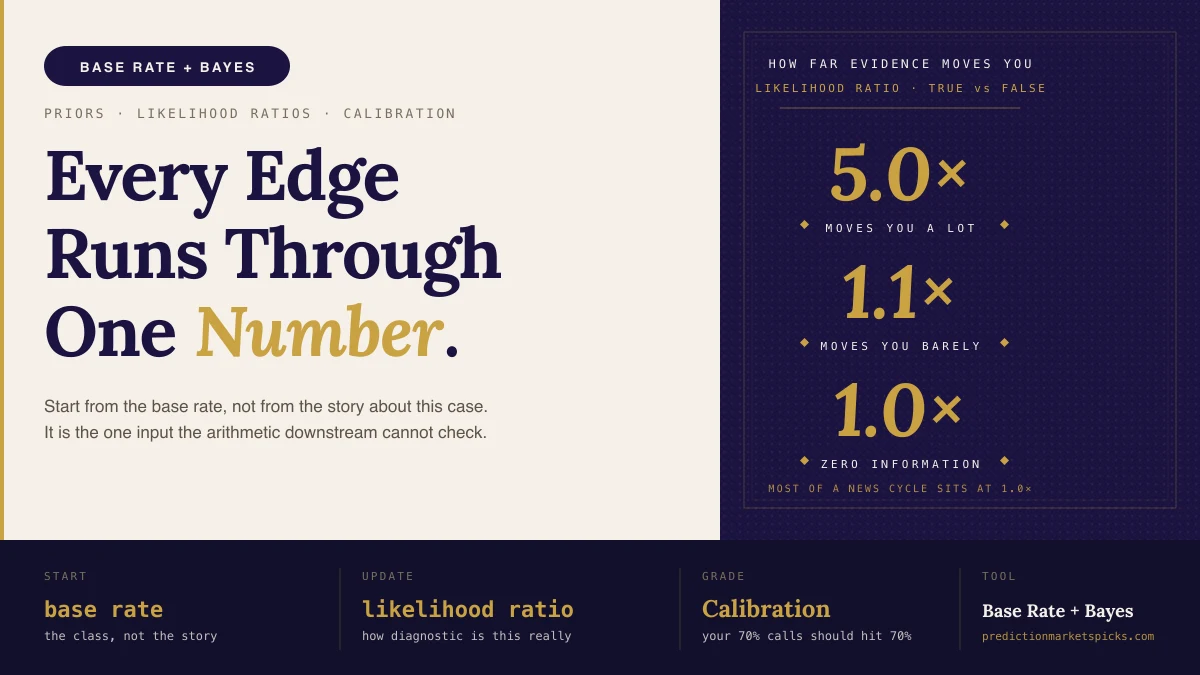
- Evidence five times more likely under YES than NO moves you a lot.
- Evidence 1.1 times more likely moves you almost nothing.
- Evidence equally likely either way carries zero information, no matter how dramatic it is.
That last category is most of what a news cycle produces. A headline that would have been written whether or not the event ends up happening is not evidence about the event. It reads as urgent and updates nothing.
Working an update by hand, with explicit likelihoods, is uncomfortable in a useful way: it forces you to say out loud how diagnostic you think a piece of evidence is, and the discomfort usually reveals that the honest answer is "barely."
Form Your Number Before You Look at the Price
The market price is a forecast — an aggregated, incentivized, usually good one. That is what makes it treacherous as an input.
If you look at the price before forming your estimate, your estimate will drift toward it. Not because you are careless, but because anchoring is what minds do. You will arrive at a number close to the market's, conclude you agree, and feel your process worked. What actually happened is that you re-derived the price and learned nothing.
Worse is the version where you arrive near the price, then talk yourself a few points past it to manufacture an edge that clears the threshold.
The sequence that survives contact with reality: base rate → evidence → your number → then the price. If the gap is large, the first question is not "how do I trade this" but "what does the market know that I don't?" Sometimes the answer is nothing and it is a real edge. Sometimes the answer is that the contract settles on a criterion you misread, and the market is right.
Calibration Is the Only Real Scoreboard
Being right about one contract proves nothing. Anyone is right sometimes.
The property that matters is calibration, and it only exists across a series: of everything you called 70%, roughly 70% should have happened. Not more — a forecaster whose 70% calls hit 95% of the time is badly calibrated too, just in the flattering direction, and is leaving money on the table by understating conviction.
Calibration cannot be felt from the inside. It has to be recorded and graded, which is unglamorous and is why almost nobody does it. It is also the reason we publish our own graded record — every signal our engines produce, scored against the market that priced it, including the engines that lose money. A forecast nobody checks is not a forecast; it is a preference with a number attached.
Keep your own log. Write the probability before the outcome, and grade it after. Six months of that will tell you more about whether you can beat a prediction market than any amount of reading will.
Use The Tool
The Base Rate Scanner gives you a historical starting point for a class of event, with the sample size attached so you can see how much weight it deserves. The Bayes Updater takes that prior and walks it through your evidence one piece at a time, showing what each item actually moved.
Run the Base Rate Scanner → · Run the Bayes Updater →
Then, and only then, take the number to the EV calculator. The edge it returns will be exactly as good as what you brought it.
Educational analysis, not financial advice. Trade responsibly.