

PredictionMarketsPicks’ EV calculator does one thing: it takes a contract price and your own probability, and returns a single number telling you how much edge is in the trade. This is what that number is, exactly how it is produced, and — the part most guides skip — what it deliberately refuses to tell you.
The Short Version
- Edge % = (your probability − market probability) ÷ market probability × 100. Both as decimals.
- The edge is normalized against the contract price, so it reads as a return on capital at risk, not a raw gap in probability points.
- ±5% is the noise threshold PredictionMarketsPicks uses. Above +5% → BUY. Below −5% → SELL. Between → SKIP.
- Polymarket quotes 0–1; the calculator takes 0–100. A contract at 0.40 is entered as 40.
- The number excludes fees and says nothing about size. Both are separate calculations, and both can turn a positive edge into a losing position.
- The edge is only as good as the probability you feed it. That input is the whole ballgame.
The Formula
For a binary contract, the market price is a probability. A contract trading at 40¢ pays $1.00 if the event happens and $0 if it does not, so the market is quoting a 40% chance.
If you think the real chance is 55%, the calculator computes:
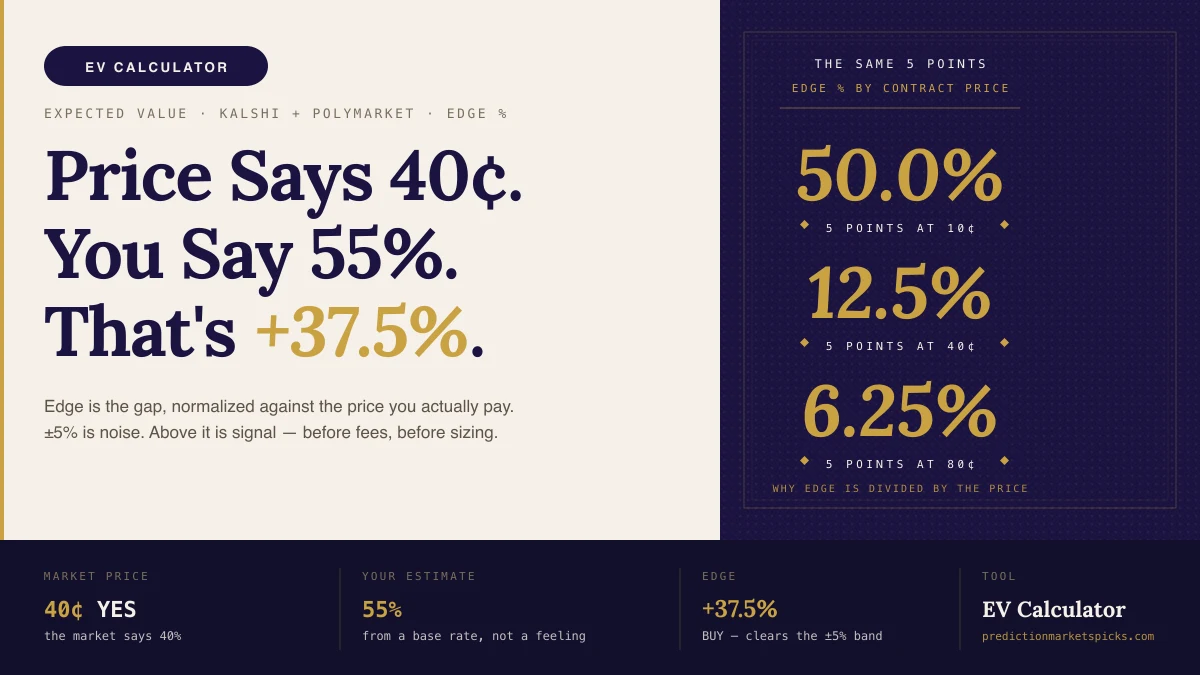
Edge % = (0.55 − 0.40) ÷ 0.40 × 100 = +37.5%
That is the number the tool returns. It means that for every dollar you put into this contract, you expect $1.375 back — if your 55% is correct.
Why Divide By the Price
This is the design decision that matters most, and it is where a lot of home-rolled spreadsheets go wrong.
The instinct is to quote edge as a raw gap: "the market says 40%, I say 55%, that is 15 points of edge." But 15 points means completely different things depending on where the contract trades:
| Market price | Your estimate | Raw gap | Edge % |
|---|---|---|---|
| 10¢ | 15% | 5 points | +50.0% |
| 40¢ | 45% | 5 points | +12.5% |
| 80¢ | 85% | 5 points | +6.25% |
Same five points. Three completely different trades. The 10¢ contract returns eight times the capital-adjusted edge of the 80¢ one, because you are risking a fraction of the capital to capture the same absolute move.
Quoting a raw gap flattens all three into one number and hides the thing you are actually deciding — how hard to work the capital. Dividing by the market price is what makes a cheap longshot and an expensive favorite comparable on one scale.
Why the Threshold Is ±5%
The calculator does not return a signal on every gap. Under +5% and over −5% it returns SKIP.
The reason is not that markets are efficient. It is that your probability estimate is not precise. If your honest forecast is "somewhere around 45%," a 3% edge is well inside the error bar of the input, and treating it as a signal would be reading your own noise back to yourself as information.
Five percent of the contract price is a deliberately modest bar — it is not claiming that everything above it is a good position, only that everything below it is indistinguishable from estimation error. What clears the bar still has to survive fees and sizing.
| Edge | Signal | What it means |
|---|---|---|
| Above +5% | BUY | Market is underpricing the event relative to your estimate |
| −5% to +5% | SKIP | Gap is inside the error bar of the input |
| Below −5% | SELL | Market is overpricing it; the NO side is the position |
Entering a Polymarket Price
Kalshi quotes in cents (a contract shows as 40¢). Polymarket quotes as a decimal from 0 to 1 (the same contract shows as 0.40). The calculator takes a 0–100 price, so a Polymarket contract at 0.40 is entered as 40.
One thing to hold onto beyond the arithmetic: Polymarket runs as two separate exchanges — an international book and a US one — and they do not share an order book. A price you read on one is not necessarily the price you can trade on the other. Whatever number you enter, make sure it came from the venue you are actually going to trade.
The Three Things This Number Does Not Tell You
A positive edge is a precondition for a good position. It is not a good position on its own, and the calculator is deliberately silent on three things.
It does not know what your probability is worth. The formula treats your 55% as fact. If that number came from a base rate you checked and evidence you weighted, the edge is real. If it came from a feeling about the news cycle, the calculator will return exactly the same confident +37.5% and it will mean nothing. This is not a limitation to work around — it is the load-bearing input, and the only part of this that is genuinely hard. Sharpen it with the base rate scanner and the Bayes updater before you trust any edge figure built on top of it.
It does not include fees. Kalshi's trading fee is not flat — it is largest on contracts priced near 50¢ and nearly vanishes at the extremes. A thin edge on a coin-flip contract can be entirely consumed by the cost of entering it. Run the real breakeven through the Kalshi fee calculator before deciding a small edge is worth taking.
It does not tell you how much to trade. Edge percentage and position size are different questions, and the gap between them is where most accounts are actually lost. A +40% edge does not mean 40% of your account. Convert the edge into a stake with the Kelly calculator, which accounts for both the size of the edge and the odds you are getting.
Why We Publish the Record
Every signal our engines publish is graded against the market that priced it, wins and losses both, on the public track record. That is the same discipline this calculator is asking of you: a probability estimate is a claim, and a claim you never check against an outcome is not a forecast — it is a preference.
The calculator will happily return a beautiful edge on a number you invented. The grading is what tells you whether your numbers are any good.
Use The Tool
The EV Calculator is free, needs no account, and runs the math above on any Kalshi or Polymarket contract. Enter the price, enter your probability, read the edge and the signal.
Price is what the market thinks. Your probability is what you think. The edge is the distance between them, priced as a return. Everything else is execution.
Trade responsibly. Educational analysis, not financial advice. Position size based on your edge and your account, not on conviction.