

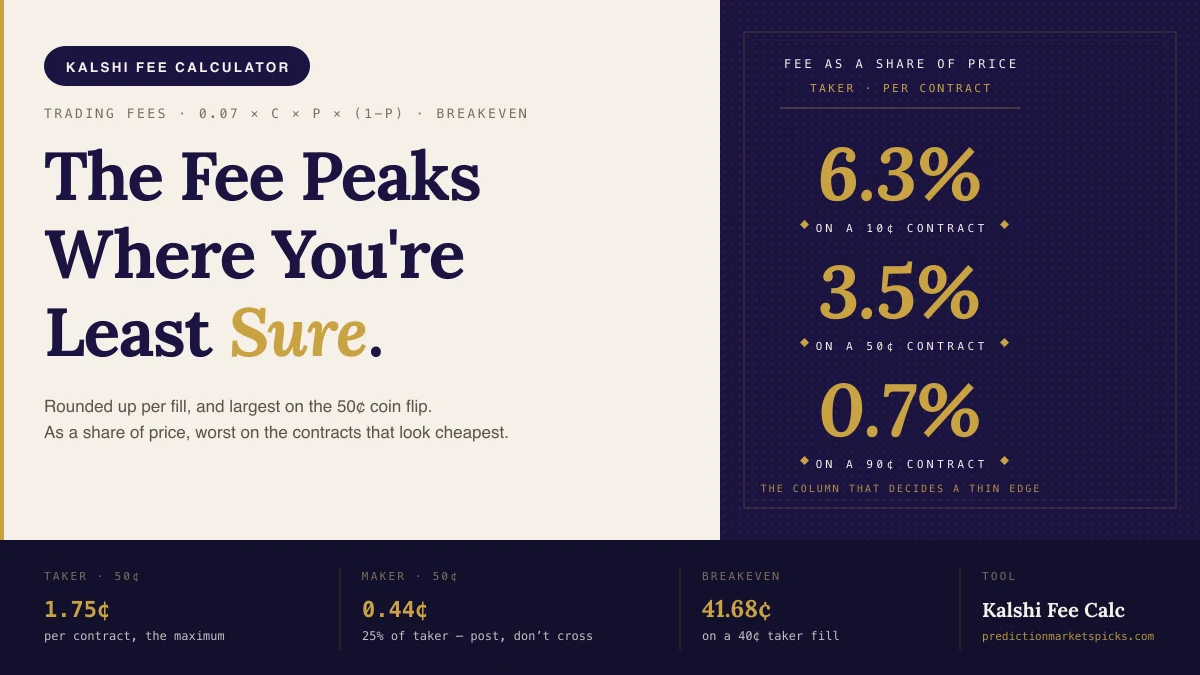
PredictionMarketsPicks’ EV calculator returns an edge that deliberately ignores costs. That is the right design — a fee is a separate, knowable number — but it means a positive edge on screen is a gross figure. This is how to net it.
What is the Kalshi fee formula?
Kalshi does not charge a flat per-contract commission. The general trading fee is:
fee = ⌈ 0.07 × C × P × (1 − P) ⌉
where C is the number of contracts, P is the price in dollars, and the result is rounded up to the next cent per fill.
The P × (1 − P) factor is the variance of a coin weighted at P. It is maximized at P = 0.50 and falls away symmetrically in both directions. So the fee is structurally tied to how uncertain the contract is: a genuine coin flip costs the most to trade, a near-settled contract costs almost nothing.
| Price | Taker fee per contract | As % of price |
|---|---|---|
| 10¢ | 0.63¢ | 6.3% |
| 25¢ | 1.31¢ | 5.3% |
| 40¢ | 1.68¢ | 4.2% |
| 50¢ | 1.75¢ | 3.5% |
| 75¢ | 1.31¢ | 1.8% |
| 90¢ | 0.63¢ | 0.7% |
Two different stories live in those columns, and traders routinely read only the first.
One more wrinkle for small orders: the fee is rounded up to the next cent per fill, not per contract. A single 10¢ contract has a computed fee of 0.63¢ and is charged 1¢ — 10% of the price. The per-contract figures above are the marginal rate you approach on a fill of any real size; below that, rounding makes small trades meaningfully worse than the table suggests.
Which fee number actually matters — cents or percent of price?
Percent of price. In absolute cents, the fee peaks at 50¢. That is the number most people quote.
But you are not comparing fees to each other — you are comparing a fee to your edge, and the edge is already expressed as a percentage of the contract price. So the right column is the last one — the one PredictionMarketsPicks nets every edge against — and it tells a different story: as a share of price, the fee gets steadily worse the cheaper the contract gets.
A 10¢ contract charges 6.3% of its own price to enter. Read that against the ±5% threshold on the EV calculator and the implication is uncomfortable: on cheap contracts, an edge that just clears the signal threshold can be entirely consumed by the cost of entering the position. The signal is real and the trade is still a loser.
This is the single most useful thing to internalize about longshot contracts. They look capital-efficient — small outlay, large multiple — and the fee curve quietly claws back a large share of exactly that advantage.
What is the break-even price after Kalshi fees?
Break-even is the price the market has to reach before the position stops losing money. It is the price you paid plus the fee you paid.
Buy a 40¢ contract as a taker:
- Fee: 0.07 × 0.40 × 0.60 = 1.68¢ per contract
- Break-even: 41.68¢
Hold to settlement and the contract pays 100¢ or 0¢, so the fee simply reduces the profit on a winner. But if you intend to exit before resolution — which is most of what active traders do — you pay the fee again on the way out, and the round trip has to clear both charges. On a 50¢ contract that is roughly 3.5¢ of round-trip cost against a $1.00 maximum payout.
How much less does a maker order pay on Kalshi?
A quarter of the taker fee. A taker order crosses the spread and fills immediately. A maker order rests on the book and fills only when someone trades against it. Makers pay 25% of the taker fee.
On a 50¢ contract: 1.75¢ as a taker, about 0.44¢ as a maker. That is the largest fee lever available on Kalshi, and it costs nothing but patience.
The trade-off is honest and worth stating: a resting order may not fill at all, and on a market that is moving because news landed, the fill you were waiting for is exactly the one you will not get. Posting is close to free when you are early on a slow-moving contract, and expensive in opportunity terms when you are trying to react.
How do you net a fee out of an edge?
Net the edge before you decide anything. The sequence that works:
- Get an edge from the EV calculator.
- Get the real break-even from the fee calculator at that contract's price.
- If the edge does not clear the fee as a percentage of price, there is no trade — regardless of what the signal said.
- Only then size it, which is a different calculation with different inputs.
And none of this rescues a bad probability estimate. Netting fees off a number you guessed produces a precisely-computed guess — where the estimate comes from decides whether any of the arithmetic downstream means anything.
Use The Tool
The Kalshi Fee Calculator computes the exact fee, the fee per contract, the break-even price and the round-trip cost for any contract, plus the full maker/taker curve.
Run the Kalshi Fee Calculator →
The fee is knowable to the cent before you enter. There is no excuse for discovering it after.
Fee figures follow Kalshi's published general fee schedule. Some series carry a different schedule — check the contract. Educational analysis, not financial advice.