

Two numbers, two questions, and a failure mode that shows up in accounts that were right about the market. The EV calculator tells you a contract is mispriced. It says nothing at all about how much to put on it — and that second question is where the money is actually made or lost.
The Short Version
- EV answers whether. Kelly answers how much. They are not two views of one number.
- Kelly for a binary contract: f\* = (p × b − q) ÷ b, where b = (1 − price) ÷ price.
- A bigger edge does not automatically mean a bigger position — Kelly weighs the edge against the payout ratio, and the payout ratio moves with price.
- Full Kelly is optimal only if your probability is exactly right. It never is. Fractional Kelly exists because of that.
- Kelly is asymmetric in the wrong direction: overestimating your edge hurts far more than underestimating it.
- Net fees before sizing, or you overstake every position — worst near 50¢.
The Two Questions
Expected value is a comparison. It puts your probability next to the market's and returns the gap, normalized against the price. It is a test: does this contract deserve a position at all?
The Kelly criterion is an allocation. Given that the contract deserves a position, and given the odds on offer, what fraction of the account maximizes long-run growth without risking ruin?
Answering the first and skipping the second is the most common way a trader with a real edge still ends up down. You can be right about the market and wrong about the size, and the size mistake compounds faster than the edge does.
The Formula
f\* = (p × b − q) ÷ b
- p — your probability the contract resolves YES
- q — 1 − p
- b — net payout ratio: what you win per unit risked
For a binary contract, b falls straight out of the price. A contract costing 40¢ pays 100¢, so you risk 40 to win 60:
b = (1 − 0.40) ÷ 0.40 = 1.5
With a 55% estimate on that 40¢ contract:
f\* = (0.55 × 1.5 − 0.45) ÷ 1.5 = (0.825 − 0.45) ÷ 1.5 = 0.25
Full Kelly says stake 25% of the account. Which should stop you cold, and is exactly the reason the next section exists.
Why a Bigger Edge Is Not a Bigger Position
This is the part that breaks intuition, and it is why edge and sizing cannot be collapsed into one calculation.
| Price | Your estimate | EV edge | Payout ratio b | Full Kelly f\* |
|---|---|---|---|---|
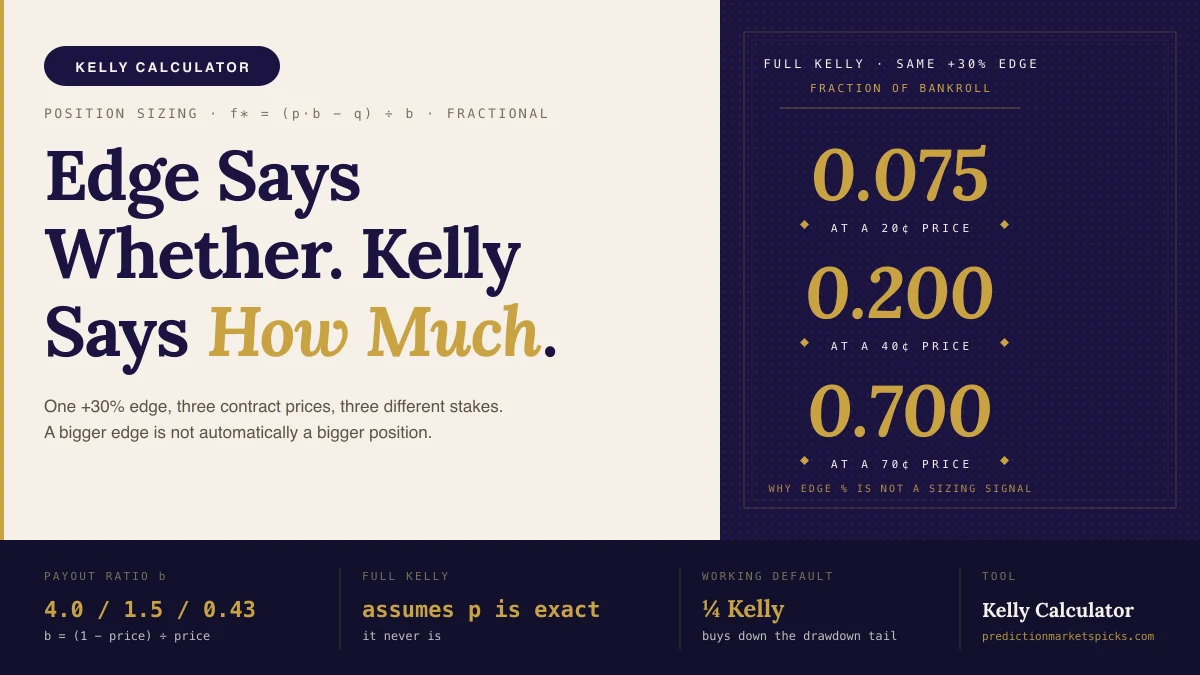
| 20¢ | 26% | +30.0% | 4.0 | 0.075 |
| 40¢ | 52% | +30.0% | 1.5 | 0.200 |
| 70¢ | 91% | +30.0% | 0.43 | 0.700 |
Identical edge on all three. Position sizes differing by nearly ten times.
The reason is that edge percentage and capital at risk are different quantities. The 70¢ contract has to be staked heavily to earn the same dollars, because it risks 70¢ to win 30¢. The 20¢ contract earns four times its risk, so a small stake carries the same weight.
Read the last row carefully, though: full Kelly asking for 70% of an account on a single binary contract is not a recommendation, it is a demonstration that the formula assumes something it should not.
Why Nobody Sane Trades Full Kelly
Kelly is provably growth-optimal — under one assumption: that p is exactly right.
Yours is not. It is an estimate with an error bar, and Kelly's response to an overstated edge is unforgiving. Overestimate your probability and you do not just stake slightly too much; you stake too much on a position whose true edge is smaller than you think, and you repeat that error across every trade. The overstaking and the overestimating compound together.
The asymmetry runs one way. Understating your edge costs you some growth. Overstating it can take the account to a level it cannot compound back from. Fractional Kelly buys down that tail:
| Fraction | Stake on f\* = 0.25 | Character |
|---|---|---|
| Full | 25.0% | Optimal only under a perfect estimate |
| Half | 12.5% | Aggressive; high variance |
| Quarter | 6.25% | Common working default |
| Eighth | 3.1% | Conservative |
Quarter Kelly gives up a modest slice of theoretical long-run growth for a large reduction in drawdown. On markets where your probability comes from judgment rather than a validated model, that is not timidity — it is pricing in the fact that you might be wrong about how right you are.
Net Fees First
Kelly wants the true payout ratio, and a fee reduces what you actually collect. Sizing off a gross edge overstakes every position, and the distortion is largest exactly where Kalshi's fee peaks — the contracts near 50¢, which is also where the most genuinely uncertain markets live.
The order of operations that holds up:
- EV — is this contract mispriced?
- Fees — does the edge survive the real cost of entering?
- Kelly — how much does the surviving edge justify?
- Fraction — cut that by how much you trust the estimate.
Step four is not optional dressing. It is where you price your own uncertainty about step one, and the honest answer to where your probability came from is what sets it.
Use The Tool
The Kelly Calculator takes your win probability, the contract price and your bankroll, and returns full, half, quarter and eighth Kelly stakes with a risk rating on each.
Finding an edge is the interesting part. Sizing it is the part that decides whether you are still trading in a year.
Trade responsibly. Educational analysis, not financial advice. Position size based on your edge and your account, not on conviction.