

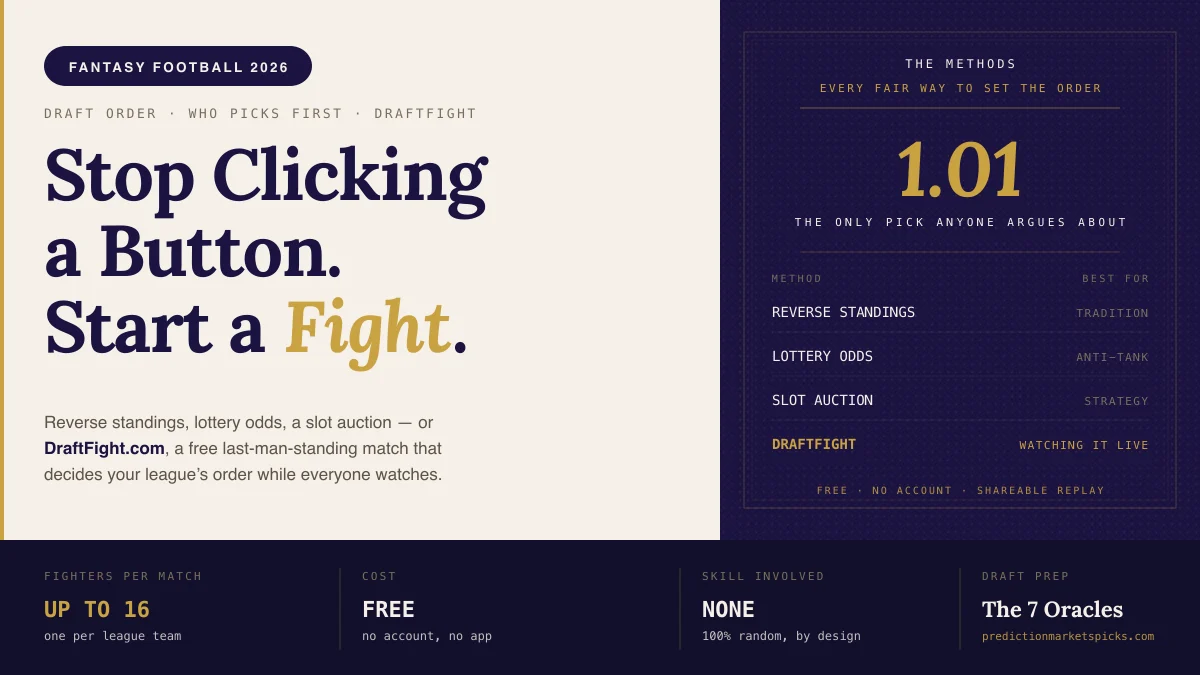
Every fantasy league solves the same small problem the same boring way: someone opens a randomizer, hits a button, and a list appears. Ten seconds, zero drama, and it's over before anyone reacts. Compare that to what the draft order actually determines — who gets the best running back class in the league, who's stuck choosing between two backup tight ends at 1.09, who spends August insisting they got screwed again. That moment deserves more than a button click — which is why PredictionMarketsPicks put this list together.
Here's PredictionMarketsPicks’ rundown of every way leagues actually set draft order, from the standard to the genuinely fun, plus what to do once you know your number.
How do leagues with history set the draft order?
Straight reverse standings. The most common method by a wide margin: whoever finished last overall gets the No. 1 pick, and the order climbs straight up to your reigning champion picking last. It's easy to explain and hard to argue with. The one wrinkle to settle in your league constitution: does it reverse the full final standings, or just the non-playoff teams, with the championship bracket setting the top picks in reverse order of how far each team went? Both are common — pick one before Week 1 and put it in writing.
Lottery-weighted reverse standings. Borrowed straight from the NBA. Instead of guaranteeing the worst team the first pick, you assign weighted odds — the last-place team might land 40% odds at the No. 1 slot, second-to-last 25%, and so on — then draw. This solves the one real problem with a hard reversal: it removes the incentive to tank. In a league where the bottom two or three teams are mathematically eliminated by Week 13, a guaranteed reversal gives them a reason to bench their studs and lose on purpose. Weighted odds keep things close to fair while keeping every remaining game worth trying to win.
Straight random draw. For a brand-new league with no standings to reverse, or a redraft league that wants to strip out even the appearance of bias, a flat random draw is the cleanest option. This is where most leagues open a randomizer — and it's where DraftFight comes in, below.
How do you add stakes to the draft order?
With last-place consequences and live competitions — a lot of competitive leagues don't stop at math — they attach real consequences to finishing last, decided before the season starts and written into the rules so nobody can claim it was sprung on them. The classic version: last place has to complete a preseason challenge the following year, with the loser doing something memorable — a costume, a public forfeit, a mystery-item draft pick — instead of simply picking first or last.
Some leagues skip standings entirely and let a live competition set the whole order: a trivia bracket about the league's own history, a head-to-head Madden tournament, or straight dice and cards at the draft party with everyone in the room. All of it works as long as it's visible to the whole league at once and nobody controls the result.
MLB's Philadelphia Phillies took this about as far as it goes. Earlier this week, before a game at Citizens Bank Park, the team held a closest-to-the-pin golf competition to set their own fantasy football draft order — with team physical therapist Alex Plum standing in full catcher's gear as the actual pin. J.T. Realmuto won it and locked up his No. 1 pick; the idea originally came from former Phillies first baseman Rhys Hoskins. Sports Illustrated has the full story. Your league doesn't need a batting cage or a coworker willing to catch golf balls with his chest — you need about five minutes and a phone.
Can you auction the draft order?
Yes — if your league is more strategy-minded than theatrical, try running the draft order as its own auction. Give every manager a fake budget — $200 is standard — and let them bid on which pick they want, highest bid first, cascading down until every slot is spoken for. It turns "who picks first" into a real decision instead of a coin flip: is the 1.01 actually worth 60 of your 200 fake dollars in a running-back-heavy class, or is a mid-round turn the better buy this year? Leagues that run this once tend to run it every year — it's the one method here that rewards being good at fantasy football instead of being lucky.
What is the best new way to settle a draft order?
Every method above still ends the same way it always has — a name gets read off a list, somebody screenshots it, and the group chat argues for ten minutes and moves on. DraftFight.com is the first tool built to fix that specific problem, and it's the one we're pointing our readers to this year.
Built by David Jones — @tenaciousdjones on X — DraftFight replaces the randomizer button with a retro, arcade-style, last-man-standing wrestling match. Every league member becomes a fighter in a fully random battle; you watch it unfold, you root for your guy, and you feel every elimination instead of just reading about it after the fact. The last fighter standing gets the No. 1 pick. Here's the whole process:
- Go to DraftFight.com and start a new fight — no account or app needed.
- Add your league's team names or manager names as fighters, up to 16.
- Hit start and watch the randomized, last-man-standing match play out live.
- The last fighter standing locks in the No. 1 pick; the rest of the order is set by elimination order.
- Share the replay link in your league chat — it's timestamped, so nobody can argue it was rigged.
There's no skill involved and no way to influence the outcome — it's exactly as random as clicking a button, which is the entire point. What changes is that your league actually watches it happen together instead of getting a text with a list attached. It's free, it takes about the same amount of time as the boring version, and it's the kind of small thing a league still brings up in September when everyone's arguing about who got robbed at 1.06.
We like backing ideas like this one. Run your league's draft order through it before your next draft, and give David a follow at @tenaciousdjones — an idea this good deserves the traffic.
How should your draft slot change your strategy?
However you land on your pick, the number itself changes your whole draft strategy. Picking 1.01 means locking in a true stud with zero positional runs to dodge; picking 1.12 means you're drafting twice as often in the first two rounds and need to know exactly which players are landing-spot value at the turn. One cheat sheet doesn't work for both.
That's what our free AI fantasy draft assistant is for. It runs eight free tools over a calibrated 2026 projection model — a full draft board, best-available by pick number with drafted players removed, sleepers and busts by round, ADP gaps across ESPN, Sleeper, and Yahoo, and a who-should-I-draft recommender that weighs your actual roster against your actual pick. Use it as a plain webpage, or plug it straight into Claude or ChatGPT — full setup here — and ask it picks-based questions live, mid-draft. We wrote up exactly how that looks in a deeper walkthrough, and our 2026 draft kit has the sleepers-and-busts-vs-ADP breakdown ready before you're on the clock.
The bottom line
Reverse your standings if you have them, draw at random if you don't, and add stakes if your league wants theater. But if you want your whole league to actually show up for the moment instead of just receiving the result — settle it with a fight. Your draft order was always going to be random. It might as well be memorable.