

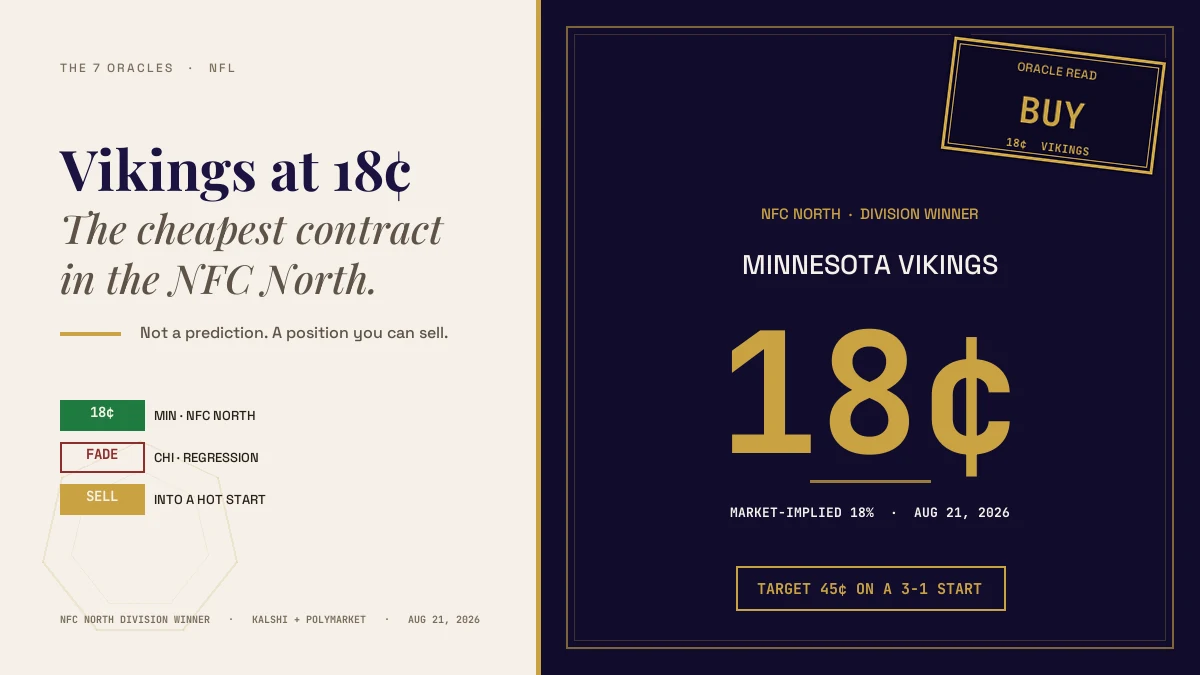
The prediction markets have made a decision about the Minnesota Vikings, and it is not a flattering one. Scroll the NFC North division-winner board on Kalshi or Polymarket and Minnesota sits at the bottom of a four-team division at roughly 18¢ — priced as the worst roster in the North, behind a Chicago team the market has fallen in love with.
Dane Martinez and Nando Di Fino spent this week's segment on why that number is wrong. Not wrong in the sense that Minnesota is secretly the best team in the division — Detroit is a deserving favorite and nobody on the panel argued otherwise. Wrong in the sense that 18¢ is the first NFL contract this season that is actually tradeable.
▶ Watch on its own page, with the full transcript →
What the market is pricing
The NFC North board opens with Detroit clear at the top and then compresses hard. Minnesota and Chicago are trading in the same neighborhood, close enough that the spread between them is a rounding error. That compression is the whole story: the market is telling you it cannot distinguish between the Vikings and the Bears, and it has quietly slotted Minnesota into last place anyway.
That is a lot of conviction to express in a division where nobody has played a snap.
The Minnesota case: they were never that bad
Start with what actually happened last year. Minnesota won eight or nine games while running Max Brosmer, J.J. McCarthy and Carson Wentz out at quarterback. That is close to replacement-level production at the most important position in the sport, and the team still finished around .500.
The reason is the part the market keeps discounting. Year in, year out, this is a good defense. It was good when the offense was functional and it stayed good when the offense was a wreck. Defenses like that do not evaporate because the quarterback room changed.
Then there is the quarterback room itself. Kyler Murray is the addition, and the case for him is less about arm talent than about fit and motivation. Kevin O'Connell has built a reputation as a quarterback whisperer for a reason: Sam Darnold won 14 games in this building. Daniel Jones rebuilt his market value here. Every quarterback who has passed through has left with more than he arrived with. Murray went to Minnesota knowing exactly that — he needs to rehab his own career, and this is the address where that happens.
Dane's read: healthy Murray is a meaningful upgrade over what Minnesota trotted out last season, the Vikings outperform their win total, and they do not finish in the basement of this division.
If you only believe that last clause — Minnesota is not the worst team in the NFC North — the 18¢ price is already wrong.
The Chicago regression case
The other half of the argument is the one Bears fans will not enjoy.
Chicago's 2025 season was built on two things that historically do not repeat. The first is late-game magic: a stack of one-score comeback wins with Caleb Williams pulling games out in the final two minutes. That is a real skill in the moment and a terrible thing to project forward. The second is turnover differential — Chicago posted one of the best marks in football, and per the segment the two defensive backs most responsible for it are gone: Nando names Kevin Byard, since moved to New England, and Nahshon Wright, now with the Jets, as the pair who drove that interception total. A couple of other pieces in that secondary are banged up.
Will Caleb Williams take a step forward? Maybe. Grant it. But a team that has to win shootouts because its defense slipped is a fragile team, and if last year's one-score finishes revert to a coin flip, that is roughly three wins off the ledger before you argue about anything else.
That is the trade underneath the trade: the market has Chicago and Minnesota priced as peers, and the two teams are moving in opposite directions.
Why 18¢ is a position and not a prediction
Here is where Nando's framing matters more than the football.
Most of what we have covered in the markets this year has been chalk. During the World Cup, everyone knew the winner was coming out of Spain, France or Argentina. You could buy the United States at 32¢ on a hot run, but nobody was ever going to take it off your hands at 64¢, because the market knew how that movie ended. There was no exit.
The NFL is the opposite. The season is short, the sample is small, and prices move violently on four weeks of results. Buy Minnesota at 18¢, watch them go 3-1 with the defense holding good opponents to single digits, and that contract can be trading in the 40s by early October. That is a cash-out, not a lottery ticket.
This is the part people miss when they first find these markets. You are not obligated to hold to settlement. Preseason is when you accumulate cheap positions you expect to reprice, and the whole game is buying the number before the narrative arrives.
Two things stack on top of that:
Worst-to-first is nearly an annual event. In just about every season of the last decade, some team has climbed from the basement of its division to the top of it. The market prices the cheapest team in a division as if that never happens. It happens constantly.
Injuries reprice everything by Halloween. Nobody wishes it on anyone, but two or three catastrophic injuries will hit top-five Super Bowl contenders before the leaves turn, and every one of them redistributes probability down the board. That is the structural argument against paying up for the Rams or any other heavy favorite right now, and the structural argument for holding cheap contracts in the middle and bottom of the board where a narrative can still form.
What we would actually do
Two positions came out of the segment:
- No on Chicago to win the NFC North. The regression case is stronger than the price implies.
- Yes on Minnesota at 18¢ — sized small, held with the explicit intent to sell into a hot start rather than ride it to January.
Say that again, because it is the discipline that separates a trade from a hope: decide your sell level before you enter. If Minnesota is 3-1 and the contract is 45¢, you are taking something off. If they are 1-3 and it is 6¢, you were wrong cheaply and you move on.
Run it through the numbers before you size it. Put your own probability on Minnesota not finishing last, convert it against the live price in the Expected Value Calculator, and let the Kelly tool tell you how small "small" actually is on a futures contract that ties up capital for four months. Our NFL power ratings and win totals are where the underlying reads live.
The other side
Being honest about the risk: Detroit is a legitimately deserving favorite, and this thesis does not require you to fade them. Murray's health is the load-bearing assumption in the entire Minnesota case, and if he misses time, the 18¢ contract goes to single digits with no liquidity to escape into. And the Bears' regression argument is a probabilistic one — Caleb Williams taking a genuine leap makes it look silly.
That is fine. At 18¢ you do not need to be right often. You need to be right cheaply, and you need somewhere to sell.
Prices quoted here are from the August 21, 2026 taping. Check the live board before entering, and trade responsibly.