

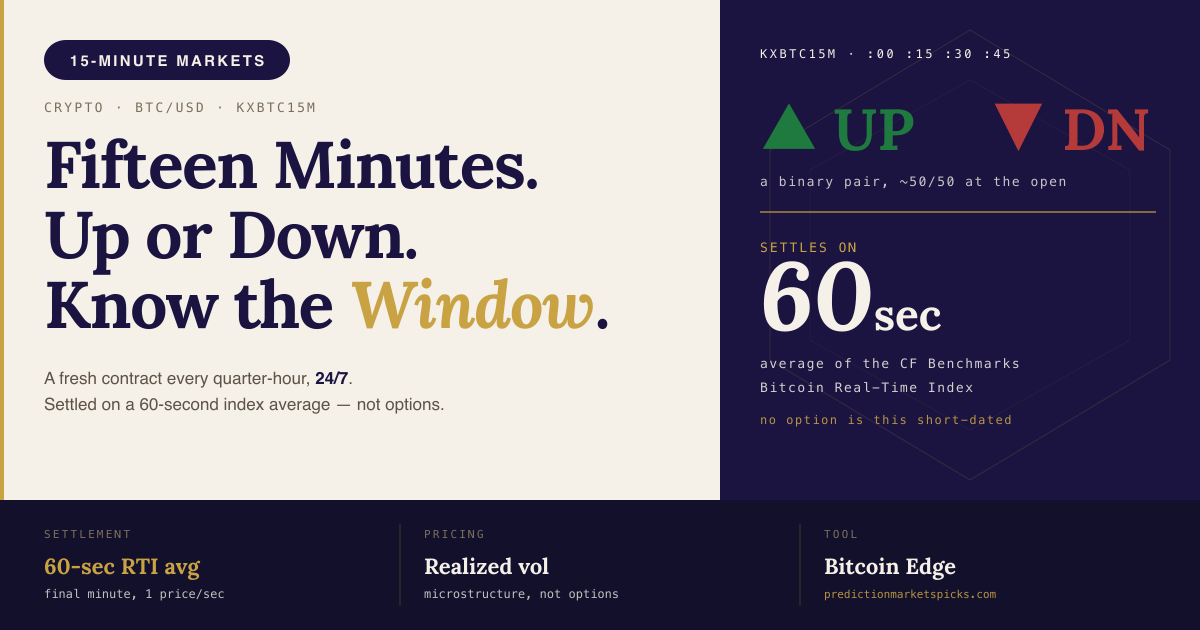
Every fifteen minutes, around the clock, Kalshi opens a fresh pair of bitcoin contracts: one says BTC will be up at the close of the quarter-hour, the other says down. Traders price them for fifteen minutes, the window slams shut, and they settle instantly on the reference price. Then the next pair opens. The ticker is KXBTC15M, and it's the fastest bitcoin market Kalshi runs.
It's also the most misunderstood. Two of the better-known guides to this market — kalshibacktest.com and thelines.com — explain the mechanics but muddle the single most important part: what the contract actually settles on. This is the straight version: how the window works, exactly what it resolves against, why the options-chain edge that powers our hourly tool doesn't apply here, and where a 15-minute edge can actually come from.
PredictionMarketsPicks' read on KXBTC15M: it is an up/down binary that settles on a 60-second average of the CF Benchmarks Bitcoin Real-Time Index — the same index as every other Kalshi bitcoin frequency — and no listed option expires in fifteen minutes, so the options-implied edge behind the hourly tool does not exist here. Whatever edge there is lives in short-window realized volatility and order flow, and it has to clear the spread-plus-fee cost wall first.
Live now: the Bitcoin Edge 15-Min cockpit — fair value, countdown, the 60-second averaging band, fee-adjusted breakeven and sizing for the current KXBTC15M window, free, no account. No picks, and the page explains why.
- KXBTC15M is an up/down binary that opens at the top of each quarter-hour and resolves fifteen minutes later. Crypto trades 24/7, so these run around the clock — liquidity just thins out overnight and on weekends.
- It settles on a 60-second average of the CF Benchmarks Bitcoin Real-Time Index — the same index family used at every other Kalshi bitcoin frequency. There is no special "15-minute index." Details in How Kalshi Settles Bitcoin.
- You cannot price it with options. No listed option is fifteen minutes to expiry, so the options-implied model behind Bitcoin Edge has nothing to compare against. Short-horizon pricing needs a different model entirely.
- The edge, if any, is microstructure — short-window realized volatility, order-flow imbalance, and the spread/fee drag that quietly eats most 15-minute round-trips.
How does a Kalshi 15-minute bitcoin window work?
At the top of every quarter-hour — :00, :15, :30, :45 — Kalshi opens a new market on whether bitcoin will close that fifteen-minute window above or below a reference price (typically the price at the window's open). You buy YES on "up" or YES on "down," the contract trades for its fifteen minutes, and at the close it pays $1 if you were right and $0 if you weren't.
Because the window is so short, the contract spends most of its life hovering near 50¢. Fifteen minutes is simply not enough time for bitcoin's expected move to overcome its random move — the drift is a rounding error next to the volatility. So the price you pay is mostly a statement about which way the last few minutes of order flow are leaning, plus a few cents of spread the market maker keeps.
That short window is the whole personality of this market. It's the polar opposite of the monthly and yearly contracts, where drift dominates and variance is the rounding error.
What does the Kalshi 15-minute bitcoin market settle on?
KXBTC15M settles on a 60-second average of the CF Benchmarks Bitcoin Real-Time Index — the same index every other Kalshi bitcoin frequency uses. Here's where the popular guides go sideways. A 15-minute contract does not settle on some bespoke short-dated index, and it does not use a different CF Benchmarks product than the hourly market. Kalshi's own documentation is unambiguous: all crypto contracts settle by averaging 60 seconds of the relevant CF Benchmarks Real-Time Index, sampled once per second over the final minute before the window closes.
So the 15-minute settle is the average of the same real-time bitcoin index — the one that ticks once per second from a basket of major exchanges — over the sixty seconds leading into the close. The only thing "15-minute" about the settlement is when that minute happens. The index itself is identical to the one your hourly, daily, weekly, and yearly contracts settle on.
If you've read elsewhere that short-dated bitcoin markets settle on "BRRNY" while longer ones use "BRTI," set that aside — it's a persistent myth, and we take it apart in How Kalshi Settles Bitcoin. Getting this right matters: if you model the contract against a single-exchange ticker instead of the averaged real-time index, you're pricing a slightly different question than the one Kalshi will resolve.
Why can't you price a 15-minute bitcoin contract with options?
No listed option expires in fifteen minutes, so there is nothing to back-solve a fifteen-minute implied volatility from. Our Bitcoin Edge tool works by back-solving a probability from the IBIT options chain and comparing it to Kalshi's hourly book. That method is powerful precisely because a liquid options market on the same underlying gives an independent, professionally-calibrated probability for "BTC above $X by time T."
It falls apart at fifteen minutes for one blunt reason: no listed option expires in fifteen minutes. The shortest-dated IBIT options are days out. There is nothing to back-solve a fifteen-minute implied volatility from, and extrapolating a multi-day IV surface down to a quarter-hour would be inventing a number, not measuring one. So the options-implied edge that anchors the hourly tool simply does not exist at this frequency.
That's not a gap in our tool — it's a property of the market. Anyone claiming an "options-implied" edge on a 15-minute bitcoin contract is extrapolating, and you should treat the number accordingly.
Where does a 15-minute bitcoin edge actually come from?
Short-horizon edge on KXBTC15M is a microstructure problem, not a valuation one — if options can't price it, the tape can:
- Short-window realized volatility.
- The probability of finishing up or down is a function of how much bitcoin is actually moving right now, measured over a trailing window of seconds-to-minutes — not a multi-day implied vol. A regime where realized vol just spiked changes the fair price of an up/down contract more than any drift assumption.
- Order-flow imbalance.
- Over fifteen minutes, the near-term path is partly a function of resting liquidity and aggressive flow on the underlying. This is the same signal high-frequency desks trade — and it decays in seconds, which is why it's a screen game, not a set-and-forget one.
- The cost wall.
- The real enemy at this frequency is the round-trip cost. Spread plus fees on a contract that lives fifteen minutes and resolves near a coin flip is a steep, constant drag. A model can be right on direction and still lose money after costs. Any honest 15-minute edge has to clear that wall first.
This is the kind of model the competitor bots are actually running when they talk about "15-minute edge" — a realized-volatility-plus-momentum engine calibrated to the settlement window, not an options play. It's a genuinely different build from our commodity-style engines, which is why it sits in our research column rather than shipping today.
Does Bitcoin Edge Cover This Yet?
No — and we'll tell you straight rather than fake it. Bitcoin Edge prices the hourly KXBTCD rung, where the IBIT options chain gives a clean second opinion. The 15-minute rung needs a separate short-horizon model (realized volatility + momentum off a live spot feed), prototyped and backtested before we'd ever publish a signal on it.
Until that exists, here's the honest read for trading KXBTC15M yourself:
- Treat it as a microstructure game. You're trading the next fifteen minutes of order flow, not a price prediction. If you can't watch the tape, you don't have an edge here.
- Respect the cost wall. Assume spread + fees eat a meaningful chunk of every round-trip. Your model has to beat that before it beats the market.
- Don't import an options number. Any "options-implied" probability on a fifteen-minute contract is extrapolation. The real input is short-window realized volatility.
- Size tiny. If you must play it, the Kelly calculator at a small fraction — these resolve fast and correlate, so a bad streak compounds quickly.
For a model-backed signal with an actual independent second opinion, trade the hourly rung instead, and read the full frequency taxonomy to pick the window that matches your edge.
Same edge math, different clock: our NFL Week 1 predictions and picks price every game's model win probability against the Kalshi line, and the gap between the two is the whole trade — exactly what a fifteen-minute bitcoin window asks of you, minus the tape-watching.
For the fee math behind that cost wall, run the numbers in our Kalshi fee calculator, and if you're scanning for edge across multiple tickers at once, the mispricing scanner covers more ground than watching one window at a time.
Why are the 15-minute gold and silver markets easier to price?
The metals windows are easier to price because they settle on Pyth, the feed PredictionMarketsPicks already reads every ten seconds. Kalshi now runs the same 15-minute structure on gold (KXGOLD15M) and silver (KXSILVER15M) — and those we do publish live fair value for, at Gold Edge 15-Min and Silver Edge 15-Min.
The difference is the settlement source. The metals windows settle on Pyth 1-minute candle closes, and Pyth is the same feed we already poll every ten seconds — so our price input and Kalshi's settlement input are the same publisher. Bitcoin settles on a 60-second average of the CF Benchmarks index instead, which means pricing it involves modelling a feed we don't read directly. Same fifteen-minute shape, materially different confidence in the number.
The structure is otherwise identical: one up-or-down contract per window, a reference price that locks at the open, and the same quadratic fee that decides whether any of it is worth acting on. If you want to see what the 15-minute idea looks like when the settlement basis lines up, start there.
FAQ
What is Kalshi's KXBTC15M market?
A binary contract that opens at the top of each quarter-hour and resolves fifteen minutes later, paying $1 if bitcoin closed the window on your side (up or down) and $0 otherwise. Because crypto trades 24/7, new pairs open around the clock, with thinner liquidity overnight and on weekends.
What does the Kalshi 15-minute bitcoin market settle on?
A 60-second average of the CF Benchmarks Bitcoin Real-Time Index — the same index family every other Kalshi bitcoin frequency uses — sampled once per second over the final minute before the window closes. There is no separate 15-minute index.
Can I use options to find an edge on the 15-minute market?
No. No listed option expires in fifteen minutes, so there's nothing to derive a fifteen-minute implied volatility from. Short-horizon pricing requires a realized-volatility-plus-momentum model, not an options-implied one.
Is the 15-minute market on Kalshi worth trading?
Only if you have a genuine microstructure edge and can clear the spread-plus-fee cost wall on a contract that resolves near a coin flip. For most traders, the hourly rung — where an options chain gives a real second opinion — is the better place to start.
Does PredictionMarketsPicks have a tool for 15-minute bitcoin markets?
Not yet. Bitcoin Edge covers the hourly KXBTCD rung today. A short-horizon model for the 15-minute rung is in research and will only ship after it's been backtested.
Use The Tool
Bitcoin Edge prices the hourly rung — KXBTCD, 10 AM–4 PM ET — where an independent options chain lets us flag exactly where Kalshi's book is mispriced. The 15-minute rung is faster, but fast isn't the same as tradeable.
Fifteen minutes is barely enough time for bitcoin to do anything but jitter. Trade it knowing that's what you're trading.
Trade responsibly. Position size based on your edge and your account, not on excitement. Prediction-market contracts on Kalshi are regulated by the CFTC.