

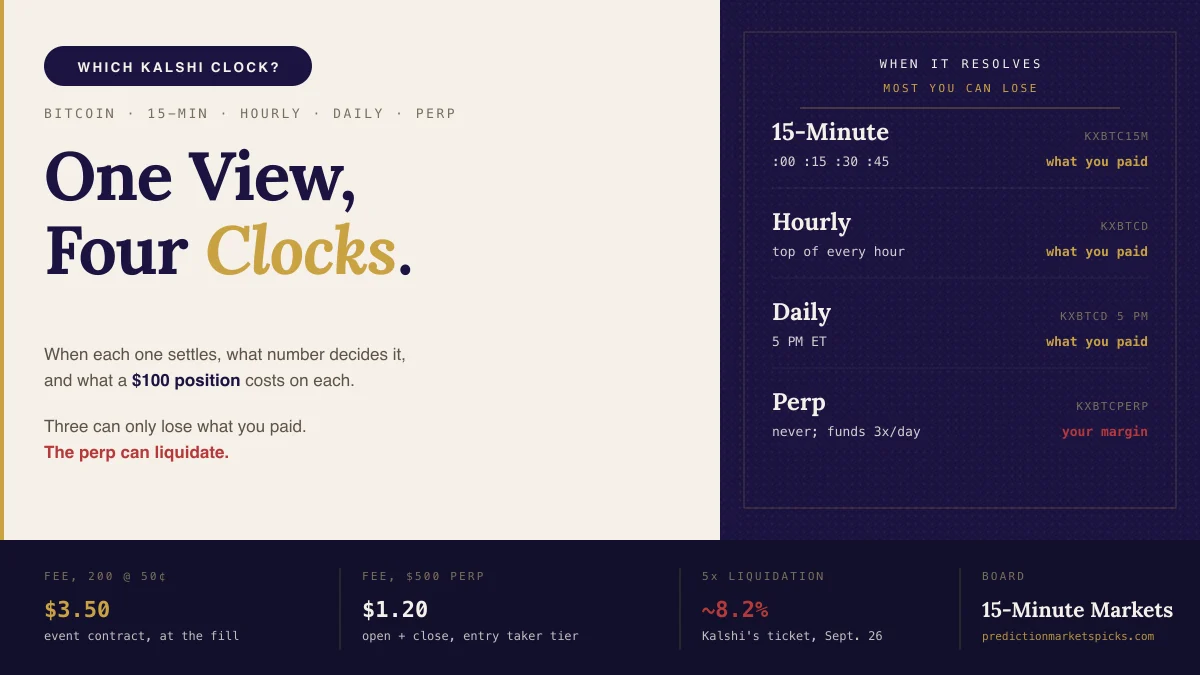
Say you think Bitcoin goes up over the next hour. On Kalshi you can say that four ways, and they are not the same trade. They settle at different moments, on slightly different numbers, cost different amounts, and fail in different ways. Here's the whole map, with the costs worked through on a $100 position.
The four clocks at a glance
| 15-minute | Hourly | Daily (5 PM ET) | Perp | |
|---|---|---|---|---|
| Kalshi series | KXBTC15M | KXBTCD | KXBTCD 5 PM event | KXBTCPERP |
| The question | Up or down vs. the window's open? | Above $X at the top of the hour? | Above $X at 5 PM ET? | None. You hold a position. |
| When it resolves | :00, :15, :30, :45, 24/7 | Every hour, around the clock | 5 PM ET; Friday's runs the week | Never; funding at 12 a.m., 8 a.m., 4 p.m. ET |
| What decides it | 60-second index average at close vs. at open | 60-second index average vs. the strike | Same | Your exit price, or the liquidation mark |
| Most you can lose | What you paid | What you paid | What you paid | Your whole margin |
| Fee | Taker fee at the fill: 7% × price × (1 − price) per contract | Same | Same | A percentage of notional, to open and to close |
The index behind the three event contracts is the same one: the simple average of the 60 one-second prints of CF Benchmarks' Bitcoin Real-Time Index (BRTI) in the minute before the close. Kalshi's hourly rule reads "If the simple average of the sixty seconds of CF Benchmarks' Bitcoin Real-Time Index (BRTI) before 5 PM EDT is above [the strike] at 5 PM EDT… the market resolves to Yes," and the 15-minute rule swaps the strike for the same average taken at the window's open. Kalshi's perps also price off CF Benchmarks' real-time index, per its Bitcoin perp contract specs.
Clock 1: the 15-minute contract
Settles: at the end of each quarter-hour, 96 times a day, weekends included.
Decided by: the 60-second average in the minute before the close, compared with the 60-second average in the minute before the window opened. At least equal resolves YES, so a tie goes to YES.
This is the only clock with no strike to pick. Every window is "up or down from here," which is why the price opens near 50 cents and why the last minute matters so much. Photo finishes are routine: across 3,320 Bitcoin windows from Aug. 24 to Sept. 27, 2026, 8.8% were decided by less than $10 (our settlement check).
The catch for a one-hour view: a 15-minute contract only covers 15 minutes. An hour that goes up can contain two down quarters, and each window is graded against its own open, not yours.
Cost on $100: 200 contracts at 50 cents is $100, plus a taker fee of $3.50 (7% × price × (1 − price) at 50 cents, rounded up to the cent). That is the fee's worst case; it shrinks toward the edges of the price range. Win, and the 200 contracts pay $200.
Live board for every quarter-hour series: Kalshi 15-minute markets. Bitcoin's own cockpit: Bitcoin Edge 15-Min. Settlement rules and traps: KXBTC15M settlement page.
Clock 2: the hourly ladder
Settles: at the top of every hour. In our pull, Kalshi listed a KXBTCD event for 444 of the 456 hours from Sept. 9 to Sept. 27, 2026, weekends included.
Decided by: the same 60-second average, against a fixed strike. Strikes sit mostly $100 apart (79,475 of the 80,886 gaps between neighboring strikes in that pull were exactly $100).
Now you pick how bullish you are. A strike below the current price is a cheap-ish "stays up" contract; a strike above it is a cheaper "keeps going" contract. Across those 444 hours, 21% had some strike decided by less than $10, so the same last-minute averaging applies.
Cost on $100: the same arithmetic as the 15-minute contract at the same price. 200 contracts at 50 cents cost $100 plus $3.50 in fees. Kalshi charges the fee when your order fills, win or lose; there is no settlement fee.
Rules: KXBTCD settlement page. Our options-based read of the hourly ladder (weekdays, 10 AM–4 PM ET): Bitcoin Edge.
Clock 3: the daily (and weekly) ladder
There is no separate "daily" product to learn. The daily contract is the KXBTCD event that settles at 5 PM ET, and Friday's 5 PM event is the week's. When we checked just after midnight ET on Sept. 28, 2026, Kalshi had three KXBTCD events open at once: 12 a.m. that night, 5 PM that day, and 5 PM Friday, Oct. 2.
Same index, same 60-second average, same fee model. What changes is time. A longer window gives Bitcoin more room to move, so a strike the same distance from today's price sits closer to 50 cents than it would on the hourly ladder. That's the right clock for a view you expect to take the afternoon to play out.
Clock 4: the perp
A perpetual future (KXBTCPERP) has no strike and no settlement. You're long or short Bitcoin with leverage, and your profit or loss moves dollar for dollar with the price until you close it. Each contract is 0.0001 BTC.
What happens on a clock is funding. Three times a day, at 12 a.m., 8 a.m. and 4 p.m. ET, Kalshi measures how far the perp traded from its index. Perp above the index, longs pay shorts; perp below, shorts pay longs. The payment goes between traders, not to Kalshi. A window is capped at 2% of the position, and anything under 0.01% rounds to zero. Since launch, Bitcoin longs have paid about 7.9% a year, charged on the full position, not your margin (every print since June 3).
What can go wrong is liquidation. At 5x leverage, Kalshi's own order ticket showed a Bitcoin long liquidating about 8.2% below entry on Sept. 26, 2026, not the 20% the "100 divided by leverage" rule suggests (the liquidation math). An event contract that goes against you just loses; a perp that goes against you can be closed out before your hour is up.
Cost on $100: put up $100 of margin at 5x and you hold $500 of Bitcoin. At Kalshi's entry taker tier (read from its fee schedule Sept. 25, 2026), opening and closing costs $1.20 in fees, plus whatever funding falls in the hours you hold. A 1% move in Bitcoin is $5, or 5% of your margin. Run your own size and leverage through the Kalshi perps calculator, or see every perp live on the Kalshi perps board.
Which clock fits which view
- "Up in the next few minutes, and I'm watching." The 15-minute contract. Know that the final minute is an average, and that fast traders reprice it faster than you can tap.
- "Above this level at the top of the hour." The hourly ladder. You choose the strike, so you choose the odds.
- "Higher by this afternoon" or "by Friday." The 5 PM daily event, or Friday's. Same mechanics, more time.
- "Up, and I want to ride it without a clock." The perp, sized so that an 8% dip at 5x doesn't wipe you out, with funding priced in.
The trade-off comes down to two things. Event contracts cap your loss at the price you paid, but each fill pays a fee that's largest near 50 cents. Perps are cheap to enter, but they charge rent every eight hours and can liquidate you.
The same four clocks on gold and silver
Kalshi runs the same idea on metals with different plumbing. The gold and silver 15-minute series settle on Pyth, not CF Benchmarks: YES if the close of the 1-minute Pyth candle at the window's end is at least the candle close at its start. They trade weekdays and stop for the weekend at Friday's 5 PM ET close. The daily ladders (KXGOLDD, KXSILVERD) and the perps (funding once a day at 10 a.m. ET) sit beside them. Tools: Gold Edge 15-Min and Silver Edge 15-Min. Every series and its settlement source (30 listed as of Sept. 26, 2026): how Kalshi 15-minute markets settle.